Château Haut-Brion
Updated on
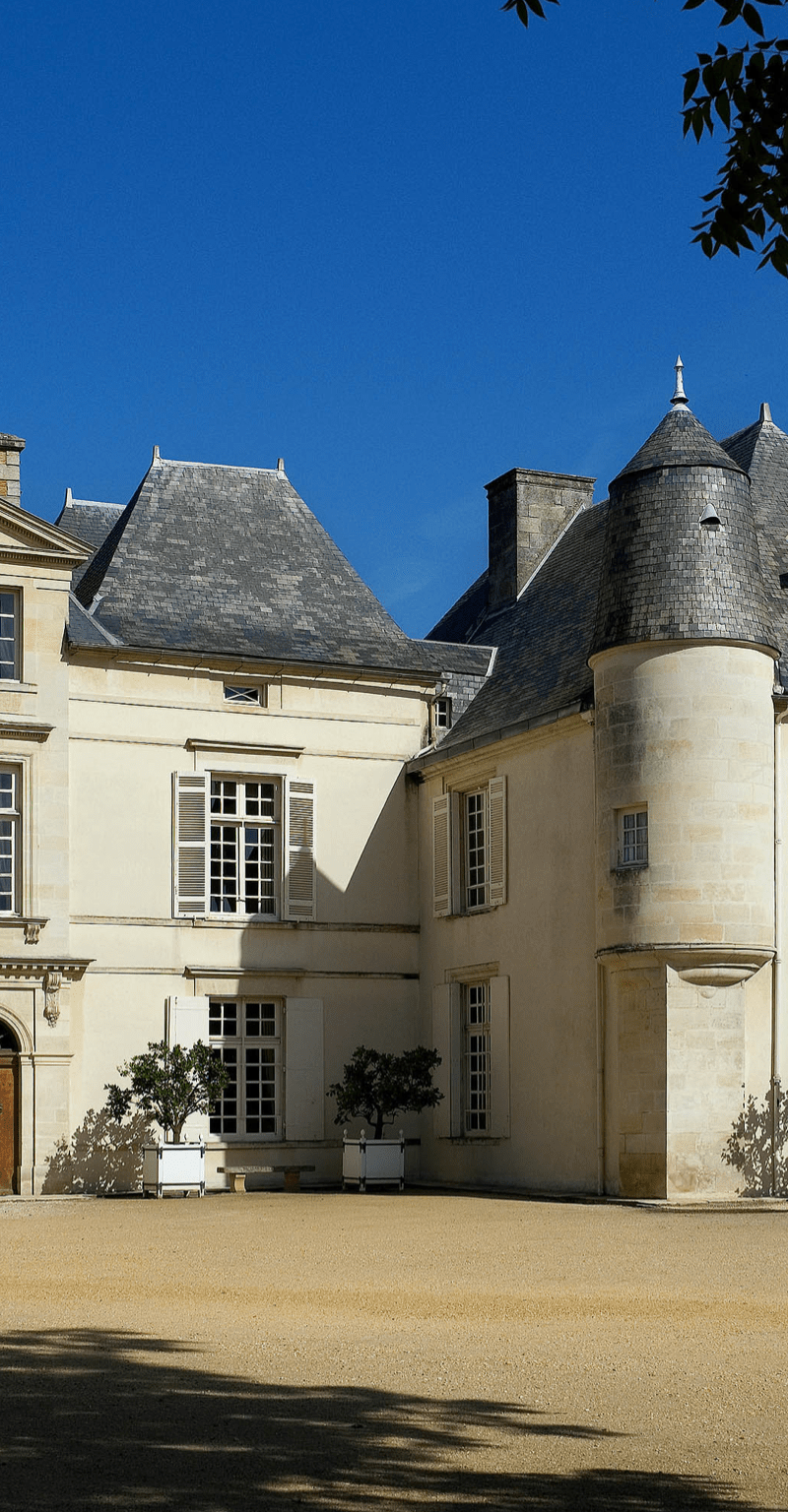
Château Haut-Brion, a Premier Grand Cru Classé in the 1855 classification, is a historic winegrowing estate in Pessac-Léognan. Owned by prince Robert du Luxembourg, it produces red and white wines across 52.82 ha of gravel soils, with grape varieties dominated by Merlot and Cabernet Sauvignon.
Identity
Château Haut-Brion is a winegrowing estate located in the commune of Pessac, in the Gironde département. Its current owner is prince Robert du Luxembourg, through the company Domaine Clarence Dillon S.A.S. Jean-Philippe Delmas is the managing director, Jean-Philippe Masclef the technical director, Florence Forgas the cellar master, and Pascal Baratié the vineyard manager. The estate is distinguished as a Premier Grand Cru Classé in the 1855 Classification, being the only non-Médoc growth included.
History and Philosophy
Winegrowing history on the lands of Haut-Brion dates back to the 1st century AD, with the first recorded mention of wines named after their terroir occurring in 1521. The estate was established in 1525 by Jean de Pontac, who began construction of the château in 1549. In the 17th century, Arnaud III de Pontac contributed to the estate's renown, and the wines of Haut-Brion were recorded in the UK National Archives as early as 1660. Historical figures such as Thomas Jefferson and Charles-Maurice de Talleyrand-Périgord shared close ties with the château. In 1935, Clarence Dillon acquired the estate. Technical innovations have marked its history, such as the introduction of stainless steel vats in 1961. The Pessac-Léognan appellation, in which the château is situated, was created in 1987. Prince Robert du Luxembourg became president in 2008. The estate joined the Primum Familiae Vini in 2018. Château Haut-Brion favours traditional vineyard management practices.
The Appellations
The parcels of Château Haut-Brion are situated in the northern part of the Graves wine region of Bordeaux, in the commune of Pessac. The estate produces wines under the Pessac-Léognan appellation.
Winemaking and Ageing
Harvesting is performed by hand, followed by sorting and destemming of the grapes. Maceration and fermentation last around two weeks. Ageing takes place in new oak barrels over a period of 18 to 20 months, with regular rackings throughout this phase.
Practical Information
Château Haut-Brion is located at 135 Avenue Jean Jaurès, 33600 Pessac. The estate can be contacted by telephone on +33 (0)5 56 00 29 30 and by email at info@haut-brion.com. Visits and tastings are by appointment only and can be conducted in German, English, French, and Norwegian. The cellar is open Monday to Thursday from 8:30 am to 11:30 am and from 2:00 pm to 4:30 pm, and on Friday from 8:30 am to 11:30 am.
Find out more
Frequently asked questions
- What is the primary appellation of Château Haut-Brion?
- Château Haut-Brion produces its wines under the Pessac-Léognan appellation. Created in 1987, this appellation is celebrated for both red and white wines and is located in the northern part of the Graves region of Bordeaux, of which Haut-Brion is a historic benchmark.
- Who owns Château Haut-Brion?
- Château Haut-Brion is owned by prince Robert du Luxembourg. The estate is managed by the company Domaine Clarence Dillon S.A.S. The Dillon family acquired the property in 1935 and continues to play a central role in its development and leadership.
- What is the size and terroir of the Haut-Brion vineyard?
- The vineyard of Château Haut-Brion covers 52.82 hectares. Its terroir is characterised by gravel soils resting on a subsoil of clay, sand, limestone, and faluns. This geological profile is essential to the expression of the estate's wines.
- Which grape varieties are grown at Château Haut-Brion?
- For the red wines, the grape varieties are predominantly Merlot (around 48%) and Cabernet Sauvignon (around 41%), complemented by Cabernet Franc (around 10%) and Petit Verdot (around 1%). For the white wines, Sémillon (around 53%) and Sauvignon (around 47%) are grown.
The Vineyard (Terroir)
The vineyard of Château Haut-Brion spans a total area of 52.82 hectares, of which 49.89 hectares are dedicated to red grape varieties and 2.93 hectares to white grape varieties. The average vine age is 38 years, and 37 years for the red vines. The soils consist of gravel resting on a subsoil of clay, sand, limestone, and faluns, with west-facing ridges composed of white sand blended with gravel. Harvesting is carried out by hand. The estate holds the HVE-3 environmental certification.
The grape varieties for the red wines comprise Cabernet Sauvignon (41% or 42%), Merlot (48% or 46%), Cabernet Franc (10% or 11%), and Petit Verdot (1%).
For the white wines, the grape varieties are divided between Sémillon (53% or 52%) and Sauvignon (47% or 48%), including Sauvignon blanc and gris.
Flagship Cuvées
Château Haut-Brion produces both red and white wines. The principal red and white cuvées both bear the name Château Haut-Brion. The second red wine is Le Clarence de Haut-Brion (formerly Château Bahans Haut-Brion until 2007), and the second white wine is La Clarté de Haut-Brion (formerly Les Plantiers du Haut-Brion until 2009). The estate's wines are renowned for their complexity and ageing potential.
- Appellation
- Pessac-Léognan
- Commune
- Pessac
- Wine region
- Graves & Sauternais
- Classification
- 1er Grand Cru Classé 1855
- Owner
- Domaine Clarence Dillon S.A.S.
- Technical direction
- Florence Forgas
- Surface area
- 52.82 ha
- Second wine
- Le Clarence de Haut-Brion
- Certifications
- HVE
- Grape varieties
- Merlot 48%, Cabernet Sauvignon 41%, Cabernet Franc 10%, Petit Verdot 1%, Sémillon 53%, Sauvignon 47%
Estate news
20 May 2017
Ces «Suisses» et leurs vignobles bordelais - thomasvino.ch
L'article explore la présence de propriétaires suisses ou résidant en Suisse, souvent d'origine française, à la tête de nombreux châteaux viticoles prestigieux dans le Bordelais. Il souligne l'attractivité de Bordeaux pour les investisseurs, d'abord les géants du luxe dans les années 1990, puis plus récemment les investisseurs chinois. Parmi les propriétaires mentionnés, Pierre Castel, dont la fille Romy réside à Genève, est associé au Château Mirefleurs et au Château Beychevelle. Bernard Arnault, patron de LVMH, est cité pour ses acquisitions du Château d'Yquem et copropriétaire du Château Cheval-Blanc. La famille Wertheimer de Chanel possède le Château Canon et Rauzan-Ségla. Silvio Denz, un Bâlois, est propriétaire du Château Faugères et de Lafaurie-Peyraguey. Karl Friederich Scheufele de Chopard détient le Château Monestier La Tour à Bergerac. Michel Reybier, établi à Genève, est le châtelain de Cos d'Estournel. Bruno Prats, ancien propriétaire de Cos d'Estournel, réside près de Morges. May-Eliane Miailhe, veuve du général de Lencquesaing, s'est installée à Vevey après avoir vendu le Château Pichon Comtesse-Lalande. Hervé Laviale et Griet van Malderen ont possédé les châteaux Franc-Mayne, Château de Lussac et Vieux-Maillet. Le prince Robert de Luxembourg, genevois d'adoption, préside les Domaines Clarence Dillon, incluant le Château Haut Brion. Caroline Frey gère le Château La Lagune. Enfin, la branche genevoise des Rothschild, avec le baron Benjamin (décédé en 2021), était à la tête des châteaux Clarke et des Laurets, regroupés sous Edmond de Rothschild Heritage avec d'autres domaines mondiaux. L'article, actualisé en mai 2017 et octobre 2022, est paru initialement en janvier 2016 dans une version du magazine L'Hebdo.
Read the source — thomasvino.chPractical information
- Address
- 135 Avenue Jean Jaurès, 33600 Pessac
- Phone
- +33556002930
- info@haut-brion.com
- Contact form
- Contact the estate
- Opening hours
- Du lundi au jeudi de 8h30 à 11h30 et de 14h à 16h30. Le vendredi de 8h30 à 11h30.
- Visits
- Sur rendez-vous