
Château Cantemerle
Updated on
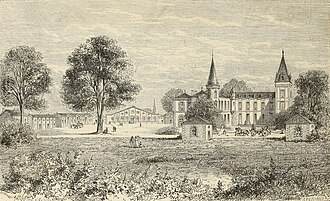
Château Cantemerle, a 5th Cru Classé in Haut-Médoc, is owned by the SMA BTP group. The estate is renowned for its environmental commitment and its 98-hectare vineyard planted on silica-gravel soils.
Identity
Château Cantemerle is a 5th Cru Classé, located in the commune of Macau in Gironde.
History and philosophy
The history of the Cantemerle estate dates back to 1147. Wine production became its primary activity from the 16th century onwards. In 1579, the Villeneuve family acquired the property, followed by the Dubos family in 1892. Château Cantemerle was added to the 1855 Official Classification of Bordeaux Wines in September of that same year.
In the 1980s, following the Second World War, the vineyard covered 25 hectares. In 1981, the estate was acquired by the French group SMA BTP. Since 2021, the managing director has been Laure Canu, working alongside consulting oenologist Éric Boissenot. The estate is actively committed to environmental stewardship, having earned the CIVB's CSR certification “Cultivons Demain” in 2023, and holds HVE certification.
Appellations
Château Cantemerle produces wines under the Haut-Médoc appellation.
Practical information
Château Cantemerle can be contacted by telephone on +33 (0)5 57 97 02 82 and by email at cantemerle@cantemerle.com. The estate offers tours and wine tourism workshops from Tuesday to Friday morning. Cellar door sales are available.
Find out more
Frequently asked questions
- What is Château Cantemerle's ranking among Bordeaux classified growths?
- Château Cantemerle is recognised as a 5th Cru Classé, a status awarded in 1855, highlighting its historical importance and the quality of its wines within the Grands Crus Classés of Bordeaux. This distinction reflects its rich heritage and viticultural expertise.
- What is the grape variety composition of Château Cantemerle's vineyard?
- The grape varieties at Château Cantemerle are predominantly Cabernet Sauvignon, representing 71% of the vineyard area. Merlot accounts for 18%, Petit Verdot for 7%, and Cabernet Franc for 4%. This varietal balance is tailored to the estate's silica-gravel terroir to produce wines characteristic of the Haut-Médoc appellation.
- Is Château Cantemerle committed to environmentally friendly practices?
- Yes, Château Cantemerle is certified HVE (Haute Valeur Environnementale), reflecting its dedication to sustainable agricultural practices. The estate also received the CIVB's CSR certification “Cultivons Demain” in 2023, and its modern facilities integrate environmental solutions, such as geothermal energy and vats designed to reduce water consumption.
- What type of soil characterises the terroir of Château Cantemerle?
- The terroir of Château Cantemerle is characterised by silica-gravel soils. These soils are composed of deep gravels that are particularly well-suited to viticulture, especially for grape varieties such as Cabernet Sauvignon. These geological features contribute to the distinctiveness and quality of the estate's wines.
The vineyard (terroir)
The Château Cantemerle vineyard extends over 98 hectares within a total estate of 200 hectares. The soils are silica-gravel with deep gravel deposits. The average vine age is 40 years. The grape varieties are predominantly Cabernet Sauvignon (71%), complemented by Merlot (18%), Petit Verdot (7%), and Cabernet Franc (4%).
Flagship cuvées
The estate's grand vin, classified as a Grand Cru Classé of Haut-Médoc, exhibits the quintessential profile of its appellation. The estate also produces a second wine, Les Allées de Cantemerle, also under the Haut-Médoc appellation.
Vinification and ageing
Vinification at Château Cantemerle favours a gentle approach that respects the fruit, prioritising infusion over extraction. Each parcel is vinified separately. The 3,500 m² vat room is equipped with 114 stainless steel vats ranging from 38 to 170 hectolitres in capacity. Barrel filling is carried out entirely by gravity.
Ageing takes place in French oak barrels for 12 months, with 35% new oak. Press wine accounts for approximately 12% of the blend. Following ageing, the wine rests in vat for 4 months before estate bottling.
The 2,500 m² barrel cellar can accommodate up to 2,000 barrels. In 2025, the estate inaugurated new technical facilities designed by BPM architects (Arnaud Boulain), including an underground barrel cellar. These facilities incorporate sustainable solutions, such as a geothermal loop powered by water from the property's lake for energy supply, and stainless steel vats that reduce water consumption for cleaning by 75%.
- Appellation
- Haut-Médoc
- Commune
- Macau
- Wine region
- Médoc
- Classification
- 5e Cru Classé 1855
- Owner
- Groupe SMA BTP
- Technical direction
- Éric Boissenot
- Surface area
- 98 ha
- Second wine
- Haut-Médoc Les Allées
- Certifications
- HVE
- Grape varieties
- Cabernet Sauvignon 71%, Merlot 18%, Petit Verdot 7%, Cabernet Franc 4%
Estate news
04 August 2026
Grand Cru, Premier Cru, DOCG: ce înseamnă, de fapt, clasificările
L'article explore les systèmes de classification des vins en France et en Italie, en démystifiant les appellations comme Grand Cru, Premier Cru et DOCG. Il souligne la différence fondamentale entre la France, qui classe les terroirs (notamment en Bourgogne, où les parcelles sont hiérarchisées), et l'Italie, qui réglemente les règles de production. En Bourgogne, la hiérarchie est régionale, village, Premier Cru et Grand Cru, ce dernier représentant moins de 2% de la production et se référant directement à la parcelle, comme Corton ou Montrachet. L'article met en garde contre la confusion, car à Bordeaux, le système de 1855 classifie les châteaux (comme Château Cantemerle, un Haut-Médoc Grand Cru Classé) et non les parcelles, et le terme "Grand Cru Classé" n'a pas la même signification qu'en Bourgogne. En Italie, le DOC et le DOCG garantissent l'origine et le respect des méthodes de production, avec des règles plus strictes et une dégustation obligatoire pour le DOCG, comme le Massolino Barbaresco DOCG. Cependant, l'article insiste sur le fait que ces classifications garantissent l'authenticité et la conformité, mais pas nécessairement l'excellence, citant l'exemple des "Super Toscans" des années 70 qui, bien que classés "vino da tavola", étaient de très haute qualité. L'auteur, Sergiu Nedelea, sommelier chez Winedom, conseille de privilégier le producteur et le millésime avant la classification, car un Grand Cru mal travaillé peut être médiocre, tandis qu'un vin régional fait avec soin peut être excellent. La classification est un indice d'ambition et non de qualité intrinsèque, et il est recommandé de choisir des vins régionaux ou de village pour les occasions courantes, et de monter en gamme pour les occasions spéciales, en gardant toujours à l'esprit que le talent du vigneron reste primordial.
Read the source — winedom.roPractical information
- Address
- Macau, 33460
- Phone
- 05 57 97 02 82
- Contact form
- Contact the estate
- Visits
- large offre œnotouristique