Château Haut-Bailly
Updated on
Château Haut-Bailly, a Cru Classé de Graves in Léognan, is owned by the Wilmers family. It produces red wines in Pessac-Léognan from a 39-hectare vineyard boasting century-old vines. The estate is certified HVE 3 and Entreprise du Patrimoine Vivant.
Identity
Château Haut-Bailly is a Cru Classé de Graves located in the commune of Léognan in the Gironde. It is owned by the Wilmers family, with general management led by Véronique Sanders, while Chris Wilmers serves as Chairman of the Supervisory Board. Gabriel Vialard is the cellar master.
History and philosophy
The earliest records of vine growing on the estate's land date back to the 15th century, with vines mentioned at Le Pujau as early as 1461. The modern vineyard took shape in the 17th century under the impetus of Firmin Le Bailly and Nicolas de Leuvarde. The name “Haut-Bailly” was bestowed around 1630 by Firmin Le Bailly.
In the late 19th century, Alcide Bellot des Minières, nicknamed “the king of winegrowers” for his scientific acumen, made an enduring mark on the estate's history. Following a challenging period in the early 20th century, Belgian wine merchant Daniel Sanders acquired the property in 1955. In 1998, American banker Robert G. Wilmers purchased Château Haut-Bailly. Following his death in December 2017, his son Chris Wilmers took over the property. The estate unveiled its new cellars in 2021.
Château Haut-Bailly is committed to a philosophy of excellence, harmonising tradition and innovation. The estate strives to preserve and enhance biodiversity, limit its carbon footprint, and support its workforce and local communities. The estate's cellar was awarded HQE certification with an “Excellent” rating, and the property has held the Entreprise du Patrimoine Vivant label since 2016. High Environmental Value certification (HVE 3) was achieved in 2019.
Appellations
Château Haut-Bailly produces wines under the Pessac-Léognan appellation. It is also classified as a Cru Classé de Graves.
Practical information
Château Haut-Bailly is located at 48 Rue de La Liberté, 33850 Léognan.
You can contact the estate by telephone on +33 (0)5 56 64 75 11 or by email at mail@haut-bailly.com. The estate is open Monday to Friday from 9:00 am to 12:30 pm and from 2:00 pm to 5:30 pm. On Saturdays in May, June, September, and October, it is open from 10:00 am to 5:00 pm. It is closed on Sundays and public holidays.
Tours and tastings are available by prior appointment. They include an introduction to the century-old vines, the vat room, the barrel cellar, and a tasting of the Château's wines. The site is accessible to persons with reduced mobility (PRM).
Château Haut-Bailly also offers guest rooms and a private table providing a refined culinary experience in the château's reception rooms, paired with the wines and the seasons. Bespoke seminars and receptions can be organised in private hire spaces.
Find out more
Frequently asked questions
- Where is Château Haut-Bailly located and which appellation does it belong to?
- Château Haut-Bailly is located in the commune of Léognan, in the Gironde. It is classified as a Cru Classé de Graves and produces wines under the Pessac-Léognan appellation. The estate sits on a high knoll on the Left Bank, characterised by gravel, sand, and clay soils over a subsoil of faluns and marine sediments, exceptionally suited to viticulture. The vineyard covers 39 hectares, dedicated entirely to red grape varieties.
- Who are the current owners of Château Haut-Bailly and what is its history?
- Château Haut-Bailly is owned by the Wilmers family, with Chris Wilmers serving as Chairman of the Supervisory Board. General management is overseen by Véronique Sanders, and Gabriel Vialard is the cellar master. The earliest traces of vine growing on this terroir date back to the 15th century, with the name “Haut-Bailly” given around 1630 by Firmin Le Bailly. The property was acquired by the Wilmers family in 1998, upholding a long winemaking tradition.
- What are Château Haut-Bailly's environmental and biodiversity commitments?
- Château Haut-Bailly is actively committed to environmental conservation and biodiversity enhancement. The estate holds High Environmental Value (HVE 3) certification, awarded in 2019, and its cellar earned HQE certification with an “Excellent” rating. Sustainable viticultural practices are implemented, such as zero herbicide use, hand-harvesting, gentle pruning, and the use of technologies like the Vitibot Bakus electric robot to reduce carbon emissions. Regular fauna surveys and tree planting also contribute to preserving local biodiversity. The château garden received an award for its landscape integration.
- Which grape varieties are grown and what wines are produced at Château Haut-Bailly?
- The vineyard of Château Haut-Bailly is planted with Cabernet Sauvignon (60%), Merlot (34%), Cabernet Franc (3%), and Petit Verdot (3%). These grape varieties are used to craft the grand vin, Château Haut-Bailly, as well as its second wine, Haut-Bailly II. In certain years, the estate also produces a third wine called La Parde de Haut-Bailly. When the vintage allows, a saignée rosé, Rosé de Haut-Bailly, made from 100% Cabernet Sauvignon, is produced.
The vineyard (terroir)
The vineyard spans 39 contiguous hectares entirely dedicated to red grape varieties. It is situated on soils of gravel, sand, and clay, over a subsoil composed of faluns (fossil-rich shell limestone) and marine sediments. The vineyard's topography features one of the highest knolls on the Left Bank, with gentle slopes that ensure natural drainage. Planting density is 10,000 vines per hectare.
The grape variety mix consists of 60% Cabernet Sauvignon, 34% Merlot, 3% Cabernet Franc, and 3% Petit Verdot. The average age of the vines is 35 years. A 4-hectare parcel of century-old vines is cultivated right in front of the château.
The estate prioritises sustainable viticultural practices: no herbicides, hand-harvesting, gentle pruning, and crop thinning when required. Technologies such as the Vitibot Bakus electric robot are deployed to reduce the carbon footprint. Wildlife inventories have revealed numerous species of birds, butterflies, and dragonflies. In 2023, 6,000 young trees were planted across 2.5 km to promote biodiversity. The château's garden was awarded the Silver Medal at the Victoires du Paysage in 2022 for its environmental integration.
Flagship cuvées
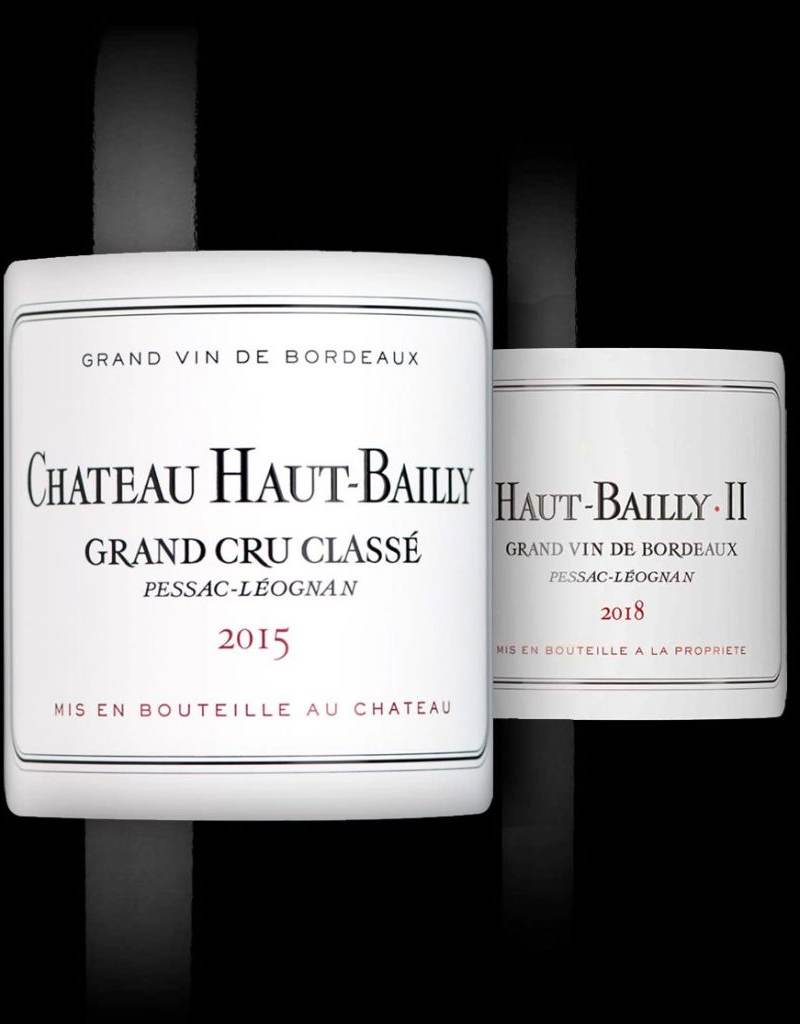
The estate's grand vin is Château Haut-Bailly, a red wine from the Pessac-Léognan appellation. The second wine is Haut-Bailly II, first released in 1967 (previously known as Domaine de la Parde, then La Parde de Haut-Bailly from 1979). In certain vintages since 1987, the estate has also produced a third wine, La Parde de Haut-Bailly.
When vintage conditions permit, a saignée rosé, Rosé de Haut-Bailly, crafted entirely from 100% Cabernet Sauvignon, is produced, having first been commercialised in 2004.
Vinification and ageing
Vinification is conducted plot by plot in approximately thirty concrete vats. The process includes temperature control and gentle pump-overs to preserve fruit purity and extract silky tannins. The wines are aged for 16 to 18 months in French oak barrels. Since 2021, these operations have taken place in brand-new cellars. These modern facilities were designed to be both innovative and environmentally friendly, notably incorporating rainwater harvesting and recycling systems.
- Appellation
- Pessac-Léognan
- Commune
- Léognan
- Wine region
- Graves & Sauternais
- Classification
- Cru Classé de Graves
- Owner
- Famille Wilmers
- Technical direction
- Gabriel Vialard
- Surface area
- 39 ha
- Second wine
- Haut-Bailly II
- Certifications
- HVE
- Grape varieties
- Cabernet Sauvignon 60%, Merlot 34%, Cabernet Franc 3%, Petit Verdot 3%
Practical information
- Address
- 48 Rue de La Liberté, 33850 Léognan
- Phone
- +33 (0)5 56 64 75 11
- mail@haut-bailly.com
- Contact form
- Contact the estate
- Opening hours
- Ouvert du lundi au vendredi de 9h à 12h30 et 14h à 17h30. Ouvert les samedis de Mai - Juin et Septembre-Octobre de 10h à 17h. Fermé dimanche et jours fériés.
- Visits
- Visite et dégustation : invitation à la rencontre de Haut-Bailly : pénétrez un jardin remarquable à la découverte des vignes centenaires et du chai contemporain et dégustez les vins du Château.