
Château Perron
Updated on
Château Perron, a family winegrowing estate in Lalande-de-Pomerol since 1958, spans 36.17 hectares of sandy-gravelly soils with a grape variety composition dominated by Merlot. The vineyard is farmed organically and is HVE3 certified.
Identity
Château Perron is a family winegrowing estate located in the commune of Lalande-de-Pomerol, in the Gironde. It is owned by the Massonie family, with Michel-Pierre Massonie as the proprietor. Its management is overseen by his son, Bertrand Massonie, who works alongside Béatrice and Thibaut Massonie, representing the third generation at the helm of the vineyard.
History and Philosophy
The history of Château Perron dates back to its first documented mention in 1642, with its foundation identified in 1647. The Massonie family acquired the estate in the late 1950s, specifically in 1958. Since the year 2000, the third generation of the family has taken the reins of the property, thus perpetuating the family legacy.
In terms of its winegrowing philosophy, Château Perron is committed to an environmentally respectful approach. The estate has begun its conversion to organic farming and is certified High Environmental Value (HVE) Level 3. It is also engaged in ISO 14001 certification, demonstrating a comprehensive environmental management approach.
The Appellations
Château Perron produces wines under the Lalande-de-Pomerol appellation. The vineyard plots are located at the entrance to the village of Lalande, in the immediate vicinity of the 12th-century church.
Winemaking and Ageing
Winemaking at Château Perron is plot-by-plot, with each plot worked separately. Harvesting is carried out manually for young and very old vines, and mechanically for the rest of the vineyard. The Merlots are harvested first and vinified in temperature-controlled concrete vats, while the Cabernet Franc and Sauvignon are harvested later and processed in a temperature-controlled stainless steel vat room.
Malolactic fermentation is carried out for some batches in barrels and for others in vats. The ageing of the wines takes place in truncated conical wooden vats, as well as in vats and barrels, as indicated by the practices for certain cuvées. Two monthly tastings are conducted before the final blend. Bottling generally occurs in late spring or early autumn, and the wines are then stored in a climate-controlled area.
Practical Information
Address: 2 Rue des Écoles, 33500 Lalande-de-Pomerol
Telephone: +33 5 57 51 40 29
Email: contact@chateauperron.net
Cellar Door Opening Hours: Monday to Friday from 08:00 to 18:00.
Tastings are available at the property.
Find Out More
Frequently asked questions
- What is Château Perron's main appellation and its location?
- Château Perron is located in the Lalande-de-Pomerol appellation, on the Right Bank of Bordeaux. Its plots are situated at the entrance to the village of Lalande, near the 12th-century church, in the commune of Lalande-de-Pomerol.
- What are the characteristics of Château Perron's vineyard?
- The vineyard spans 36.17 hectares. It is predominantly planted with Merlot (80%), complemented by Cabernet Franc (10%) and Cabernet Sauvignon (10%). The soils are sandy-gravelly, resting on an iron oxide subsoil, and the average age of the vines is approximately 70 years.
- What environmental certifications does Château Perron hold?
- Château Perron practices organic farming and is HVE (High Environmental Value) Level 3 certified. The estate is also engaged in ISO 14001 certification, highlighting a comprehensive environmental management approach.
- What are the main wines produced by Château Perron?
- The estate notably produces Château Perron, a red wine whose blend varies but remains predominantly Merlot. A specific cuvée, Château Perron La Fleur, is also crafted, often based on pure Merlot or with a variable blend including Cabernet Franc and Cabernet Sauvignon.
The Vineyard (Terroir)
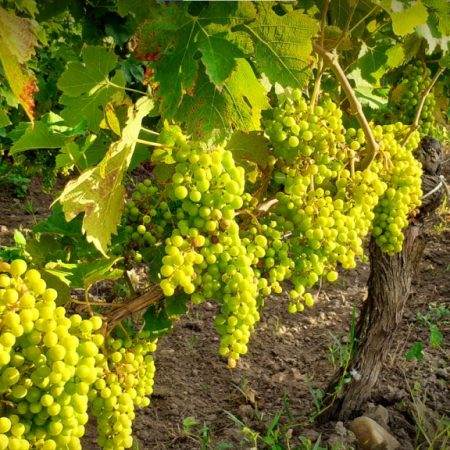
The vineyard of Château Perron spans an area of 36.17 hectares. The soils are characterised by a sandy-gravelly composition, resting on a subsoil rich in iron oxide. For certain plots, notably that of the La Fleur cuvée, the soils are specifically described as gravels.
The average age of the vines is approximately 70 years, with a distribution where young vines represent 37% of the total grape varieties planted, and old vines 63%. The young vines are planted at a density ranging from 5,500 to 7,800 vines per hectare.
The estate's grape varieties are dominated by Merlot (80%), complemented by Cabernet Franc (10%) and Cabernet Sauvignon (10%). Cultivation practices include single Guyot pruning and green operations such as bud removal, suckering, and leaf removal. Harvesting is carried out both manually, for the young and oldest vines, and mechanically for the rest of the property, using a Pellenc Optimum machine equipped with an on-board sorting system.
Flagship Cuvées
The estate primarily produces the Château Perron cuvée. This red wine is crafted from the grape varieties cultivated on the property, with a dominance of Merlot, complemented by Cabernet Franc and Cabernet Sauvignon. Its structure is generally intended for ageing, with a potential of 15 to 20 years, or even longer for certain vintages. Some vintages may feature a specific blend, such as 70% Merlot, 20% Cabernet Franc, and 10% Cabernet Sauvignon.
A specific cuvée, sometimes named Château Perron La Fleur, is also produced. It is primarily made from pure Merlot, or with a blend varying by vintage, for example, 70% Merlot, 20% Cabernet Franc, and 10% Cabernet Sauvignon. This cuvée is generally aged in new oak foudres, on gravel soils.
- Appellation
- Lalande-de-Pomerol
- Commune
- Lalande-de-Pomerol
- Wine region
- Libournais
- Owner
- Famille Massonie
- Technical direction
- Michel-Pierre Massonie
- Surface area
- 36.17 ha
- Certifications
- Bio, HVE
- Grape varieties
- Merlot 80%, Cabernet Franc 10%, Cabernet Sauvignon 10%
Practical information
- Address
- 2 rue des Écoles, 33500 LALANDE-DE-POMEROL
- Phone
- 05 57 51 40 29
- Contact form
- Contact the estate
- Opening hours
- Lundi – Vendredi : 08:00 – 18:00
- Visits
- Oui