
Château Cheval Blanc
Updated on
Château Cheval Blanc is a 39-hectare winegrowing estate in Saint-Émilion, jointly owned by Bernard Arnault and the Frère family. Committed to agroecology, it withdrew from the official classification in 2022. It is renowned for its red wines (Château Cheval Blanc, Le Petit Cheval) and its white wine (Le Petit Cheval Blanc).
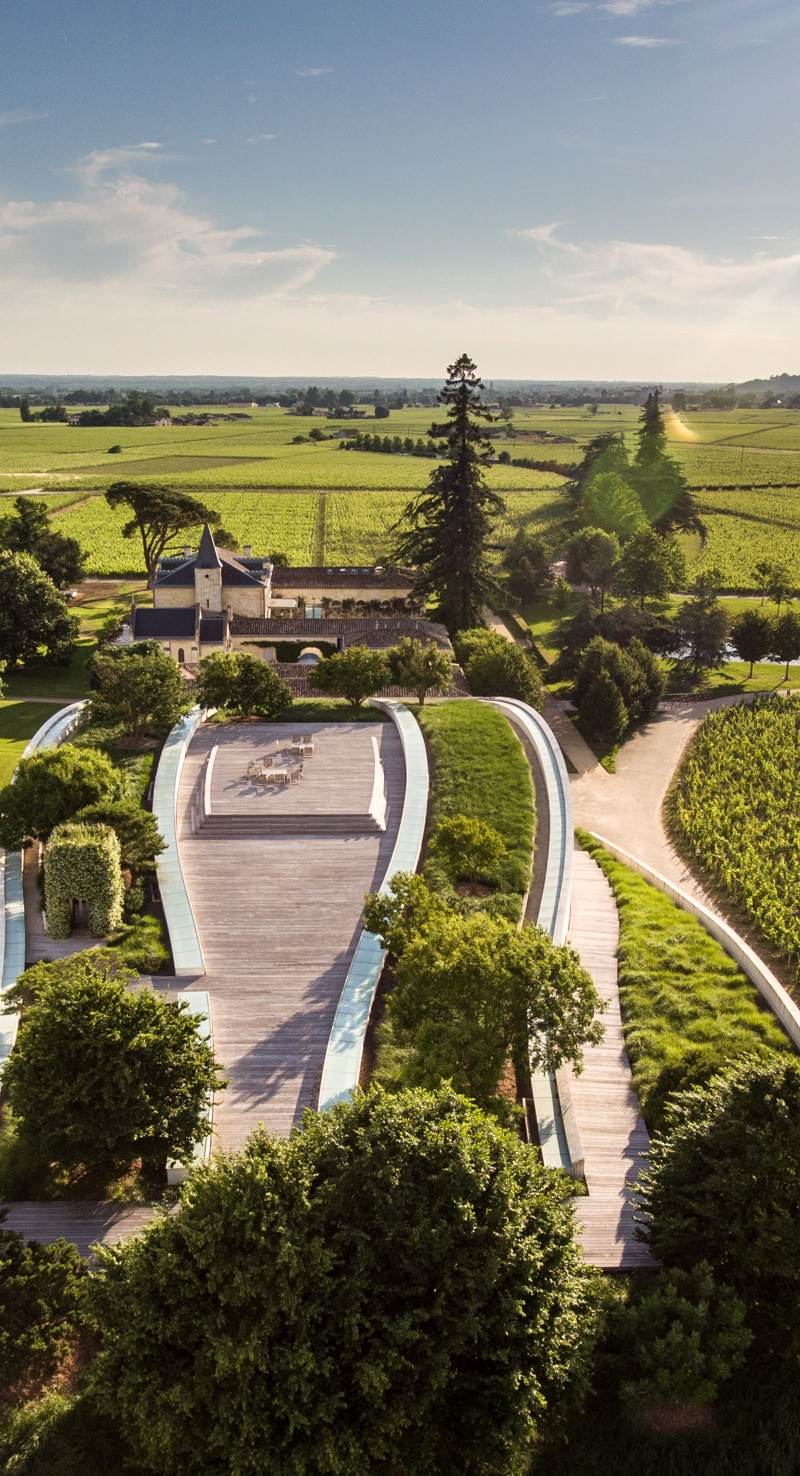
Identity
Château Cheval Blanc is a winegrowing estate located in Saint-Émilion, in the Gironde department. It has been jointly owned by Bernard Arnault and the Frère family since 1998. General management is overseen by Pierre-Olivier Clouet.
History and philosophy
The history of Château Cheval Blanc dates back to the 15th century, with vines documented on the land from this period. The estate officially became a château in 1834. Its reputation flourished in the 19th century, notably following its acquisition by Jean-Jacques Ducasse in 1832 and the modernisation led by Jean Laussac-Fourcaud. The estate was awarded gold medals at the Universal Exhibitions of Paris in 1878 and Antwerp in 1886. In 1871, the vineyard's current parcel structure was established. In 1955, Château Cheval Blanc was classified as a Premier Grand Cru Classé 'A' of Saint-Émilion, a distinction it held until its withdrawal from the classification starting from the 2022 vintage.
The estate's philosophy aims to guide the birth of a wine that faithfully reflects its terroir and the climatic conditions of each vintage. Château Cheval Blanc is committed to agroecology to preserve its soils and ensure their stewardship for future generations. In 2011, a new vinification cellar was constructed, designed by architect Christian de Portzamparc.
Appellations
Château Cheval Blanc produces wines under the Saint-Émilion Grand Cru appellation.
Practical information
Château Cheval Blanc is located in Saint-Émilion, postcode 33330.
Address: Château Cheval Blanc
Telephone: 0557555555
Email: contact@chateau-chevalblanc.com
Visits to the estate are strictly by appointment for wine trade professionals only.
Find out more
Frequently asked questions
- What is the main appellation produced by Château Cheval Blanc?
- Château Cheval Blanc primarily produces wines under the Saint-Émilion Grand Cru appellation. The estate voluntarily withdrew its wines from the Saint-Émilion classification starting from the 2022 vintage.
- Who owns Château Cheval Blanc?
- Château Cheval Blanc is jointly owned by Bernard Arnault and the Frère family, who acquired the property in 1998. Pierre-Olivier Clouet serves as the estate's Managing Director.
- What is the vineyard surface area and grape variety breakdown of Château Cheval Blanc?
- The vineyard of Château Cheval Blanc covers 39 hectares. Grape varieties are predominantly composed of 52% Cabernet franc, 43% Merlot, and 5% Cabernet Sauvignon. The estate has also replanted 6.5 hectares with Sauvignon blanc for white wine production.
- What are the terroir characteristics and environmental practices at Château Cheval Blanc?
- The terroir of Château Cheval Blanc features soils composed of clay and gravel, including veins of blue clay. The estate is committed to an agroecological approach, eschewing herbicides and fostering biodiversity through tree planting, cover crops, and the integration of animals.
The vineyard (terroir)
The vineyard of Château Cheval Blanc covers a planted surface area of 39 hectares, divided into 56 plots. Its parcel layout has remained unchanged since 1871. The terroir is characterised by a combination of clay and gravel soils, with veins of blue clay. The average age of the vines is around forty years.
The estate's main grape varieties consist of 52% Cabernet franc, 43% Merlot, and 5% Cabernet Sauvignon. Viticulture is guided by agroecology, without the use of chemical herbicides. Environmental practices such as the reintroduction of trees, hedgerows, and cover crops (clover, mustard) are carried out, with over 3,000 trees planted. Animals including sheep, pigs, beehives, and hens are also integrated, alongside a vegetable garden. Tillage is halted in mid-summer following earthing-down, allowing natural grass cover to manage water resources. One hectare of vines is replanted every three years following a soil rest period. In 2006, the château acquired an 8-hectare parcel of Château La Tour du Pin Figeac, followed by an additional 11 hectares from the same estate in 2022, of which 6.5 hectares were replanted with Sauvignon blanc to develop white wine production.
Flagship cuvées
The estate's grand vin is Château Cheval Blanc, a still red wine. Its blend varies according to the vintage—for example, 54% Merlot and 46% Cabernet franc for 2012, or 58% Merlot, 34% Cabernet franc, and 8% Cabernet Sauvignon for 2019. These wines are distinguished by their aromatic complexity, balanced structure, and exceptional ageing potential.
The estate also produces a second red wine, Le Petit Cheval, with a blend of 56% Merlot and 44% Cabernet franc in 2019, and 59% Cabernet franc and 41% Merlot in 2020. In 2014, Château Cheval Blanc launched a white wine, Le Petit Cheval Blanc, crafted from a blend of Sémillon and Sauvignon.
Vinification and ageing
Harvesting is carried out entirely by hand by a team of around fifty pickers, working bespoke parcel by parcel using small crates. Grapes are sorted meticulously to retain only pristine fruit. Following a night in a cold room, they are destemmed and crushed, then gravity-fed into fermentation vats. Vinification is tailored plot by plot, involving gentle fermentations and delicate pump-overs. Malolactic fermentation takes place in vats. The vinification cellar, built in 2011, houses 52 curved concrete vats of varying capacities, alongside 55 custom-built cement vats. The wines undergo ageing in oak barrels.
- Appellations
- Saint-Émilion Grand Cru, Bordeaux, Saint-Émilion
- Commune
- Saint-Émilion
- Wine region
- Libournais
- Classification
- Ancien 1er Grand Cru Classé A (retiré du classement 2022)
- Owner
- Bernard Arnault et Albert Frère
- Technical direction
- Pierre Lurton
- Surface area
- 76 ha
- Second wine
- Le Petit Cheval
- Grape varieties
- Cabernet franc 52%, Merlot 43%, Cabernet Sauvignon 5%, Sémillon, Sauvignon
Estate news
12 May 2026
«Faire quelque chose pour la filière» : Petrus, Yquem... Quand les grands châteaux aident les petits domaines en difficulté
Le dispositif "Vignerons AVenir", né en 2024 et basé sur le mécénat, met en relation des vignerons débutants ou en difficulté avec des châteaux bordelais renommés pour leur partager expertise et réseau. Initié par les châteaux Cheval Blanc, Lafite Rothschild, Petrus et Yquem, ce projet vise à soutenir la filière bordelaise en crise en offrant un accompagnement technique et stratégique plutôt qu'un soutien financier direct. Selon Olivia Gagey, secrétaire générale de Vignerons AVenir, et Nicolas Corporandy, chef de culture au Château Cheval Blanc, l'objectif est d'aider les vignerons à structurer leur stratégie de vente, adapter leurs produits aux consommateurs, et valoriser leur singularité dans un contexte de coûts croissants, de déconsommation et de défis climatiques. Pour l'édition 2025, Guillaume Pouvaret, propriétaire du château Grand Maison en appellation Côtes de Bourg, a été épaulé par le château Cheval Blanc. Cet accompagnement lui a permis de revoir sa surface viticole pour une meilleure qualité de vin et de développer son site internet, ouvrant des perspectives commerciales à l'export. Pour la promotion 2026, le château de la Grenière (Lussac Saint-Émilion) sera accompagné par Petrus pour l'export et la révision de plantations. Le château Haut-Rian (Côtes-de-Bordeaux et Entre-deux-Mers) bénéficiera du soutien de Cheval Blanc pour développer une "viti-boulangerie". Le château d'Yquem parrainera le château Hostens-Picant pour son expertise en vin blanc, et le château Lafite Rothschild accompagnera le château Doyac (Haut-Médoc) pour le développement d'une nouvelle cuvée et la cohérence de sa gamme. Ce dispositif s'inscrit dans la durée, avec de nouveaux projets et accompagnements chaque année.
Read the source — avis-vin.lefigaro.fr04 March 2026
Mieux vaut arracher que s'attacher aux vieilles vignes coûtant plus qu’elles ne rapportent. Parole de grand cru : "le levier d’action, c’est un rendement confortable pour avoir un résultat économique"
L'article du 4 mars 2026 de Vitisphere aborde l'initiative de mécénat de compétences "Vignerons AVenir", lancée par quatre grands crus bordelais : les châteaux Cheval Blanc (Saint-Émilion), Lafite Rothschild (Pauillac), Petrus (Pomerol) et Yquem (Sauternes). Ce programme vise à soutenir des domaines viticoles plus modestes en leur offrant un accompagnement stratégique pour améliorer leur rentabilité, notamment face à la crise viticole à Bordeaux. Les candidatures en ligne sont ouvertes jusqu'au 15 mars. Guillaume Pouvaret, vigneron du château Grand Maison (AOP Côtes de Bourg), témoigne de l'utilité du programme, ayant participé à la promotion pilote de 2025 avec le soutien de Cheval Blanc. Il souligne que la simple démarche de candidature permet de prendre du recul sur la gestion de son domaine. Nicolas Corporandy, chef de culture du château Cheval Blanc, explique que l'objectif est d'aider les propriétés à revoir leurs priorités, y compris la difficile décision d'arracher des vignes anciennes mais peu productives. Il insiste sur la nécessité d'atteindre un "rendement confortable pour avoir un résultat économique" et de ne pas s'attacher émotionnellement aux vignes en fin de vie. Le mécénat inclut également un appui technique et commercial, comme l'aide à la communication et à la création de supports promotionnels, ce qui confère une légitimité aux domaines accompagnés. Les grands crus, par cette action solidaire, cherchent à préserver la diversité du tissu viticole bordelais et à soutenir une nouvelle génération de vignerons dynamiques.
Read the source — vitisphere.comPractical information
- Address
- Château Cheval Blanc, 33330 Saint-Emilion
- Phone
- 0557555555
- Contact form
- Contact the estate
- Visits
- Oui sur rendez-vous uniquement aux professionnels