
Château Berrouet
Updated on
Château Berrouet is a family-owned winegrowing estate in Montagne, Saint-Émilion and Lalande de Pomerol, managed by Jeff Berrouet. It is renowned for its sustainable viticulture and wines aged in vats and oak barrels, placing Merlot at the forefront.
Identity
Château Berrouet is a winegrowing estate located in the commune of Montagne, in the Gironde department. The estate's vineyards have been managed by Jeff Berrouet since 2002. The Berrouet family, including Jean-Claude, Jeff, and Olivier Berrouet, is actively involved in running the estate.
History and Philosophy
The Berrouet family's history in the Bordeaux vineyards began in the 1970s with Jean-Claude Berrouet, who acquired plots on the heights of Saint-Émilion. In 1979, the estate spanned 4.5 hectares. Château Samion, comprising 1.5 hectares, was added in 1982, bringing the total surface area to 6 hectares until 2003. Jeff Berrouet took over the management of the vineyards in 2002.
The estate's viticultural practices strike a balance between organic viticulture and integrated pest management (lutte raisonnée). The estate is committed to reducing its carbon footprint and uses treatments such as sulphur and copper, as well as biocontrol products. HVE certification has been achieved.
The Appellations
The estate produces wines across several appellations. These include parcels in Montagne Saint-Émilion, Lalande-de-Pomerol, and Saint-Émilion.
Winemaking and Ageing
Harvesting is 80% manual, complemented by machine harvesting. The grapes are sorted on a table and destemmed. Transfer to the vats is carried out using a peristaltic pump without crushing, in order to preserve the integrity of the berries. Fermentation takes place in stainless steel and concrete vats, the latter being favoured for better oxygen exchange. Indigenous yeasts are used, with inoculation only when necessary. Maceration is moderate, and malolactic fermentation takes place in vats. Extraction is gentle, using short pump-overs and wetting the cap through wide hatches, following an infusion-based approach.
Press wines from a vertical press are reintroduced into the blend. The blend is assembled prior to barrelling down. Ageing lasts approximately 12 months or more, split between oak barrels (with 15% to 20% new oak) and amphorae (around 10% since 2020 for certain cuvées). Rackings are carried out every five months. The wines are fined and filtered. Sulphur additions take place at harvest and during bottling.
Practical Information
Address: 2, route de Saint-Georges, 33570 Montagne
Telephone: +33 (0)5 57 74 59 80
Email: contact@vignoblesberrouet.com
Visits and tastings are available by appointment. Cellar door sales and mail orders are available.
Find Out More
Frequently asked questions
- Who are the owners and winemakers of Château Berrouet?
- Château Berrouet is a family-owned estate. Jeff Berrouet has managed the vineyards since 2002, while Jean-Claude, Jeff, and Olivier Berrouet are all involved in the management and winemaking team.
- Which appellations are produced by Château Berrouet?
- Château Berrouet produces wines under the Montagne Saint-Émilion, Lalande-de-Pomerol, and Saint-Émilion appellations. Its key cuvées include Vieux Château Saint-André in Montagne Saint-Émilion, Château Samion in Lalande de Pomerol, and Château Hyon la Fleur in Saint-Émilion.
- What is the vineyard area and grape variety mix at Château Berrouet?
- The Château Berrouet vineyard extends over 28 hectares. The grape varieties are predominantly Merlot (90%), complemented by Cabernet Franc (10%). The vines have an average age of over fifty years.
- What winemaking and ageing practices are used at Château Berrouet?
- Winemaking involves predominantly hand-harvesting, rigorous sorting, and moving the fruit without crushing. Fermentation takes place in stainless steel and concrete vats. Ageing lasts at least 12 months, combining oak barrels (15 to 20% new wood) and amphorae for certain cuvées, guided by a gentle extraction philosophy.
The Vineyard (Terroir)
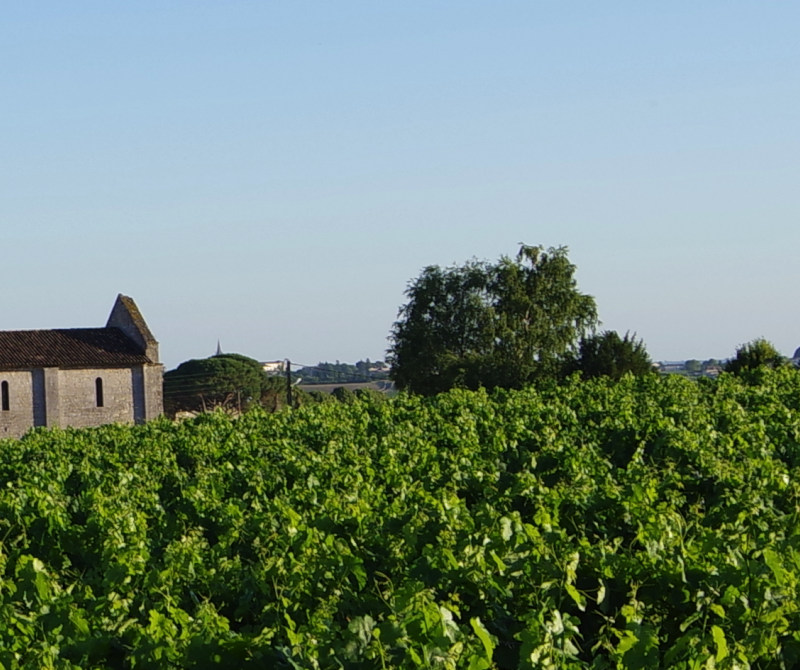
The vineyard covers a planted area of 28 hectares. The soils are predominantly clay-limestone in Montagne Saint-Émilion, and composed of fine clays and gravel in Lalande de Pomerol. The vines benefit from good natural drainage thanks to the slopes, while the high clay content fosters a steady water supply. The average age of the vines exceeds fifty years.
The grape varieties are dominated by Merlot, which accounts for 90%, complemented by 10% Cabernet Franc. The historical planting density is 1.50 metres x 1.10 metres, with narrower row spacing of 0.90 metres for new plantings. Pruning is carried out in mixed Guyot, with a shorter cane on younger vines. Soil management is tailored to its clay composition, including mechanical un-earthing (décavaillonnage) and shallow cultivation of the grass in one row out of three. Lateral shoot removal (échardage) is practised, but leaf-thinning is not carried out.
Flagship Cuvées
The estate offers several cuvées. Vieux Château Saint-André is produced in Montagne Saint-Émilion. Château Bonneau, with its first vintage in 2019, is also crafted in Montagne Saint-Émilion. Château Hyon la Fleur, first produced in the 2019 vintage, is a Saint-Émilion. Finally, Château Samion is a Lalande de Pomerol, made from 100% Merlot.
The wines are generally characterised by gentle extraction, aiming to preserve aromatic finesse and supple tannins.
- Appellations
- Montagne-Saint-Émilion, Lalande-de-Pomerol, Saint-Émilion
- Commune
- Montagne
- Wine region
- Libournais
- Owner
- Jeff Berrouet
- Technical direction
- Jean-Claude, Jeff et Olivier Berrouet
- Surface area
- 4.5 ha
- Certifications
- HVE
- Grape varieties
- Merlot 90%, Cabernet Franc 10%
Practical information
- Address
- 2, route de Saint-Georges, 33570 Montagne
- Phone
- 05 57 74 59 80
- Contact form
- Contact the estate
- Visits
- Visites et dégustations possibles sur rendez-vous.