
Château Lascombes
Updated on
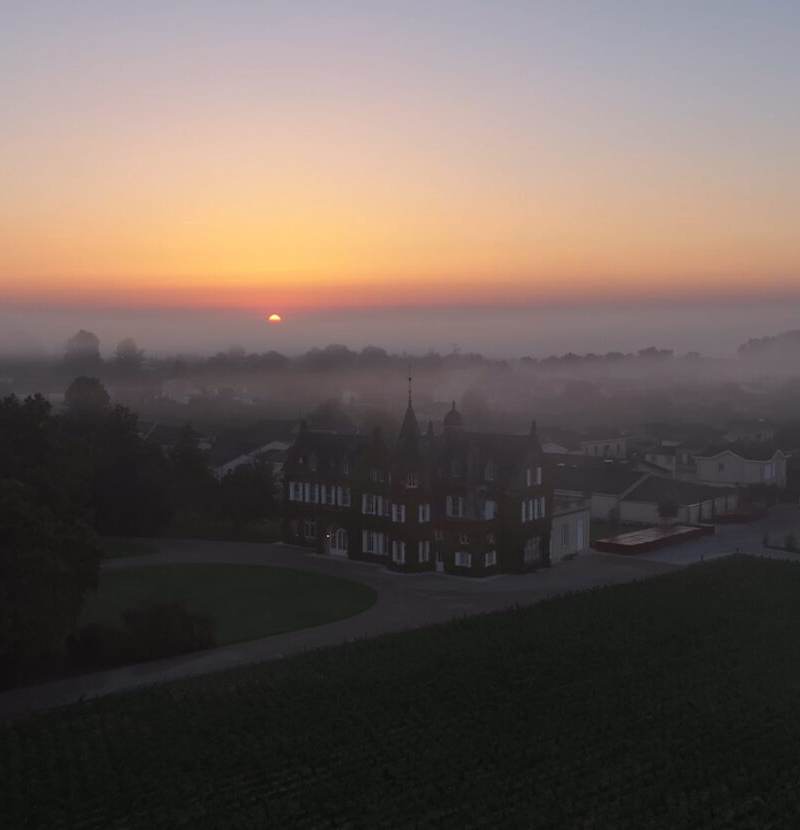
Château Lascombes is a Margaux Second Grand Cru Classé, owned by the Lawrence family and Carlton McCoy since 2022. Managed by Axel Heinz, it produces wines combining classicism with the expression of its gravel and clay terroir.
Identity
Château Lascombes is a Margaux Second Grand Cru Classé. It is located in the commune of Margaux. Since 2022, the Lawrence family has been the majority owner of the estate, in partnership with Carlton McCoy. Axel Heinz serves as its managing director.
History and Philosophy
The history of Château Lascombes dates back to 1681 with Antoine de Lascombes, the first recorded owner. In the 18th century, the estate was ranked as a second cru in the 1776 classification of Guyenne wines. After belonging to the Lascombes family, and then to Monsieur Loraigue in the early 1820s, the estate was acquired in 1867 by Gustave Louis Chaix d'Est-Ange. Under his direction, construction began on the English neo-gothic style château, designed by the architect Louis Garros. The 1855 classification confirmed its status as a Second Grand Cru Classé.
In the 20th century, Alexis Lichine managed the estate from 1952 to 1971. In 1971, Château Lascombes was sold to the British group Bass-Charrington. In 2001, it was acquired by Colony Capital, with Dominique Befve taking over management. In 2011, MACSF (Mutuelle d'assurances du corps de santé français) purchased the estate. In 2022, the Lawrence family, through Lawrence Wine Estates, acquired a majority stake in the property, with MACSF retaining roughly one-third of the shares. This acquisition marked the dawn of a new era for the estate, which notably introduced a new technical facility for the vat room and refreshed the design of its label in 2022 to return to the historic coat of arms. The estate is actively committed to biodiversity.
The Appellations
Château Lascombes produces wines under the Margaux appellation, as well as in Haut-Médoc.
Practical Information
Address: 1, cours de Verdun, 33460 Margaux
Telephone: +33 (0)5 57 88 70 66
Email: contact@chateau-lascombes.fr
Visits and tastings are by appointment only, Monday to Saturday from 9:30 am to 4:30 pm. Cellar door sales are available at the estate.
Find Out More
Frequently asked questions
- What is the classification of Château Lascombes?
- Château Lascombes is a Second Grand Cru Classé, a status awarded in the Official Bordeaux Wine Classification of 1855.
- Who are the current owners of Château Lascombes?
- Since 2022, Château Lascombes has been majority-owned by the Lawrence family, alongside Carlton McCoy. MACSF retains a minority shareholding.
- What are the main grape varieties grown at Château Lascombes?
- The Château Lascombes vineyard is planted predominantly with Cabernet Sauvignon (48%) and Merlot (48%), complemented by Petit Verdot (3%) and Cabernet Franc (1%).
- What is the surface area of the Château Lascombes vineyard?
- The Château Lascombes vineyard covers a total area of approximately 115 to 120 hectares, including 10 hectares in the Haut-Médoc appellation.
The Vineyard (Terroir)
The Château Lascombes vineyard extends over an area of approximately 115 to 120 hectares, including 10 hectares in the Haut-Médoc appellation. It is set on a gravel knoll rising to an altitude of 20 metres, composed of gravel, clay-gravel, and clay-limestone soils. Certain parcels feature seams of blue clay over limestone bedrock, particularly in the lieu-dit of La Côte. The gravel soils are ideal for Cabernet Sauvignon and Petit Verdot, whereas the clay-limestone and clay-gravel soils are well suited to Merlot. The vineyard comprises around 60 parcels.
The red grape variety plantings consist of Cabernet Sauvignon (48%), Merlot (48%), Petit Verdot (3%), and Cabernet Franc (1%). The average age of the vines is thirty-five years. The vines are trained using the double Guyot system, and harvesting is carried out by hand.
Signature Cuvées
The estate produces several cuvées, including the grand vin, Château Lascombes, an 1855 Second Grand Cru Classé. This blend, in which the proportion of Cabernet Sauvignon has been increased in recent years (67% for the 2022 vintage), is renowned for a style that marries charm, pleasure, and the quintessential classicism of Margaux. It offers a fresh, defined framework with long ageing potential, alongside a concentrated and powerful expression.
The estate's second wine is Chevalier de Lascombes. It is crafted to offer a fruitier, more supple profile that is accessible earlier, with a blend of 68% Cabernet Sauvignon and 32% Merlot for the 2022 vintage.
A new cuvée, La Côte – Lascombes, was introduced with the 2022 vintage. It is a 100% Merlot wine sourced from specific parcels with clay-limestone soils and seams of blue clay, offering a distinctive expression of the grape variety.
The estate also produces a wine in the Haut-Médoc appellation, Haut-Médoc de Lascombes.
Vinification and Ageing
Harvesting is done by hand. Vinification for both the Grand Vin and the second wine involves macerations lasting 30 to 35 days. Alcoholic fermentations take place at 28°C, followed by malolactic fermentations at 21°C and post-fermentation maceration at 30°C. Vinification for the La Côte cuvée focuses on gentle extraction through infusion.
Ageing takes place in barrels, foudres, and amphorae. For the Grand Vin, annual barrel renewal ranges between 80% and 100%, with ageing lasting eighteen to twenty months. For the La Côte-Lascombes cuvée, ageing also lasts 18 to 20 months, with nearly 60% new oak barrels and a small proportion in amphorae (less than 5%).
- Appellations
- Margaux, Haut-Médoc
- Commune
- Margaux-Cantenac
- Wine region
- Médoc
- Classification
- 2e Cru Classé 1855
- Owner
- famille Lawrence
- Technical direction
- Delphine Barboux
- Surface area
- 100 ha
- Second wine
- Chevalier de Lascombes
- Grape varieties
- Cabernet Sauvignon 48%, Merlot 48%, Petit Verdot 3%, Cabernet Franc 1%
Estate news
07 August 2026
Wine news of France, part LXXII - Paris1972-Versailles2003
Cet article, daté du 7 août 2026, aborde plusieurs actualités marquantes du secteur viticole français. Il met en lumière l'impact des vagues de chaleur intenses en Occitanie et dans le Sud, conduisant à des vendanges précoces dès juillet, une situation sans précédent pour certains domaines. Le ministère de l'Agriculture a d'ailleurs reporté ses estimations officielles en raison de l'incertitude quant aux volumes et à la maturité des raisins due au stress hydrique. L'article mentionne également une baisse historique de la demande dans les vignobles bordelais et ailleurs, forçant les producteurs à réduire leurs surfaces cultivées, les consommateurs français se tournant davantage vers les vins blancs et rosés ou d'autres boissons comme la bière. L'INAO accélère l'adaptation des cahiers des charges des appellations aux défis climatiques. Il est aussi fait mention de la tradition du "ban des vendanges" qui, depuis les années 1980, débute en moyenne plusieurs semaines plus tôt. En Saumurois, les galeries troglodytiques du Château de Targé et de la cave Robert & Marcel sont présentées comme des refuges contre la chaleur et des lieux idéaux pour l'élevage des vins et l'œnotourisme. L'Union des Grands Crus de Bordeaux (UGCB) assure que le millésime 2026 ne sera pas "affecté par les conséquences des incendies", prévoyant un "grand potentiel de qualité" et des vendanges anticipées. Grands Chais de France lance "Secrets de Cave", une plateforme de réservation d'expériences œnotouristiques, de personnalisation de bouteilles et de vente en ligne. Enfin, E. Guigal présente "La Reynarde", une nouvelle cuvée de Côte-Rôtie rejoignant la trilogie légendaire La Mouline, La Landonne et La Turque. Le Château Lascombes, Second Cru Classé de Margaux, est également mis en avant pour sa "seconde jeunesse" sous l'impulsion de la famille Lawrence et de l'œnologue Axel Heinz, qui vise à revitaliser le Grand Vin en se concentrant sur le Cabernet Sauvignon. L'article conclut sur la persistance de petits vignobles urbains en région parisienne, tels que le Clos de Morillons et le Clos de Montmartre.
Read the source — paris1972-versailles2003.com03 August 2026
Margaux-Cantenac. Lascombes fait le pari du renouveau
La famille de Gaylon Lawrence, propriétaire du Château Lascombes depuis 2022, ambitionne de restaurer le prestige de ce second grand cru classé de 1855, situé à Margaux. Cette initiative de renouveau est menée par l'œnologue franco-allemand Axel Heinz, qui fait son retour dans la région bordelaise après dix-huit ans d'expérience en Toscane, notamment auprès des domaines Ornellaia et Masseto. Né à Munich d'une mère bordelaise et d'un père allemand, Axel Heinz a grandi en Bavière avant d'obtenir ses diplômes d'ingénieur agronome et d'œnologue à Bordeaux. Après avoir travaillé dans le Médoc et à Saint-Émilion, il a passé près de deux décennies en Italie. En 2023, sur l'invitation de Gaylon Lawrence, un important propriétaire terrien américain et passionné de vin, également propriétaire de domaines réputés dans la Napa Valley, Axel Heinz a pris la direction du Château Lascombes. Ce domaine viticole couvre 120 hectares de vignes sous l'appellation Margaux et 10 hectares en Haut-Médoc. L'encépagement du vignoble est principalement constitué de merlot et de cabernet-sauvignon, en proportions presque égales, complétés par 4 % de petit verdot et 1 % de cabernet franc. Bien qu'Axel Heinz ait une passion pour la guitare classique, il se consacre désormais pleinement à la viticulture, tout en s'adonnant à la musique dès que son emploi du temps le lui permet. L'objectif est de redonner au Château Lascombes son statut historique et d'améliorer la qualité de ses vins.
Read the source — courrierdegironde.frPractical information
- Address
- 1, cours de Verdun, 33460 Margaux
- Phone
- +33 (0)5 57 88 70 66
- Contact form
- Contact the estate
- Opening hours
- Du lundi au samedi de 9h30 à 16h30
- Visits
- uniquement sur rendez-vous