
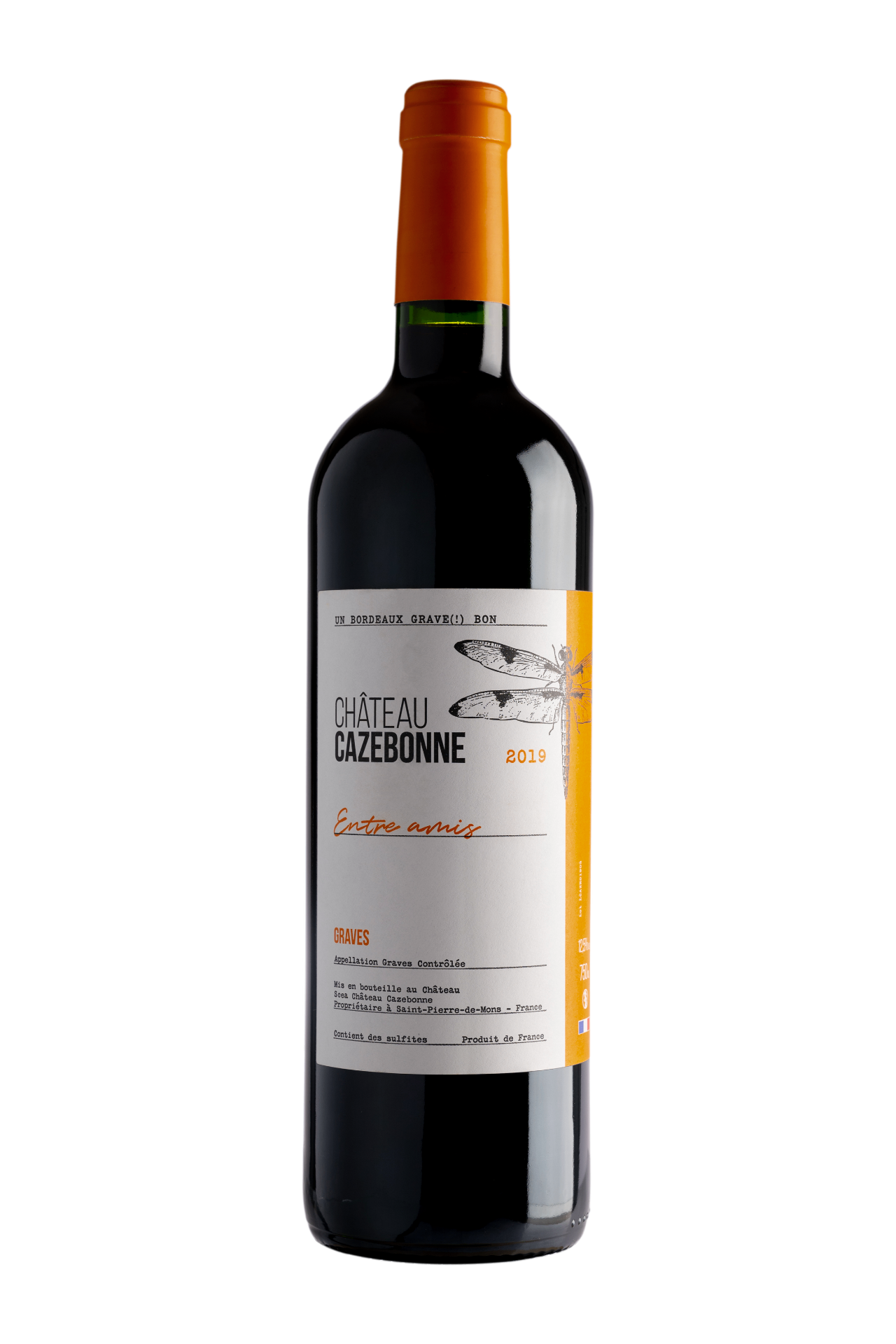
 The essential
6 × Entre Amis red
6 bottles — Graves red 2022
The best price of the cellar: €12 per bottle delivered.
The everyday red: generous and straight to the point.
I want itEstate archives
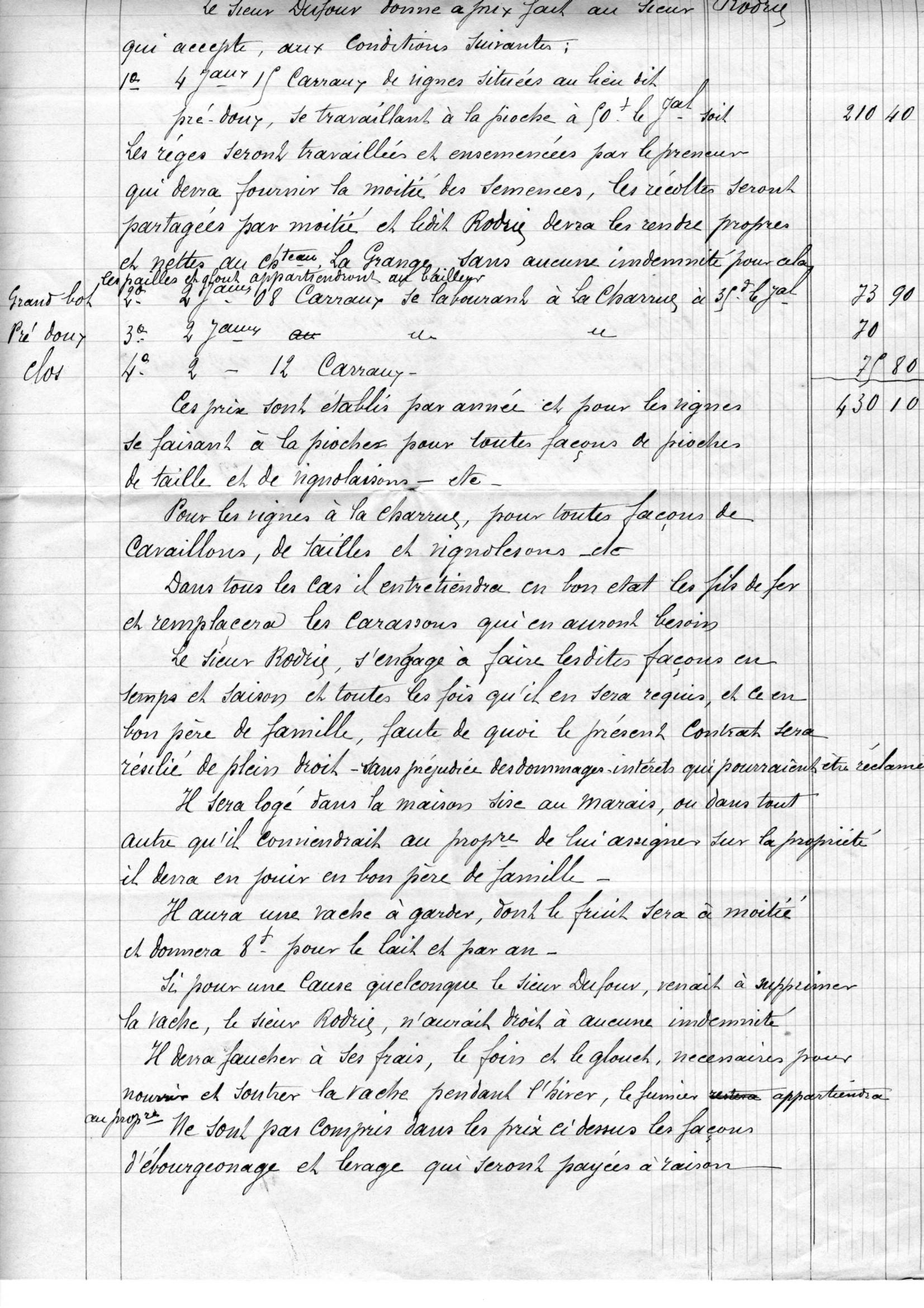
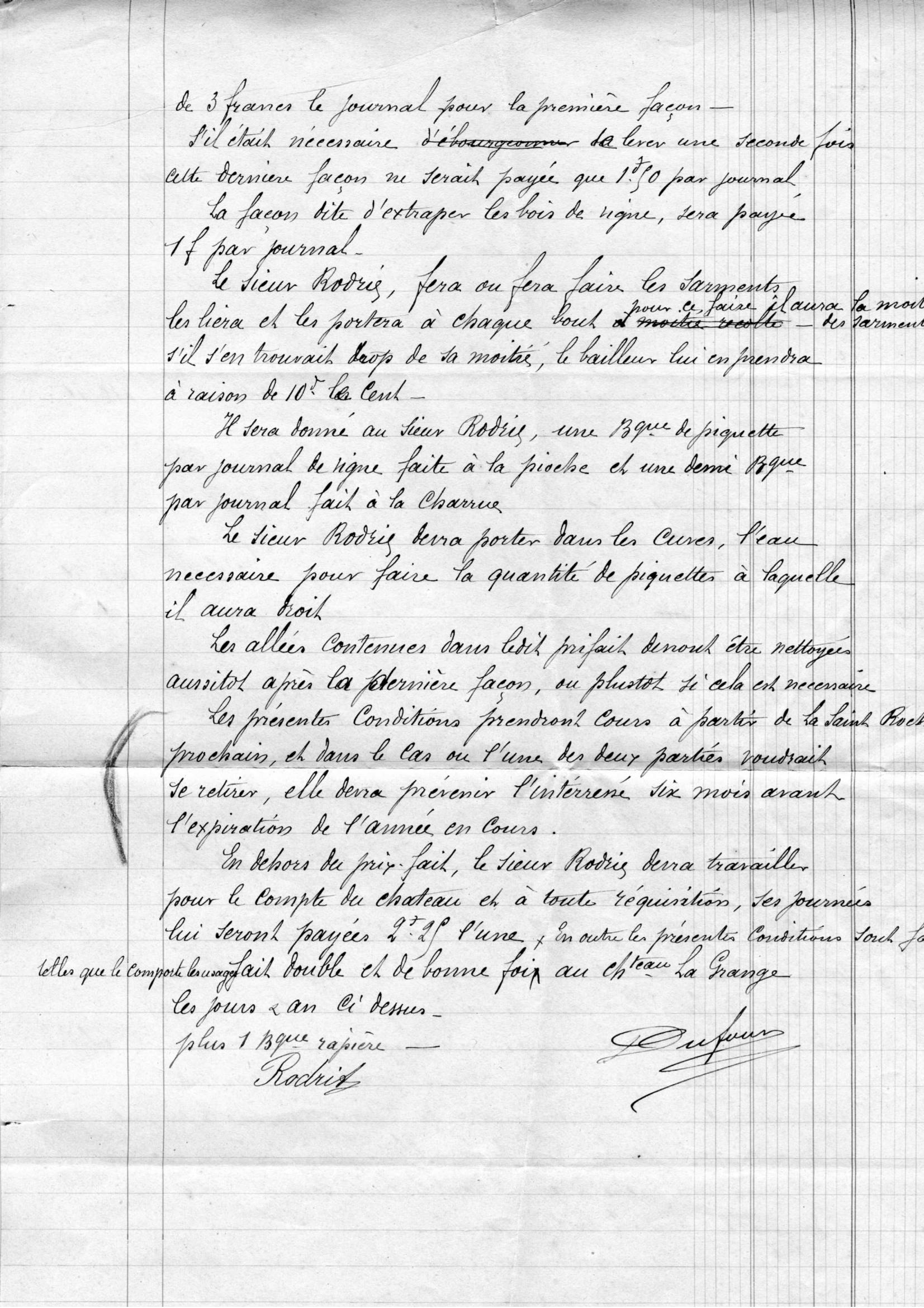
Two handwritten contracts, signed at Château La Grange at the end of the 19th century, shed light on a forgotten Bordeaux practice: the prix-fait. An agreement between the estate owner and the vineyard worker, in which every gesture, every vineyard task, and every crop share was scrupulously accounted for.
The prix-fait (literally "agreed price for the task") is an estate management contract typical of the 19th-century Bordeaux vineyard, which is still practised today in a modernised form. The proprietor — here Mr Henry Dufour, acting on behalf of the Marquis de Luppé — entrusted a vineyard worker with the full management of a group of parcels for a rate set per journal of vines (a local unit of surface area) and per year.
The tenant undertook to carry out all vineyard operations with due diligence ("en bon père de famille"): hand-hoeing or ploughing, pruning, cane tying (vignolaison), debudding, lifting and tucking-in, pulling out old wood, and maintaining the trellis wires and carassous (wooden stakes). In return, he received a flat sum per journal, supplemented by benefits in kind (the 1907 piquette contract, rapière, accommodation, shared ownership of a cow, vine shoots) and day wages paid at the estate's standard daily rate for work outside the prix-fait.
Three elements structured the balance of the contract: piece-rate pay (which took precedence over day rates), the equal sharing of crops sown between the rows, and termination as of right in the event of default — along with six months' notice for an amicable departure.
Item1895 Contract1892 ContractDate15 July 189517 January 1892LessorHenry Dufour, on behalf of the Marquis de Luppé — Château La GrangeTenantÉmile Tavernier (Les Renaud, Saint-Martin)Mr Rodrie (Saint-Martin-de-Blaye)Vines worked by hand hoe2 journaux at 57 F / journal (Pré-touy)4 ½ journaux at 50 F / journal (Pré-douy)Ploughed vines10 journaux at 30 F / journal≈ 7 journaux at 35 F / journalIndicative annual total≈ 414 F430.10 FDebudding / lifting3 F / journal (1st pass), 1.50 F (2nd pass)Pulling out wood1 F / journalDay labour outside prix-fait2.50 F (3 F on sulphur-dusting days)2 FPiquette1 barrel (Bque) rapière + 2 barrels piquette (drainage ditch); ½ barrel / journal ploughed1 barrel / journal hoed; ½ barrel / journal ploughedCrop sharingSeeds provided half-and-half; crops shared equallyVine shootsTied and carried to the end of the row — half for the tenant (surplus bought back at 10 F per hundred in 1892)Benefits in kindStraw and rye thatch to the lessorMarsh cottage accommodation, shared cow (milk: 8 F / year), manure to the ownerEffective dateFrom the feast of Saint-Roch (16 August) — 6 months' notice
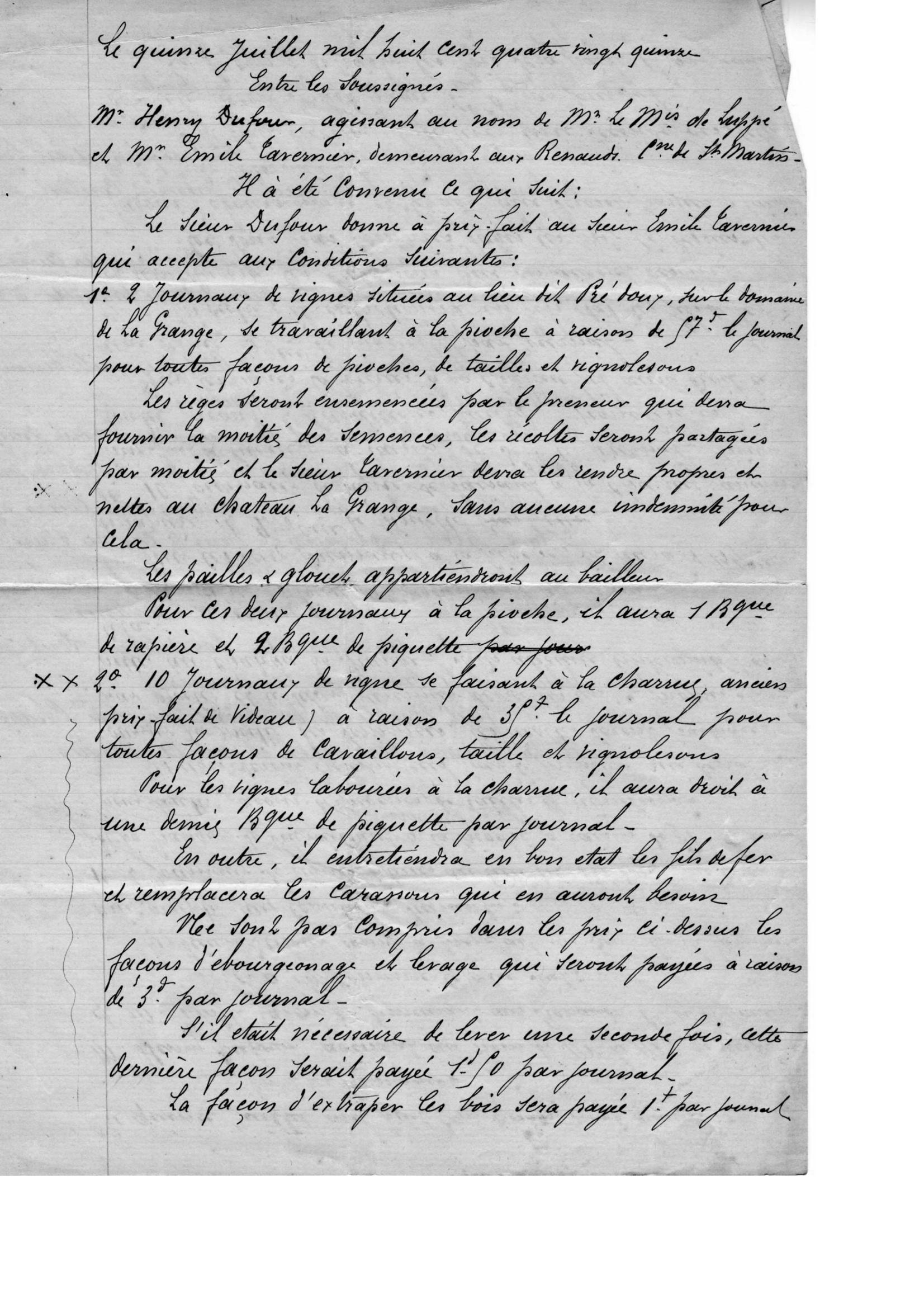
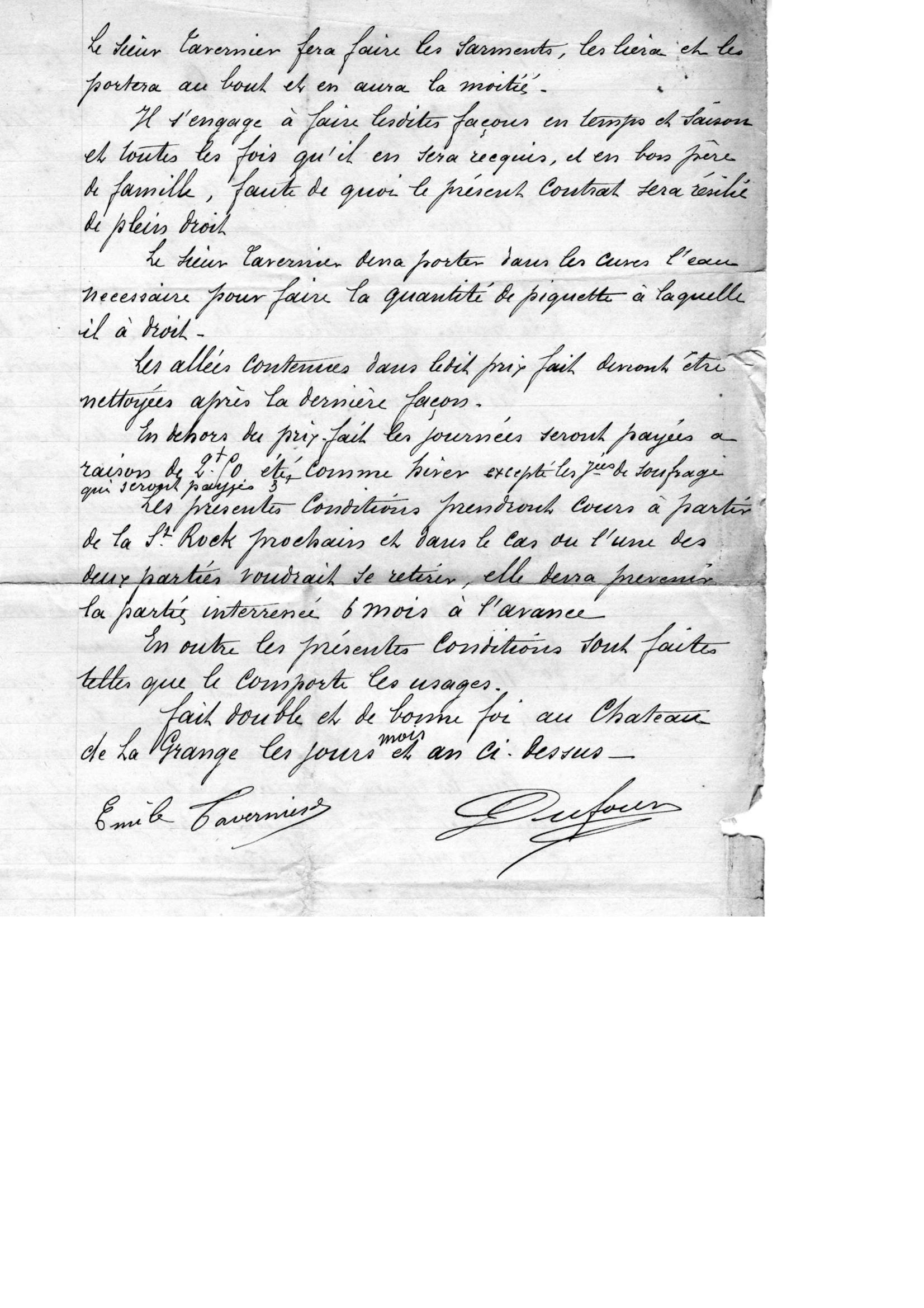
The fifteenth of July, one thousand eight hundred and ninety-five.
Between the undersigned: Mr Henry Dufour, acting on behalf of the Marquis de Luppé, and Mr Émile Tavernier, residing at Les Renaud, municipality of Saint-Martin. It has been agreed as follows: the said Mr Dufour leases on a prix-fait basis to Mr Émile Tavernier, who accepts, under the following conditions:
1° 2 journaux of vines located in the locality known as Pré-touy, on the estate of La Grange, worked by hoe, at the rate of 57 F per journal, for all hoeing, pruning, and cane-tying operations. The vines shall be sown by the tenant, who must provide half of the seed; the crops shall be divided equally, and Mr Tavernier must deliver them clean and sound to Château La Grange, without any compensation for doing so. The straw and thatch shall belong to the lessor. For these two hoed journaux, he shall receive 1 barrel of rapière and 2 barrels of piquette per ditch.
2° 10 journaux of vines worked with the plough (former prix-fait of Videau), at the rate of 30 F per journal, for all unearthing (cavaillons), pruning, and cane-tying operations. For the ploughed vines, he shall be entitled to half a barrel of piquette per journal.
In addition, he shall maintain the trellis wires in good condition and replace any carassous that require it. Not included in the above prices are the debudding and lifting operations, which shall be paid at the rate of 3 F per journal. Should a second lifting pass be required, this latter operation shall be paid at 1.50 F per journal. The pulling out of old wood shall be paid at 1 F per journal.
Mr Tavernier shall bundle the vine shoots, tie them, and carry them to the headland, and shall receive half of them. He undertakes to carry out the said vineyard tasks in due time and season, and whenever required to do so, and with due diligence, failing which the present contract shall be terminated as of right.
Mr Tavernier must carry into the vats the water necessary to make the quantity of piquette to which he is entitled. The vineyard avenues contained within the said prix-fait must be cleaned after the final operation.
Outside the prix-fait, day labour shall be paid at the rate of 2.50 F, as in winter, except for sulphur-dusting days which shall be paid at 3 F.
These conditions shall take effect from the upcoming feast of Saint-Roch, and should either party wish to withdraw, six months' advance notice must be given to the interested party. Furthermore, these terms are established in accordance with local custom.
Drawn up in duplicate and in good faith at Château La Grange, on the day, month, and year written above. — Émile Tavernier / Dufour
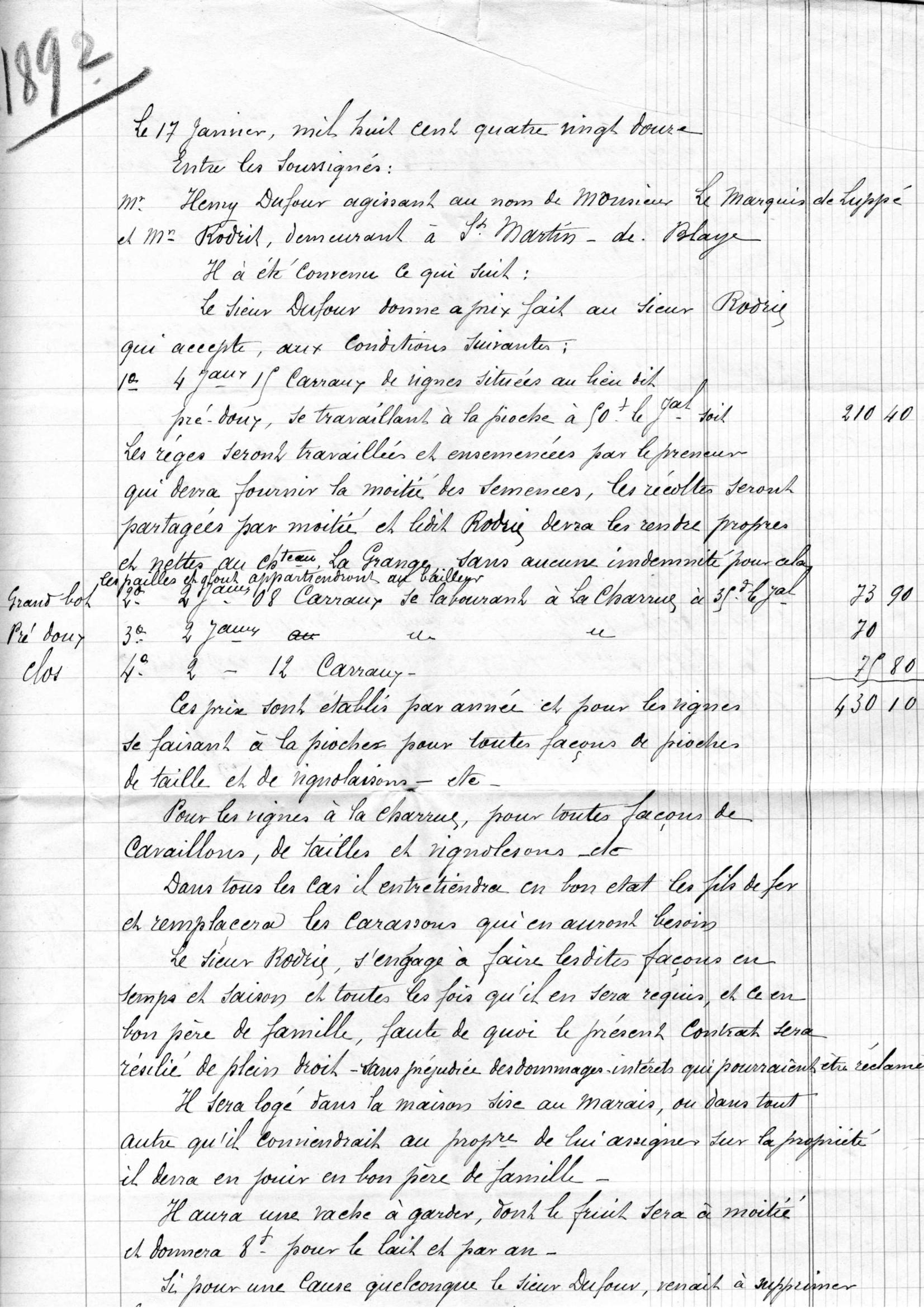
The 17th of January, one thousand eight hundred and ninety-two.
Between the undersigned: Mr Henry Dufour, acting on behalf of the Marquis de Luppé, and Mr Rodrie, residing in Saint-Martin-de-Blaye. It has been agreed as follows: the said Mr Dufour leases on a prix-fait basis to Mr Rodrie, who accepts, under the following conditions:
1° 4 journaux ½ carraux of vines located at the locality known as Pré-douy, worked by hoe, at 50 F per journal, amounting to 210.40 F. The vines shall be worked and sown by the tenant, who must supply half of the seed; the crops shall be divided equally, and the said Rodrie must deliver them clean and sound to Château La Grange, without any compensation for doing so. The straw and chaff shall belong to the lessor.
2° Grand-Bois — 2 journaux 8 carraux ploughed with the plough, at 35 F per journal, amounting to 73.90 F.
3° Pré-douy — 2 journaux in the said locality, 70 F.
4° Clos — 2 journaux 12 carraux, 75.80 F.
Total: 430.10 F.
These prices are set per year, for vines worked by hoe: all hoeing, pruning, and cane-tying operations, etc. For ploughed vines: all unearthing (cavaillons), pruning, and cane-tying operations, etc. In all cases, he shall keep the trellis wires in good order and replace any carassous that require it.
Mr Rodrie undertakes to perform the said operations in due time and season, and whenever required, with due diligence, failing which this contract shall be terminated as of right, without prejudice to any damages that may be claimed.
He shall be housed in the cottage situated in the marsh, or in any other dwelling the owner may deem appropriate to assign to him on the estate; he must occupy it with due care. He shall be given a cow to keep, whose produce shall be shared equally, and he shall pay 8 F per year for the milk. If, for any reason whatsoever, Mr Dufour should withdraw the cow, Mr Rodrie shall not be entitled to any indemnity. He must mow at his own expense the hay and rye thatch needed to feed and care for the cow during the winter; the manure shall remain and belong to the proprietor.
Not included in the above prices are the debudding and lifting operations, which shall be paid at the rate of 3 francs per journal for the first pass. Should it be necessary to debud and lift a second time, this latter operation shall be paid at only 1.50 F per journal. The pulling out of old vine wood shall be paid at 1 F per journal.
Mr Rodrie shall bundle, tie, and carry the vine shoots to each headland; in return for this, he shall receive half of the shoots. Should his half yield an excess, the lessor shall purchase them from him at the rate of 10 F per hundred. Mr Rodrie shall receive one barrel of piquette per journal of vines worked by hoe, and half a barrel per journal worked by plough. Mr Rodrie must carry into the vats the water required to make the quantity of piquette to which he is entitled.
The avenues contained within the said prix-fait must be cleaned immediately after the final operation, or earlier if necessary. These terms shall take effect from the upcoming feast of Saint-Roch, and should either party wish to withdraw, six months' notice must be given prior to the expiration of the current year.
Outside the prix-fait, Mr Rodrie must work on behalf of the château whenever requested; his daily labour shall be paid at 2 F per day. Furthermore, the present conditions are made in accordance with custom.
Drawn up in duplicate and in good faith at Château La Grange, on the day, month, and year written above. Plus 1 barrel of rapière. — Rodrie / Dufour
These two contracts remind us that in Bordeaux, viticulture was first and foremost a craft of the hand: hoeing, pruning, tying, debudding, trellising, removing dead wood — gestures paid by the journal, carefully measured and shared. At Château Cazebonne, we recognise ourselves in this culture of meticulous care. We farm biodynamically on a parcel-by-parcel basis, with a team that still tends the vineyard by hand, with due diligence — to borrow the phrase found in both contracts binding us to these essential vineyard tasks. This philosophy guides our winemaking approach.
Château Cazebonne is firmly committed to replanting these resilient, heritage grape varieties in order to reintroduce forgotten ampelographic diversity to Bordeaux and champion a sustainable model of viticulture. This long-term endeavour is supported by a community of enlightened wine enthusiasts. To learn more about this philosophy and the history of our vines, you can download our book "Bordeaux, a History of Grape Varieties". Feel free to test your knowledge about the world of wine or discover our wines available online, the fruit of this dedicated attention to our heritage and the future of our terroirs.
Sources
Our suggestions
-5%on your 1st order with code BIENVENUE
The essential6 bottles — Graves red 2022
The best price of the cellar: €12 per bottle delivered.
The everyday red: generous and straight to the point.
I want it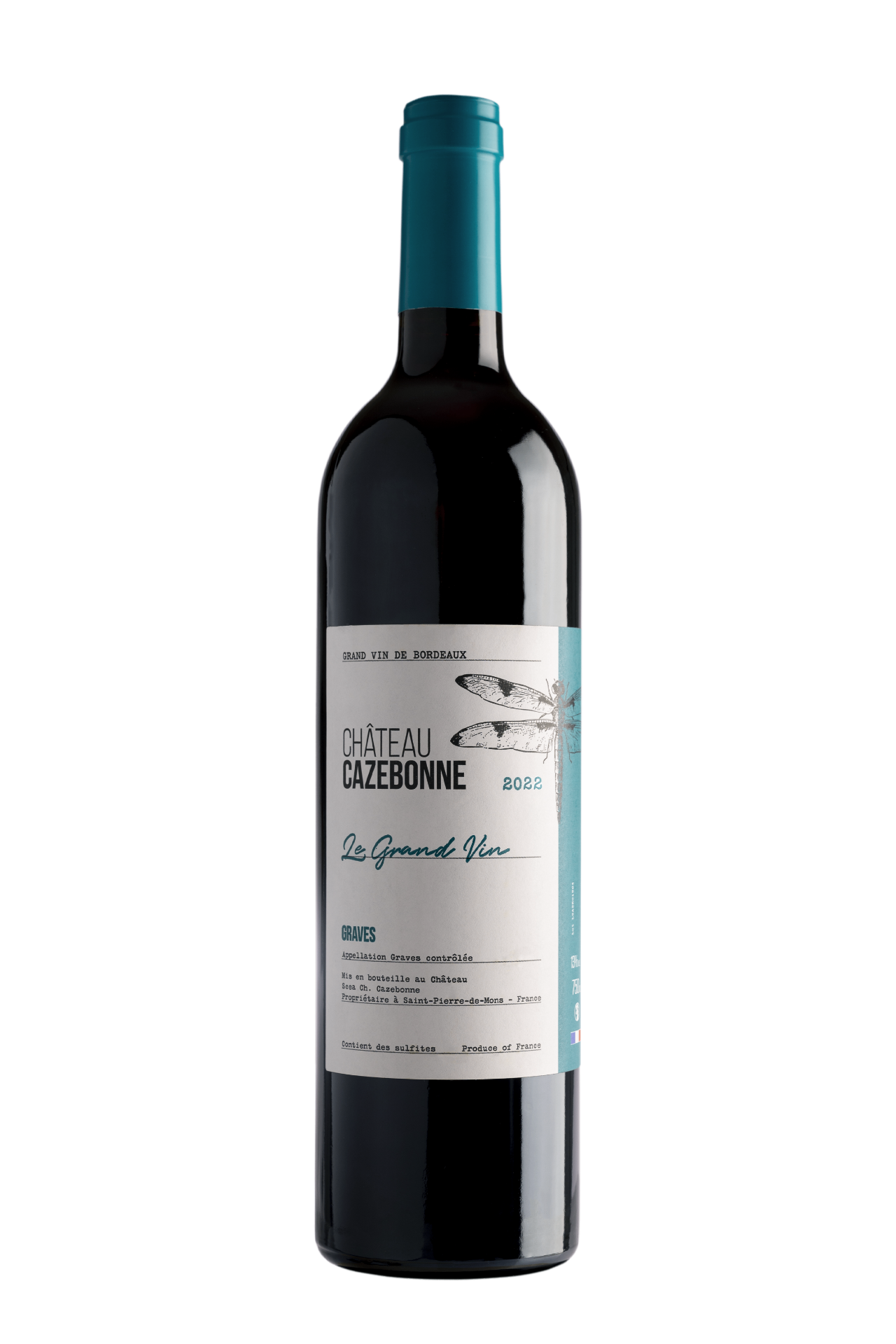 Our recommendation92/100 RVF
6 bottles — Graves red 2022, 92/100 RVF
Rated 92/100 by La Revue du vin de France: a solid 10-year ageing potential.
Our Graves for ageing, the finest gateway to the estate.
I want it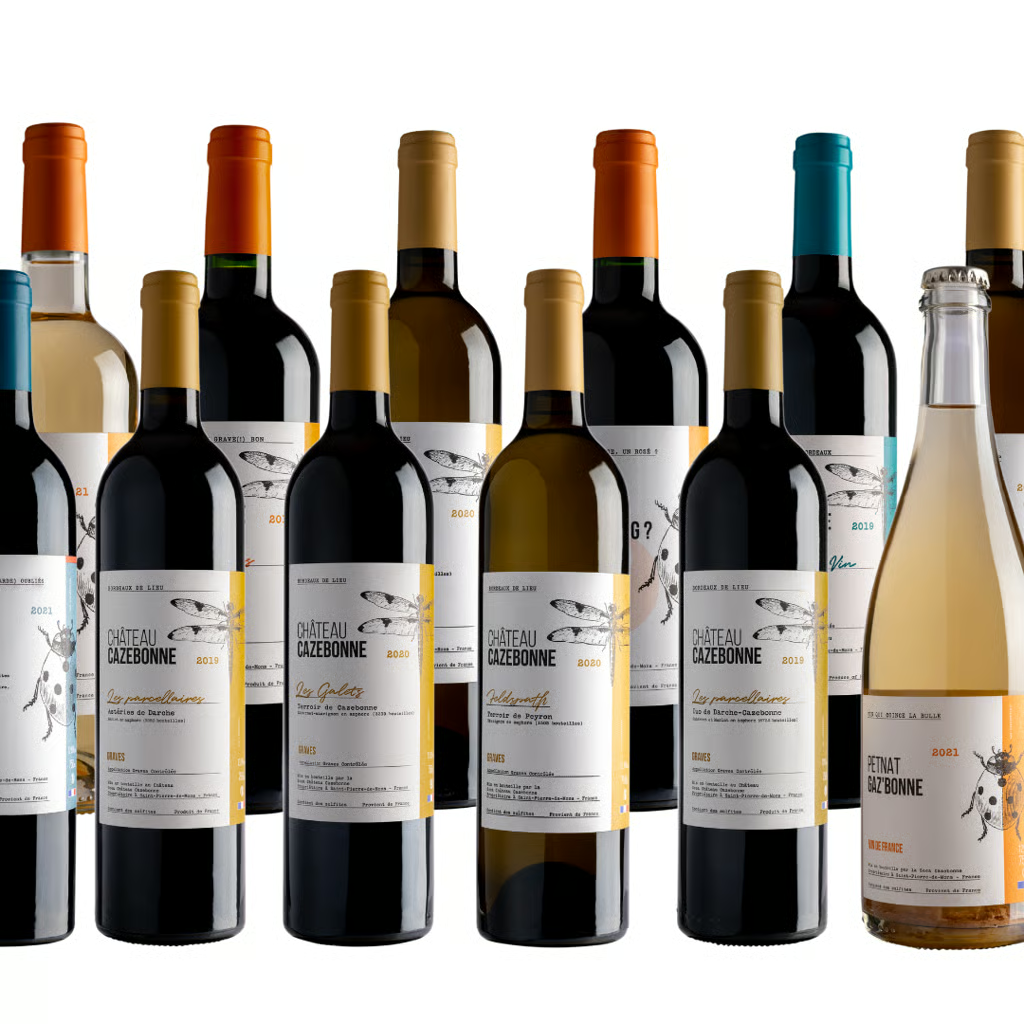 Go further
12 bottles — the whole range
12 bottles, the whole range tasted: the best discovery-to-price ratio.
The complete tour of the estate, in a single case.
I want it