
26 January 2021
Merlot, not such an ancient grape variety!

Pierre Galet, in an interview with the RVF in 2015, stated: ‘Before the 19th century, Merlot was considered merely a secondary grape variety. It was not even mentioned on the list of grape varieties of the subdelegation of Pauillac, nor in Jullien's book in 1816. The first description was made in 1857 by Rendu in his book, where he mentions “that it pairs well with Malbec and Cabernet Sauvignon and that it is accepted in the grands crus of the Médoc”. In Dupré de Saint-Maur's inventory (1783-84), in the subdelegation of Libourne (and not Pauillac), a grape variety was nevertheless recorded under the name Merlau.’
In the 19th century, Odart, then Petit-Lafitte, recorded it. The grape variety proved relatively resistant to powdery mildew (oïdium), which led to its expansion in the vineyards from 1850 onwards, even though its susceptibility to coulure, and later to downy mildew (mildiou), subsequently slowed its development.
In Féret in 1874, its qualities were recognised: ‘A sapid, mellow and fragrant wine, though not to the same degree as wine from the Cabernets; however, it matures earlier than the latter and will be preferred at two or three years of age, owing to its finesse, suppleness and charm; but it does not improve as much with age and demands good harvest conditions.
Blending roughly equal proportions of Merlot wine with Cabernet-Sauvignon and gros Cabernet yields a wine full of body, richness, finesse and bouquet.
Being little prone to powdery mildew, this grape variety is very productive and usually combines quality with quantity; thus it is spreading further day by day.’
Confirmed slightly later in Viala and Vermorel: ‘The juice of this grape variety yields a wine that is superior from all points of view, but especially remarkable for its bouquet, sapidity, mellow texture and high alcohol content. Blended with other wines, it enhances their finesse and bouquet. It deserves a better place in our vineyards, despite its regrettable tendency to coulure. It must be noted that, even in the best conditions, it yields only an average crop.’
The only reservation regarding this grape variety: ‘Let us reiterate that its fruit, ripening quickly and rotting just as rapidly at the slightest rain, must be picked promptly and at peak ripeness to achieve good results.’ At the time, of course, there were no harvesting machines to speed up the Merlot harvest if required.
In 1832, Jullien wrote: ‘The fine wines of Saint-Emilion and the Côte de Fronsac are produced by the grape varieties known as vidures and Malbek.’ Still no mention of Merlot in the Libournais.
At the end of the 19th century, Merlot was not yet the king of grape varieties we know today, and here is what Féret noted in 1874: ‘Merlot accounts for ¼ of the vineyards in the Bas-Médoc. In Entre-Deux-Mers and the Blayais, it shares the ground left open by Malbec with Mancin, Grapput (Bouchalès) and Pardotte.’ Malbec then held the primary position in Bordeaux vineyards, with the exception of the Médoc, where ¾ of the plantings were Cabernet (and probably Cabernet-Sauvignon).
Merlot underwent a major expansion during the replanting of the vineyards in the early 20th century, regaining ground from Malbec. In the 1960s, the necessary reconstruction of the vineyard following the 1956 frost definitively enabled Merlot to become the leading red grape variety planted in Gironde, particularly as the 1953 laws had rendered the replanting of Mancin, Castets, Bouchalès and Saint-Macaire, among others, virtually impossible.
Merlot has also been known as Merlau, Bigney, Vitraille and Sémillon rouge.
Merlot is a cross between Magdeleine noire des Charentes and Cabernet Franc. Through Magdeleine noire, it is also a half-sibling of Malbec.
The variety has mid-season bud break and reaches mid-period maturity. Its vigour can lead it to produce numerous water shoots.
It thrives on clay-limestone soils, which retain sufficient moisture throughout the summer.
Engraving from the Ampélographie by Mas and Pulliat.
Further reading: The Merlot Grape
Our suggestions
Treat yourself
-5%on your 1st order with code BIENVENUE
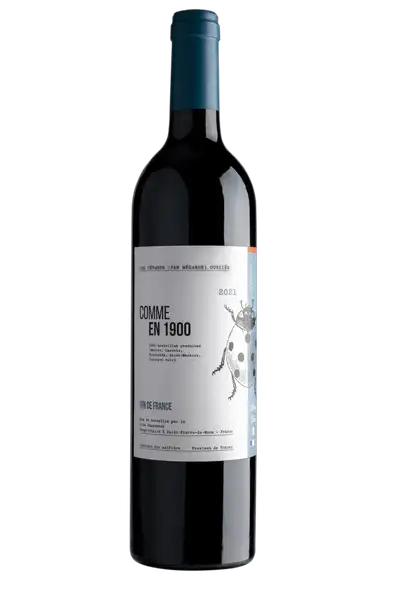 The essential92/100 RVF
Comme en 1900 red 2022
Vin de France — heritage grapes, 92/100 RVF
The pre-phylloxera Bordeaux blend, revived at the estate.
Castets, Mancin, Pardotte: the Bordeaux before Bordeaux.
I want it Our recommendation
La Dame Noire 2023
IGP Atlantique — rare grape variety
A forgotten grape brought back: dense colour, wild fruit.
For the curious about lost grape varieties.
I want it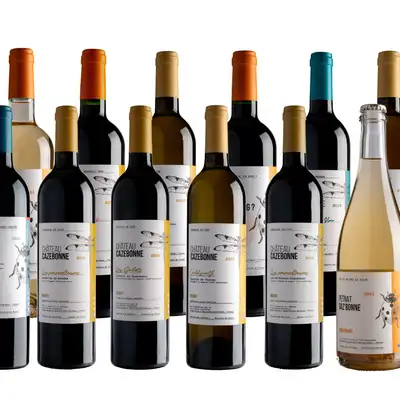 Go further
Discovery case, 12 bottles
12 bottles — the whole range
12 bottles, the whole range tasted: the best discovery-to-price ratio.
The complete tour of the estate, in a single case.
I want it