
29 December 2020
Preface or Why write this book
Like any wine lover, I have devoured countless books in order to understand the appellations, the terroirs, the grape varieties, and the people who create all the diversity of French vineyards. I learned that Cabernet Sauvignon thrived on the gravel soils of the Left Bank, that Merlot found its favoured ground on the clay-limestone soils of the Dordogne's Right Bank, and that Sémillon was the great grape variety of Sauternes.
Bordeaux wine built its worldwide reputation on 5 red grape varieties and 3 white grape varieties. Merlot, Cabernet Sauvignon, Cabernet Franc, Malbec, and Petit Verdot. 6 grape varieties if we include Carménère, which is permitted but has practically disappeared from our vineyards.
And Sauvignon, Sémillon, and Muscadelle for the whites.
Yet, contrary to popular belief, this history is a recent construct—a consequence of the introduction of the Appellation d'Origine Contrôlée system from 1935 onwards, and effectively established following the frosts of the winter of 1956, which destroyed nearly half the grapevines in Gironde.
For 5 years now, I have been working to piece this puzzle together, tracing what happened and understanding the reasons governing the selection of these quality grape varieties.
And one cannot understand the decisions made without delving into the history of Bordeaux wine and, more recently, into the successive crises the vineyard has endured since the mid-19th century: the arrival of powdery mildew (oïdium), the phylloxera crisis, the emergence of downy mildew, overproduction crises, the First World War... The French vineyard shifted from a laissez-faire approach where winegrowers planted whatever they wished, to state interventionism that culminated in the establishment of the AOCs.
Today, the system appears frozen around the AOCs, and attempts to reintroduce grape varieties into our appellations remain timid. Yet the challenges facing the winegrower are numerous: climate change, consumer rejection of pesticides, declining consumption in Western countries. I am convinced that our ampelographic heritage offers us opportunities, enabling us to respond to consumer expectations while drawing on our history to revisit the taste and the future of Bordeaux wine.
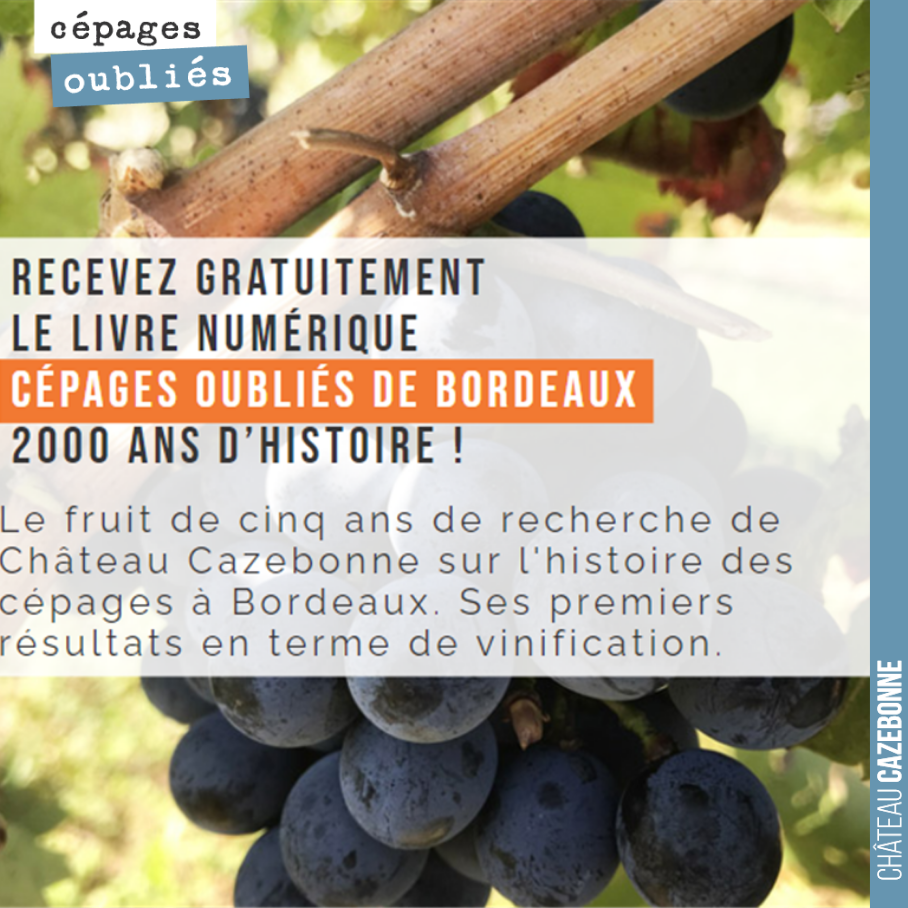
To receive our upcoming book, sign up on our website:
www.cazebonne.fr
Our suggestions
Treat yourself
-5%on your 1st order with code BIENVENUE
 The essential92/100 RVF
Comme en 1900 red 2022
Vin de France — heritage grapes, 92/100 RVF
The pre-phylloxera Bordeaux blend, revived at the estate.
Castets, Mancin, Pardotte: the Bordeaux before Bordeaux.
I want it Our recommendation
La Dame Noire 2023
IGP Atlantique — rare grape variety
A forgotten grape brought back: dense colour, wild fruit.
For the curious about lost grape varieties.
I want it Go further
Discovery case, 12 bottles
12 bottles — the whole range
12 bottles, the whole range tasted: the best discovery-to-price ratio.
The complete tour of the estate, in a single case.
I want it