30 December 2019
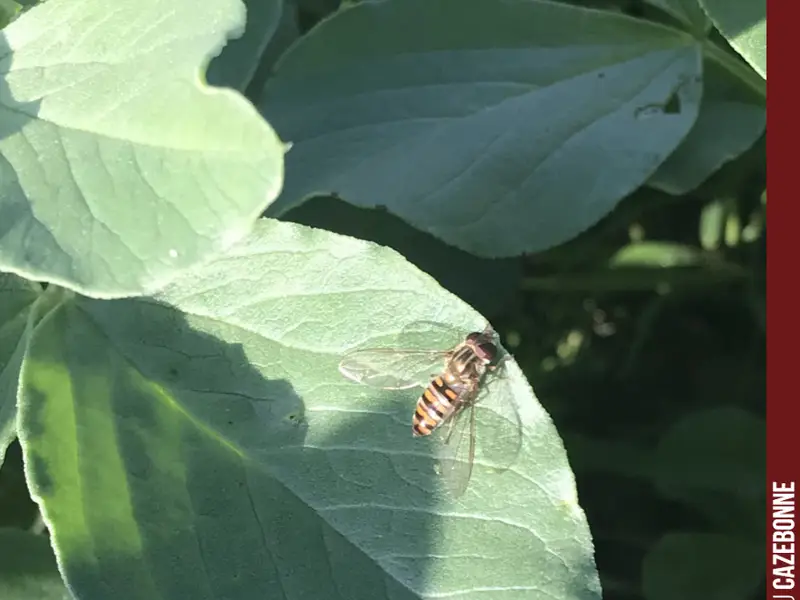
A little hoverfly on a field bean leaf……It is said that the hoverfly disguises itself as a wasp to deter predators, but that is not the case: it is simply a fly.
By Jean-Baptiste Duquesne

Hoverfly
The hoverfly, commonly known as the "flower fly", is an essential insect for the balance of our ecosystems, particularly in the vineyard. A member of the Syrphidae family, which comprises around 6,000 species, it is often mistaken for a bee or a wasp due to its yellow and black stripes and its hovering flight. However, the hoverfly is distinguished by its more slender, less hairy body, a single pair of wings, and short antennae.
The life cycle of the hoverfly unfolds in several stages, each playing its own role. Adults, present from spring throughout the summer, feed primarily on nectar and pollen. Their activity actively contributes to the flowering and pollination of plants surrounding the vines. It is the hoverfly larvae that offer the greatest benefit to the vine grower: true voracious predators, they feed greedily on aphids that attack young vine shoots, thereby preserving the health and vigour of the plant.
The hoverfly prefers environments rich in floral diversity to find nectar and pollen, as well as an abundance of aphids for its larvae. At Château Cazebonne, we encourage the presence of hoverflies by maintaining cover crops between the vine rows, and cultivating hedgerows and flowering areas. These features create indispensable habitats and food sources for this insect, as well as for other beneficial insects such as ladybirds and mason bees. This holistic approach reflects our commitment to promoting biodiversity and adopting sustainable viticulture in harmony with natural cycles.
The benefits of hoverflies in our vineyards are manifold. As adult pollinators, they support floral biodiversity. Their larvae, meanwhile, provide natural and effective biological control against aphids, reducing the need for external interventions. The presence of hoverflies is an excellent indicator of the ecological health of our terroir and bears witness to the balance we strive to maintain. Look out for these "drone flies" during your visits to Cazebonne: their elegant silhouette and agile flight are a fascinating sight.
The rigorous and rewarding work of ecosystem restoration and conservation at Château Cazebonne is made possible thanks to the unwavering support of the many enthusiasts who enjoy our wines and share our vision of respectful, sustainable viticulture intrinsically linked to the richness of its environment. Download the digital edition of the essential book "Bordeaux, une histoire de cépages", which charts our journey and that of the Bordeaux vineyard, test your wine knowledge with our wine quizzes, and discover the expression of our terroirs by exploring the Cazebonne shop.
30 December 2019
By Jean-Baptiste Duquesne
27 June 2019
By Jean-Baptiste Duquesne
The cellar, forgotten grape varieties and our cuvées, twice a month. 5% off your first order with the code BIENVENUE.