The essential
6 × Entre Amis red
6 bottles — Graves red 2022
The best price of the cellar: €12 per bottle delivered.
The everyday red: generous and straight to the point.
I want itMason bee
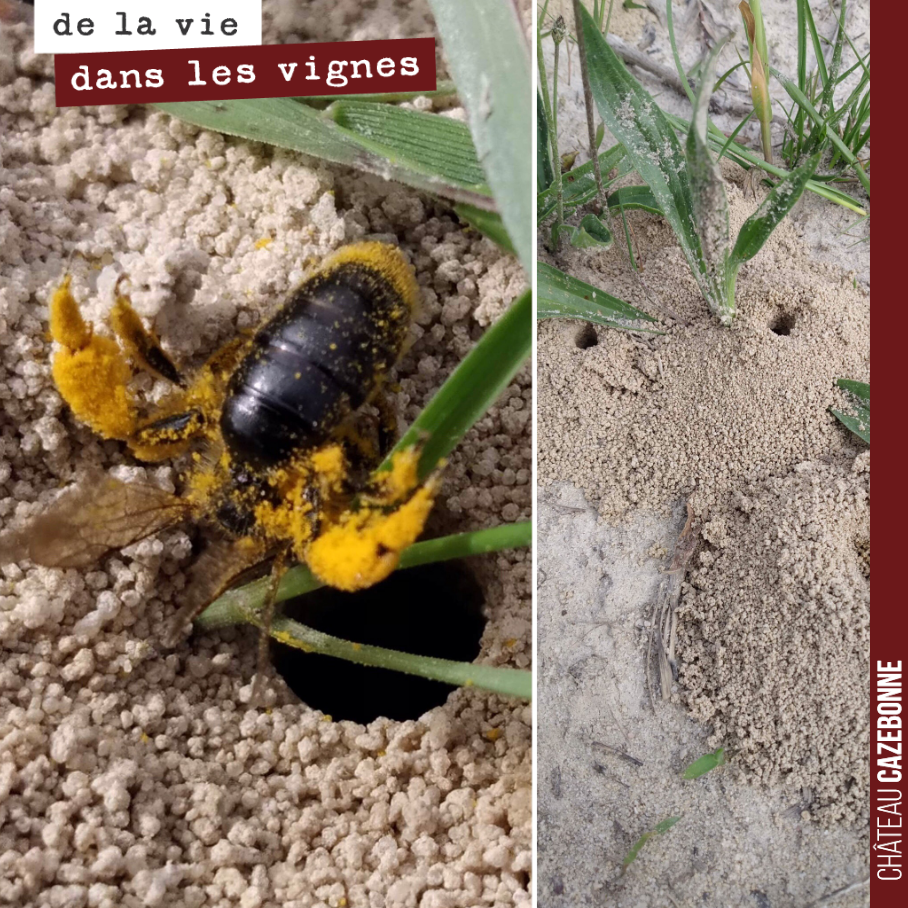
Among the multitude of insects that inhabit our vineyards, the mason bee (genus Osmia) holds a special place. Often unknown to the general public, this small solitary bee is nevertheless a precious ally for the biodiversity and balance of our terroirs at Château Cazebonne. Unlike the honey bee which lives in a colony, the mason bee builds its nest individually, often in small cavities, wall cracks (hence its name!), or even hollow stems. This unique nesting behaviour makes it a fascinating observer of our landscapes' natural resilience.
Its essential role lies in its tremendous pollination capacity. Although it does not produce honey, the mason bee forages on a wide variety of flowers, transporting pollen from one plant to another with remarkable efficiency. In a vineyard like ours, where the surrounding flora is diversified to promote a healthy ecosystem, its presence is crucial. It actively participates in the reproduction of plant species that enrich the soil, feed other insects, and provide shelter. This discreet but fundamental work is a pillar of our approach to sustainable viticulture, as so well explained by Jean-Baptiste Duquesne in his book "Bordeaux, une histoire de cépages" (Éditions BBD), where he highlights the interdependence of the plant and animal kingdoms within Bordeaux vineyards.
At Château Cazebonne, we encourage the presence of the mason bee by installing specific nesting boxes, simple bundles of hollow stems, or wooden blocks drilled with holes. These simple, yet concrete actions allow these tireless builders to find suitable nesting sites, thereby helping to strengthen the pollinator population. This approach is emblematic of our desire to restore a natural balance in our vines. By protecting and promoting auxiliary fauna like the mason bee, we contribute to the health of our plots and the typicity of our wines.
The mason bee, of the genus Osmia, is a small to medium-sized solitary bee (6 to 15 mm). It generally has a stocky body, often covered in dense hair in various colours: black, blue-green, or even russet. Its powerful mandibles are adapted for handling construction materials for its nests. It can be observed in the Château Cazebonne vineyard mainly in spring and early summer, a period during which it is most active in building its nests and collecting pollen. Each female builds and provisions several larval cells independently.
Mason bees are pollination champions. Unlike the honey bee, they are less selective and forage on a wide variety of flowers, including those of fruit trees and crops. In our vines, they are particularly important because they participate in maintaining a diverse flora, which is essential for a balanced ecosystem. They nest in existing cavities, such as holes in wood, hollow stems, or wall crevices, and use mud or earth to seal the entrances of their nests. At Cazebonne, they often occupy the nesting boxes we have set up for them and can also be found near the plots or in the wooded areas and hedgerows bordering our vines.
The mason bee's interaction with the vine is largely beneficial. As a generalist pollinator, it indirectly contributes to the health of the viticultural ecosystem by ensuring the reproduction of many surrounding wild and cultivated plants. This promotes better soil structure and offers resources (food and shelter) for other animals and auxiliary insects. Although it does not directly pollinate the vine (which is anemophilous, meaning it is wind-pollinated), its presence is an indicator of the vineyard's good health and biodiversity, which are fundamental elements of our commitment to biodynamics.
It is thanks to this global philosophy that we are also able to carry out our project of replanting forgotten grape varieties in Bordeaux, which had disappeared from the viticultural landscape. This conservation and reintroduction work is made possible by the unwavering support of the many enthusiasts who have adopted our wines and share our vision of a respectful, sustainable viticulture intrinsically linked to the richness of its ecosystem. To deepen your knowledge of our history and Bordeaux's rich wine heritage, we invite you to download the digital version of the book "Bordeaux, une histoire de cépages", published by Éditions BBD and written by Jean-Baptiste Duquesne, test your wine knowledge with our oenological quizzes, or discover the expression of our terroirs and our philosophy.
Sources
Our suggestions
-5%on your 1st order with code BIENVENUE
The essential6 bottles — Graves red 2022
The best price of the cellar: €12 per bottle delivered.
The everyday red: generous and straight to the point.
I want it Our recommendation92/100 RVF
6 bottles — Graves red 2022, 92/100 RVF
Rated 92/100 by La Revue du vin de France: a solid 10-year ageing potential.
Our Graves for ageing, the finest gateway to the estate.
I want it Go further
12 bottles — the whole range
12 bottles, the whole range tasted: the best discovery-to-price ratio.
The complete tour of the estate, in a single case.
I want itThe cellar, forgotten grape varieties and our cuvées, twice a month. 5% off your first order with the code BIENVENUE.