At the heart of the creation of every bottle of Château Cazebonne lies the cellar, a place where the magic happens and where the grapes, the fruit of our carefully cultivated vines, metamorphose into wine. This crucial stage, much more than a simple transformation, is a true symphony that requires constant attention, sharpened technical skills and a subtle interpretation by the winemaker.
From harvest to wine: key stages and delicate processes
The journey of the grape to wine begins at the harvest, where the quality of the raw material is paramount. Once in the cellar, every single berry is treated with respect. The fermentations, alcoholic (alcoholic fermentation) then malolactic (malolactic fermentation), are delicate phases where the action of yeasts and bacteria will release the aromas and flavours specific to the terroir and the grape variety. At Château Cazebonne, we favour gentle and natural methods, seeking to extract the best from the fruit without ever rushing it. It is in this meticulousness that the essence of our approach lies: letting the wine make itself, while guiding it with our ancestral know-how. The effluent management resulting from these operations is also a constant preoccupation to ensure respect for the environment.
Alcoholic fermentation: an essential transformation
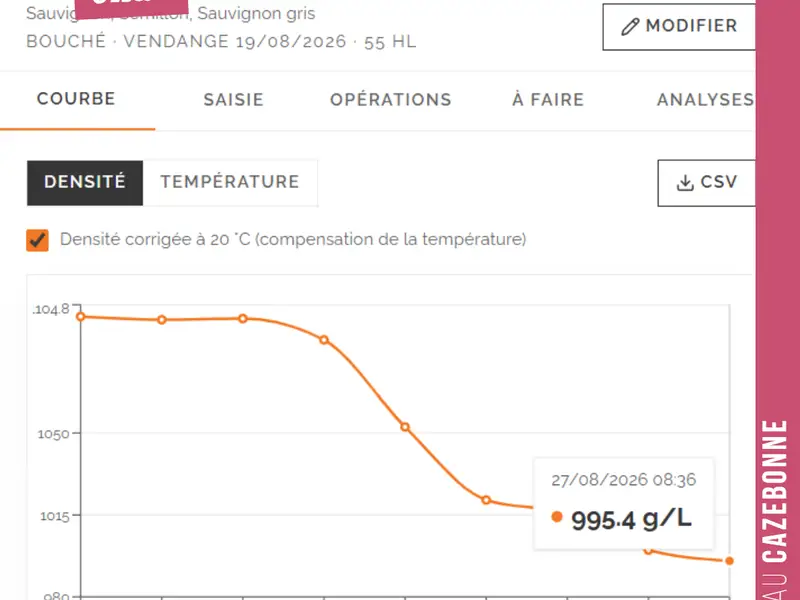
Alcoholic fermentation is the process by which the sugars in the grapes are converted into alcohol by the action of yeasts. This stage is crucial for the wine's aromatic profile and structure. Our winemakers closely monitor the temperatures and the density of the musts, adjusting the parameters to encourage a steady and complete fermentation that respects the expression of the fruit and the terroir. For a precise measurement of the density, we invite you to use a refractometer.
Malolactic fermentation: softening the wines
After alcoholic fermentation, most of our red wines, and sometimes certain whites, undergo malolactic fermentation. It is during this second transformation that the harsher malic acid is converted into softer lactic acid. This helps to soften the wine, bringing it additional aromatic complexity and better microbiological stability.
The expression of the terroir and forgotten grape varieties rediscovered in the cellar
Winemaking is the moment when the unique character of our Bordeaux terroir fully expresses itself, but it is also where an essential part of Château Cazebonne's identity is revealed: the rebirth of forgotten grape varieties. Faithful to the teachings of Bordeaux's viticultural history, as superbly detailed in the book "Bordeaux, une histoire de cépages" by Jean-Baptiste Duquesne published by Éditions BBD, we made the bold choice to replant these ancestral varieties that had disappeared from the regional vineyard plantings. Castets, Mancin, Pardotte, Bouchalès... so many names that resonate with history and which, thanks to our work in the cellar, are now finding their place in our blends again. Each wine is a story, a tribute to this rediscovered heritage.
This demanding approach is only possible thanks to the unwavering support of the many wine lovers who have adopted our wines and share our passion. It is their trust that drives us to pursue this quest for authenticity and excellence. To deepen your knowledge of Bordeaux grape varieties and our philosophy, we invite you to download the digital version of the book "Bordeaux, une histoire de cépages" via our dedicated page, and to test your knowledge with our oenological quizzes. Discover the full range of our creations by visiting our online shop.