
10 ans
Ten Years of Commitment
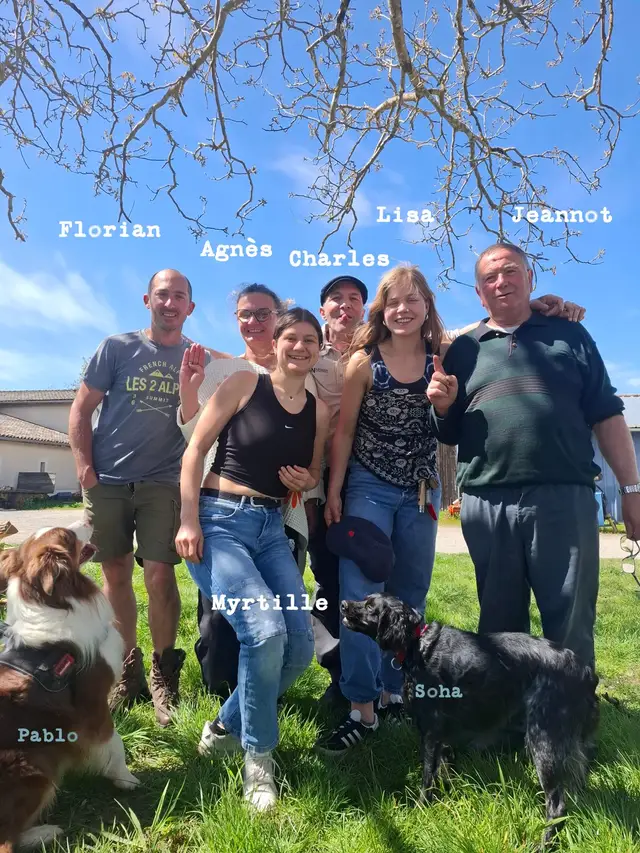
2026 marks my tenth harvest at Château Cazebonne. Ten years already.
Ten years of joys, of trials...
From day one, I had only one idea in mind: to replant all the grape varieties that once existed in Bordeaux. It was Robert Plageoles, in Gaillac, who planted this seed in my mind during a visit to his estate in the mid-1990s. I left thinking that if I ever took over a wine estate, I would work on old, historic grape varieties.
In 2016, when I arrived at Cazebonne, I asked the old-timers what had been in our vineyards previously. No one gave me a satisfactory answer.
So, I began searching through 18th and 19th-century literature.
And I rediscovered 5, then 10, then 20, then 50 grape varieties...
I even wrote a book about it (Bordeaux, une histoire de cépages, published by Editions BBD), because Bordeaux deserves for this history not to be forgotten.
Putting Down Roots
I took over vineyards in Saint-Pierre-de-Mons, near La Réole, where I spent my childhood. It was a return to my roots; my father was a farmer there, yet I had sworn I would never become a farmer myself.
But one never truly forgets their roots. So, when I sold the recipe website 750g, which I had created with my brother and some friends, I wanted to become a winemaker. A career change at 45, even though I didn't know how to make wine, let alone manage a vineyard.
I took over the property from Jean Sourget (and a few plots from Jean-Marc Bridet). Jean still lives in Peyron and provides invaluable help in preserving the history of this place and understanding its terroirs.
Building a Team
To carry out this project, I needed a team, committed men and women who shared this adventure, who would become passionate about this quest which some might see as futile: replanting all the grape varieties that once existed in Bordeaux.
Today, I am well supported by Florian, Bruno, Philippe, Agnès, Lise, Myrtille...
This is what makes the project possible, even if success is still far from guaranteed.
For my part, ten years on, I am still learning. How to better cultivate the vines, how to make wines that reflect this place and us, and how to tame these grape varieties about which we know so little in the end.
It's also important not to be alone; our involvement with the Bordeaux Pirate collective allows us to exchange ideas, support each other, and lend a hand when we can. One is far too alone in this profession. For the past three years, I have also been involved with the 'Extra-terrestres' collective, a group of neo-winemakers who settled down late in life after another career. 'But what were they getting themselves into?', some might wonder.
Turbulent Beginnings
2017: frost,
2018: hail,
2019: three minor hail episodes,
2020: drought,
2021: frost
And finally, a harvest in 2022. A magnificent vintage that we are delighted to be marketing today.
It's tough to start with such a succession of climatic incidents.
A triple blow:
- learning less from these years with little or no harvest,
- having no wine to sell to build a customer base,
- cumulative financial losses that began to jeopardise our future.
We haven't lost everything. We've learned a lot. Especially what needs to be done to help the vines cope with these crises.
Our work, our unique DNA, has been noticed by both enthusiasts and critics,
We have started to build a brand.
I used to say for a long time that we were 'the best-known château in Bordeaux among those whose wines no one had ever tasted'.
Our work has been recognised by the Revue du Vin de France, with a star in the Guide Vert for the second consecutive year.
Fortunately, we are making up for lost time, and we are going from fair to fair, from wine merchant to wine merchant, to let people taste our wines.
To show that a new Bordeaux is emerging in Bordeaux. A Bordeaux that has learned from its mistakes and wishes to connect with the hearts of wine lovers!
2026: A Rollercoaster Year...
The year began with H&A Location being placed into judicial liquidation. This company had secured the financing for our barrels from a bank.
Each year, we could order barrels and amphorae from our suppliers. It ensured payment of the invoices. On our side, we repaid the bank.
In 2026, their collapse did not extinguish the debt to the bank. We still had to pay our instalments, but the cooper had not been paid and turned to us for payment.
A loss of over €50,000 for our estate. A difficult challenge to overcome for a young estate like ours. Fortunately, you were there for us during these difficult times.
The harvest brought rays of sunshine. Despite the heatwave, yields were comfortable and quality very promising. It is this 2026 stock that will allow us to get back on track in the coming years. We could not afford for another harvest to be affected.
And for the Next 10 Years...
These past ten years have been rich. They have shaped our DNA and shown us that we know how to navigate through storms.
For a time, I considered putting our project to replant Bordeaux's forgotten grape varieties on hold. But upon reflection, that was not an option. In 2026, against all odds, we grafted 25 white grape varieties into our conservatory, and in 2027, we will graft the red ones.
Our wine is not just unique; it embodies a history. We must not lose this heritage, especially in an era of climate change.
And in 2026, post-vinification lot tastings show the excellence of some of these grape varieties: a Bouchalès that retains freshness, an expressive Saint-Macaire, a Jurançon Noir with contained alcohol content, a Mancin as elegant as ever...
And we still have 50 grape varieties to discover.
I am proud of our work, I am proud of my team, and I am proud of our wines.
Sources
- Bordeaux, une histoire de cépages — Jean-Baptiste Duquesne, Éditions BBD
News from the estate
The cellar, forgotten grape varieties and our cuvées, twice a month. 5% off your first order with the code BIENVENUE.