The essential
6 × Entre Amis red
6 bottles — Graves red 2022
The best price of the cellar: €12 per bottle delivered.
The everyday red: generous and straight to the point.
I want itErinose
Amidst the phytosanitary challenges faced by vines, erinose is a common phenomenon, albeit of lesser severity compared to devastating diseases like downy mildew or powdery mildew. Caused by the microscopic mite Eriophyes vitis, also evocatively known as the vine leaf blister mite, this condition is the result of the activity of an arachnid barely visible to the naked eye. The latter colonises the buds and young leaves from the onset of spring, feeding on the plant's sap.
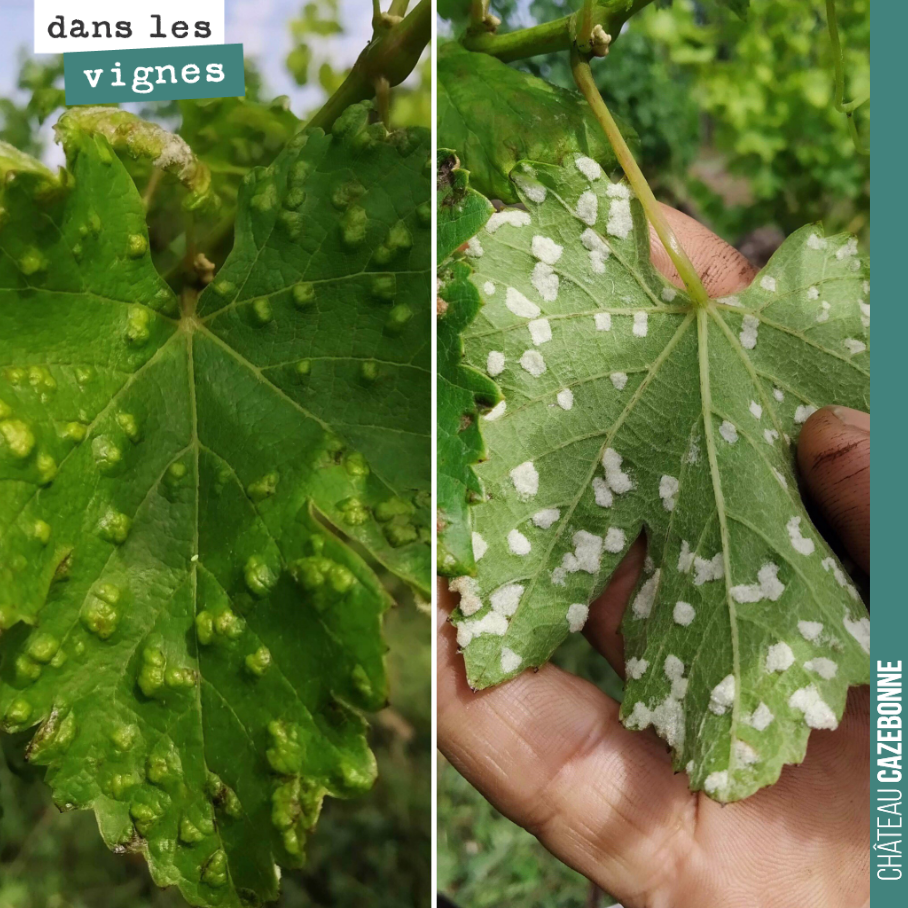
The symptoms of erinose are remarkably characteristic and allow for easy identification. On the upper surface of the leaves, we observe the appearance of swellings, blisters, or pustules, the colour of which can vary from greenish to yellowish, sometimes even reddish. The underside of these same leaves reveals a whitish, cottony felting, called 'erine'. This substance is nothing other than a mass of hypertrophied plant hairs, which the vine produces in reaction to the mite's bites. While these manifestations may appear impressive, their impact on photosynthesis and the ripening of the grapes is generally limited, except in cases of massive infestation on very young leaves.
At Château Cazebonne, our commitment to organic viticulture drives us to favour prevention and respect for the natural balance of our ecosystem. Good aeration of the foliage, achieved through adapted pruning, combined with careful and regular observation of our plots, are pillars in limiting the proliferation of erinose. We also use natural sulphur-based treatments, effective against powdery mildew, which opportunely also act against this mite. More broadly, we promote biodiversity within our vineyards, encouraging the presence of natural predators of Eriophyes vitis, which helps to keep populations under control without compromising the environment.
Our approach goes beyond the simple management of diseases and forms part of a quest for resilience for our vineyard, inspired by the lessons of the past. This is why we carry out meticulous work to research and replant ancient and forgotten Bordeaux grape varieties, a precious heritage explored in the book 'Bordeaux, une histoire de cépages' by Jean-Baptiste Duquesne. These historical varieties, often better adapted to their terroir and inherently more resistant to climatic hazards or diseases, constitute a major asset for the future and a source of unique aromatic diversity. This work helps to build a vineyard more resilient to diseases like esca or climate change.
This long-term work, fascinating and essential for the preservation of our viticultural heritage, is made possible thanks to your support. By choosing our cuvées, you actively participate in the rebirth of these Bordeaux treasures and the construction of a more resilient vineyard. Discover our wines made from these rare grape varieties and live the Château Cazebonne experience by visiting the Cazebonne boutique.
To further explore the fascinating history of Bordeaux grape varieties, we invite you to receive the digital version of the book 'Bordeaux, une histoire de cépages' by Jean-Baptiste Duquesne, published by Éditions BBD.
Erinose is a vine disease caused by a phytophagous mite, Eriophyes vitis, sometimes simply called the vine leaf blister mite. This organism belongs to the mite family and is distinguished by its microscopic size, making it invisible to the naked eye. This small arachnid measures between 0.16 and 0.2 mm long. Its fusiform body is yellowish-white and has only two pairs of legs located at the front, a characteristic of eriophyid mites.
The Eriophyes vitis overwinter as adults sheltered in the scales of the vine buds. From bud break in spring, they migrate to the young leaves and begin to feed. Their piercing activity on the leaf blade provokes a plant reaction that manifests as the formation of blisters on the upper surface of the leaves, often pale green, yellowish, or reddish in colour. On the lower surface, these blisters correspond to a dense, whitish felting called 'erine', composed of hypertrophied plant hairs. Several generations of mites can succeed one another during the growing season. Infestations are often more noticeable on young, highly vigorous plots.
Although visually spectacular, erinose is generally considered to be of little detriment to the long-term production of the vine, except in cases of very early and massive infestation on young leaves. At Château Cazebonne, we regularly observe the presence of erinose in our plots, mainly on the Cabernet Sauvignon and Merlot grape varieties, as well as on some of our ancient varieties. In accordance with our commitment to biodynamics, we favour management methods that respect the balance of the ecosystem. Good aeration of the foliage, thanks to careful pruning and desuckering, helps to limit humidity, which is unfavourable to the development of the mite. The use of sulphur, which we apply to combat powdery mildew, also has a natural acaricidal action on Eriophyes vitis. We also promote biodiversity within our vineyards to encourage the presence of natural auxiliaries, such as predatory mites (typhlodromes), which help to regulate erinose populations.
This long-term work, fascinating and essential for the preservation of our viticultural heritage, is made possible thanks to your support. By choosing our cuvées, you actively participate in the rebirth of these Bordeaux treasures and the construction of a more resilient vineyard. To discover the fascinating history of Bordeaux grape varieties, we invite you to download the digital version of our book 'Bordeaux, une histoire de cépages', then to test your knowledge with our oenological quizzes, and finally to discover our wines online in the Cazebonne boutique.
Sources
Our suggestions
-5%on your 1st order with code BIENVENUE
The essential6 bottles — Graves red 2022
The best price of the cellar: €12 per bottle delivered.
The everyday red: generous and straight to the point.
I want it Our recommendation92/100 RVF
6 bottles — Graves red 2022, 92/100 RVF
Rated 92/100 by La Revue du vin de France: a solid 10-year ageing potential.
Our Graves for ageing, the finest gateway to the estate.
I want it Go further
12 bottles — the whole range
12 bottles, the whole range tasted: the best discovery-to-price ratio.
The complete tour of the estate, in a single case.
I want itThe cellar, forgotten grape varieties and our cuvées, twice a month. 5% off your first order with the code BIENVENUE.