The essential
6 × Entre Amis red
6 bottles — Graves red 2022
The best price of the cellar: €12 per bottle delivered.
The everyday red: generous and straight to the point.
I want itGrape Berry Moth
Beyond the fungal diseases and trunk diseases that threaten the vine, other actors, more discreet but no less formidable, can compromise the harvest. Among them, eudemis (Lobesia botrana), more commonly known as the grape berry moth, is an insect whose presence is particularly monitored in the vineyards. This small lepidopteran, barely a few millimetres long, lays its eggs directly on the young grape bunches. These eggs then hatch into larvae, voracious caterpillars that feed on the developing grape berries.
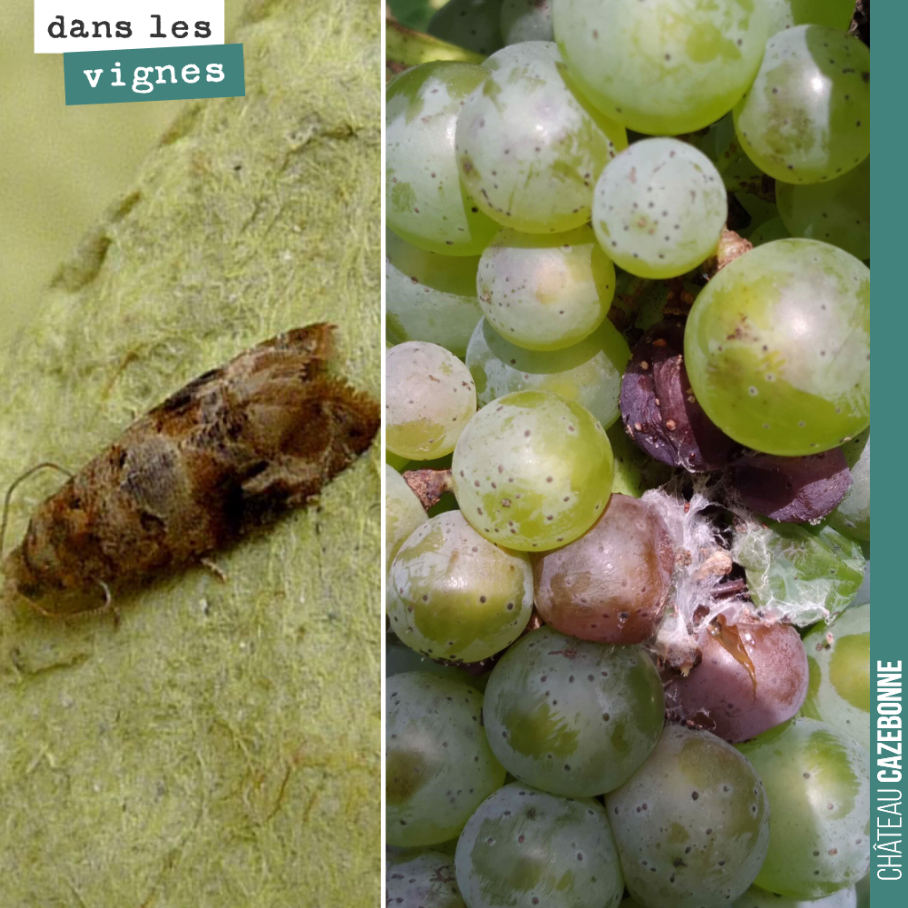
The damage caused by eudemis can be significant. By burrowing galleries into the berries, the larvae injure the grapes and create ideal entry points for the development of grey rot (Botrytis cinerea). These centres of rot, often hidden inside the bunch, spread rapidly, deteriorating the quality of the grapes and potentially leading to significant crop losses. Botrytis, although sometimes sought after for sweet wines, is a threat to dry wines, altering the aromas and clarity of the juice. Eudemis thus contributes to weakening the grapes, making the winegrower's task all the more delicate.
Small in size, the adult Lobesia botrana is a moth with a wingspan of about 6 to 8 mm, recognisable by its forewings marbled with brown, grey and ochre patterns, and its greyish hindwings. These colours provide it with excellent camouflage in the vineyard environment. Its larvae, on the other hand, are small pale green to pinkish caterpillars with a dark head, measuring up to 10-12 mm at maturity.
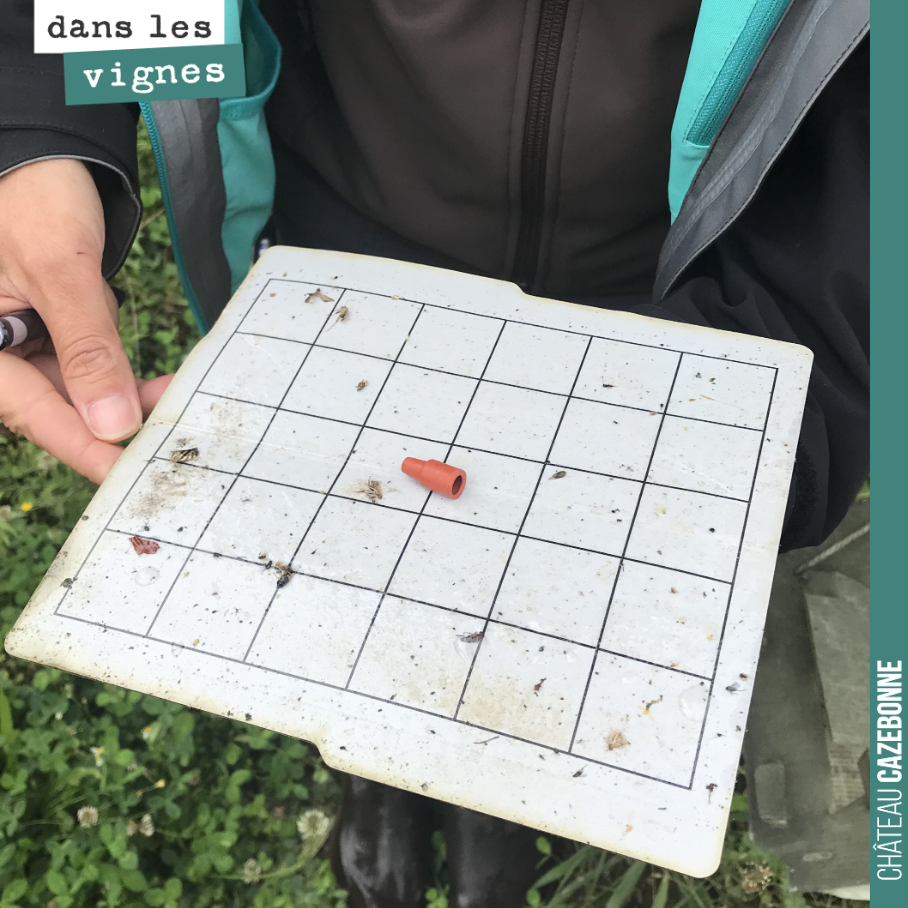
The life cycle of eudemis is characterised by development in several annual generations, generally two to three. The first generation of caterpillars feeds on the flower buds and young berries in spring (spring), while subsequent generations attack the bunches during the growth and véraison phases (summer). The females lay their eggs singly on the flowers or young berries. The insect overwinters as a chrysalis, often under the bark of the vines or in cracks. Monitoring moth captures using pheromones makes it possible to accurately determine flight and egg-laying periods, which is essential for effective control.
At Château Cazebonne, we observe eudemis mainly in the plots where the bunches are the tightest and the humidity conditions are favourable for the spread of botrytis. The insect does not show a marked preference for a particular grape variety, but its impact is more visible on thin-skinned varieties or when the vigour of the vine makes the bunches compact.
The ecological role of eudemis in its natural environment is that of a primary herbivore, participating in the insect food chain. However, in a viticultural context, its interaction with the vine is predominantly harmful. In addition to direct damage to the berries, the perforations caused by the larvae constitute ideal entry points for pathogens, notably Botrytis cinerea, responsible for grey rot. This indirect interaction is often the most detrimental to the quality of the harvest, especially with the objective of producing natural or biodynamic wines.
Controlling eudemis is a major challenge for winegrowers, particularly those committed to organic viticulture. At Château Cazebonne, we favour environmentally friendly methods to control this pest. Mating disruption, for example, consists of releasing female pheromones into the vineyard to disrupt the mating of male moths and thus reduce egg-laying. This highly specific and non-toxic technique preserves the biodiversity of our plots. Careful observation of the plots and cultural practices that promote biodiversity and ecosystem balance are all levers used to contain eudemis populations and preserve the health of our vines. We seek to establish a natural balance where the predators of eudemis can play their role, thus participating in the sustainable management of the vineyard.
The vineyard's resilience in the face of these attacks also requires a return to diversity. Bordeaux's viticultural history, richly detailed in "Bordeaux, une histoire de cépages" by Jean-Baptiste Duquesne, reveals how massal selection and genetic diversity were able to play a crucial role in the vine's ability to adapt and resist environmental pressures. At Château Cazebonne, we are committed to reintroducing old and forgotten grape varieties that once populated our terroirs. This approach, although long and demanding, aims to strengthen the biodiversity of our vineyard and give it a better capacity to adapt to various predators and diseases. This work to promote lost grape varieties is made possible thanks to the support of many wine lovers who, by tasting our wines made from these rediscovered treasures, actively participate in the revival of this viticultural heritage.
At Château Cazebonne, our commitment is to breathe new life into Bordeaux's viticultural heritage, notably by replanting old grape varieties that had disappeared, an approach you can explore in greater depth by downloading our book "Bordeaux, une histoire de cépages". This meticulous work is made possible by the support of all wine lovers who wish to discover forgotten flavours or test their knowledge via our oenological quizzes, and who inspire us every day to craft new wines, ready to be discovered in our online shop.
Sources
Our suggestions
-5%on your 1st order with code BIENVENUE
The essential6 bottles — Graves red 2022
The best price of the cellar: €12 per bottle delivered.
The everyday red: generous and straight to the point.
I want it Our recommendation92/100 RVF
6 bottles — Graves red 2022, 92/100 RVF
Rated 92/100 by La Revue du vin de France: a solid 10-year ageing potential.
Our Graves for ageing, the finest gateway to the estate.
I want it Go further
12 bottles — the whole range
12 bottles, the whole range tasted: the best discovery-to-price ratio.
The complete tour of the estate, in a single case.
I want itThe cellar, forgotten grape varieties and our cuvées, twice a month. 5% off your first order with the code BIENVENUE.