
06 September 2019
Every week, our oenological laboratory sends us statistics on grape juice analyses during harvest across the vineyards they monitor
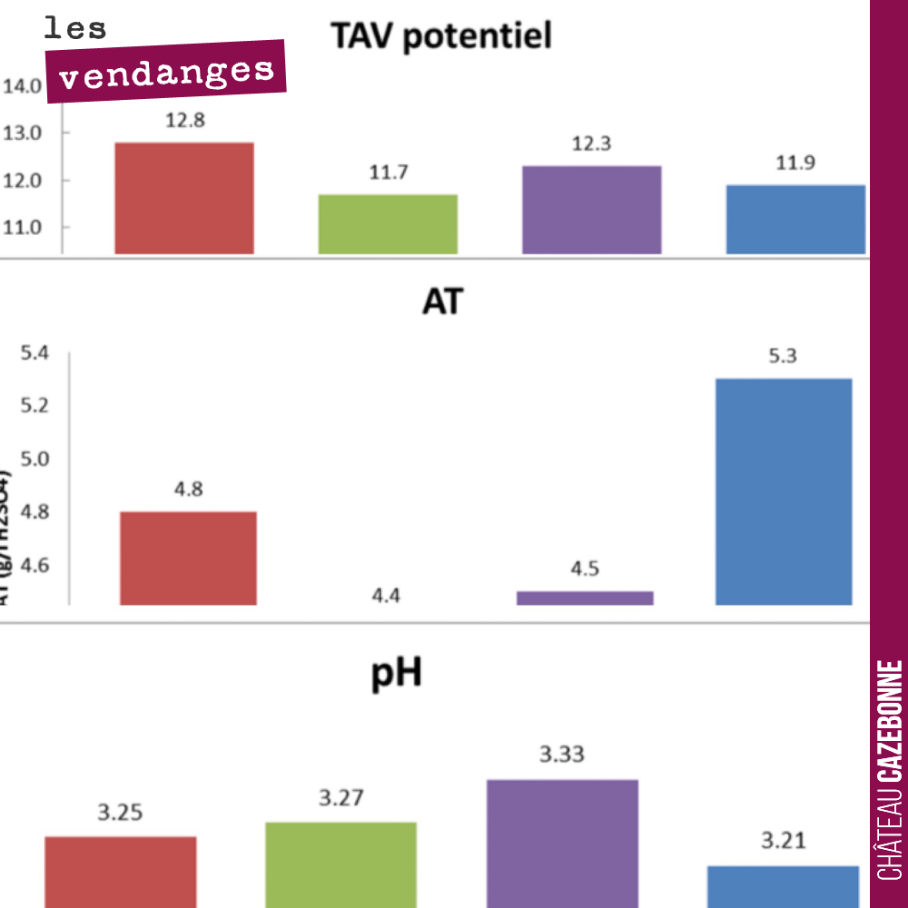
Here is the comparison for the Sauvignon grape variety, covering potential alcohol content, total acidity and pH, over the last 4 years on the same date (respectively 2016, 2017, 2018 and 2019).
We can see just how much vintages differ from one another. The winegrower seeks balance: enough alcohol, but not too much; relatively low pH levels (ideally below 3.3 for whites), but total acidity that is not too high (typically at 5, there is a risk of harvesting fruit that is not fully ripe). It is therefore essential to harvest on the right date to achieve good balance, knowing that potential alcohol increases over the days, pH rises, and acidity drops.
Where it gets tricky is that not all plots behave in the same way. Water stress, for example, can halt ripening. Another factor to take into account is rain, which can cause berries to split and rot to develop. In such cases, there is rarely any debate: you have to go and pick.
This forms the basis of our daily discussions to decide whether or not to harvest a plot. We will never make a perfect decision, but we always try to make the least bad one.
Our suggestions
Treat yourself
-5%on your 1st order with code BIENVENUE
 The essential
Entre Amis white 2024
Graves white 2024
Crisp and saline: the easy aperitif, at a gentle price.
The estate's thirst-quenching white, open it without thinking.
I want it Our recommendation92/100 RVF
Le Grand Vin white 2022
Graves white 2022, 92/100 RVF
Rated 92/100 by La Revue du vin de France: old-vine Sémillon.
The great Graves white: taut and deep.
I want it Go further
Case of 12 whites
12 bottles — plot selection
All our organic whites together: the complete plot-by-plot flight.
To explore Sémillon in all its forms.
I want it