The essential
6 × Entre Amis red
6 bottles — Graves red 2022
The best price of the cellar: €12 per bottle delivered.
The everyday red: generous and straight to the point.
I want itHawksbeard
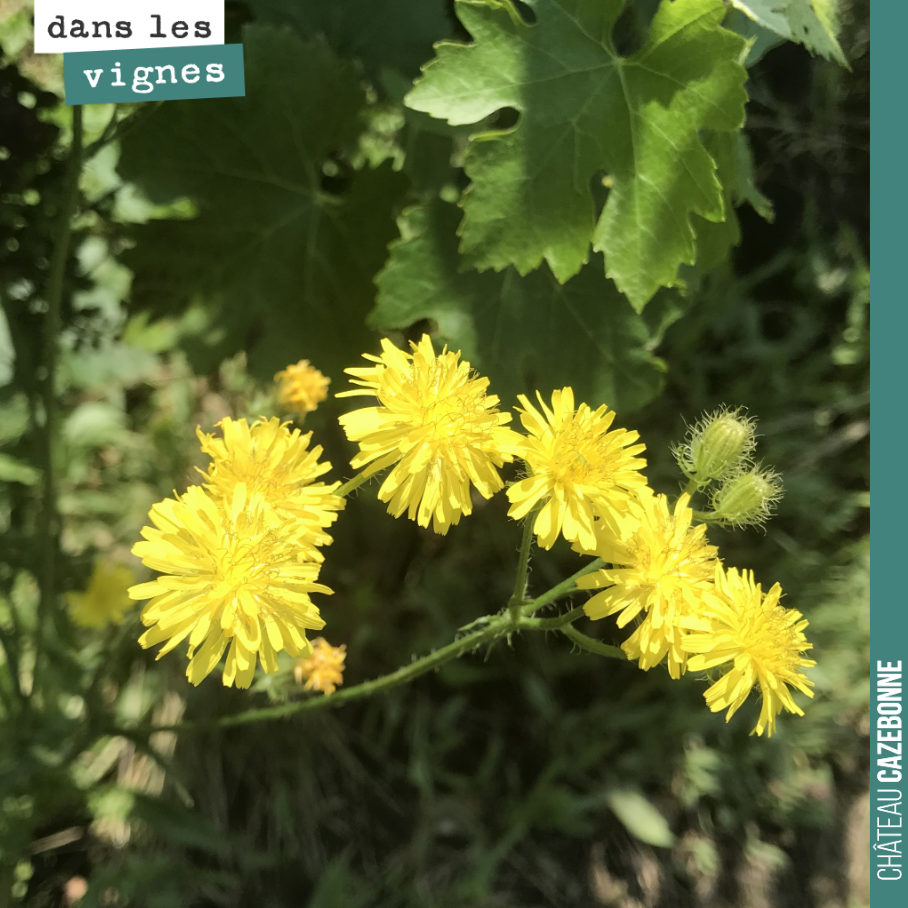
In the heart of our Bordeaux vineyards, amidst the biodiversity we passionately cultivate through organic farming, Smooth Hawksbeard (Crepis capillaris) flourishes quietly yet steadily. This charming herbaceous plant, a member of the extensive Asteraceae family, is far more than a simple floral presence. Native to Europe and Asia, it unfolds its basal rosettes and delicate yellow-orange flowers, whispering valuable insights into the biological life of our soils.
Also known as "crépide à poils", "crépide capillaire", or wild hawksbeard, Smooth Hawksbeard catches our attention through its ability to thrive on often disturbed, clay-rich, and well-drained soils, bearing silent witness to nature's resilience. Its presence indicates organic richness and biological soil activity—qualities we strive to preserve and enhance year after year at Château Cazebonne. As Jean-Baptiste Duquesne highlights in "Bordeaux, une histoire de cépages", observing spontaneous flora is key to "deciphering the true soul of a terroir".
Beyond its role as a bio-indicator, Smooth Hawksbeard integrates harmoniously into our vineyard ecosystem. Its roots contribute to aerating and structuring the soil, while its foliage provides shelter and a nectar source for a multitude of beneficial insects. These insects are invaluable allies in the natural control of vineyard pests, allowing us to minimise external interventions and preserve the delicate balance of our biodiversity.
At Château Cazebonne, Smooth Hawksbeard (Crepis capillaris) is an annual or biennial plant typically ranging from 10 to 80 cm in height. Its basal leaves, arranged in a rosette, are deeply lobed and bristly. The branched flowering stems bear numerous small ligulate flowers of a bright yellow, occasionally tinged with orange, gathered in flower heads (capitula) 1 to 2 cm across, which open mainly during the day and close in the evening. It blooms from May to October across the vineyard, offering a long and generous flowering period. This plant is particularly prominent on our clay-rich, well-drained plots, often where light mechanical weeding or shallow tillage has disturbed the soil surface, thereby encouraging germination. There, it grows alongside other indicators of biodiversity and living soils, such as common daisies or tassel hyacinth.
In our vineyards, Smooth Hawksbeard plays several ecological roles. Its taproots and fibrous roots help decompact the soil and improve its structure, facilitating the infiltration of air and water. Before flowering, its dense foliage acts as a natural cover crop, protecting the soil from erosion and excessive evaporation. During flowering, it attracts a variety of bees, hoverflies, and other pollinating or beneficial insects whose larvae help regulate vine pest populations. Its interaction with the vines is therefore overwhelmingly beneficial, as it is neither invasive nor excessively competitive for water or nutrients, particularly with appropriate cover crop management.
The vitality of this spontaneous flora reflects our commitment to living soils and, by extension, to the revival of Bordeaux's forgotten grape varieties. At Château Cazebonne, we are dedicated to replanting ancestral varieties such as Castets, Mancin, and Saint-Macaire—gems of Bordeaux's viticultural heritage that we are striving to bring back to life. This meticulous work of preservation and rehabilitation is made possible thanks to the enthusiasm and support of wine lovers who have discovered and embraced the unique flavours of our cuvées, helping to write a new chapter in Bordeaux winemaking history. To learn more about this approach and the history of the region's fine wines, we invite you to download the digital edition of the book "Bordeaux, une histoire de cépages". You can also test your knowledge of Bordeaux grape varieties and terroir via our wine quizzes, or explore the unique expression of our terroirs and resurrected grapes by visiting the Cazebonne shop.
Sources
Our suggestions
-5%on your 1st order with code BIENVENUE
The essential6 bottles — Graves red 2022
The best price of the cellar: €12 per bottle delivered.
The everyday red: generous and straight to the point.
I want it Our recommendation92/100 RVF
6 bottles — Graves red 2022, 92/100 RVF
Rated 92/100 by La Revue du vin de France: a solid 10-year ageing potential.
Our Graves for ageing, the finest gateway to the estate.
I want it Go further
12 bottles — the whole range
12 bottles, the whole range tasted: the best discovery-to-price ratio.
The complete tour of the estate, in a single case.
I want itThe cellar, forgotten grape varieties and our cuvées, twice a month. 5% off your first order with the code BIENVENUE.