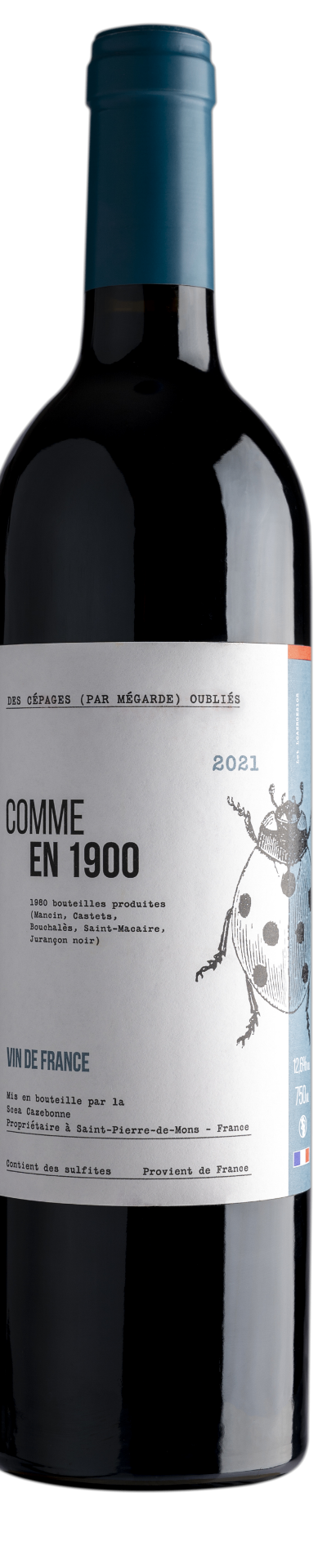
 The essential92/100 RVF
Comme en 1900 red 2022
Vin de France — heritage grapes, 92/100 RVF
The pre-phylloxera Bordeaux blend, revived at the estate.
Castets, Mancin, Pardotte: the Bordeaux before Bordeaux.
I want it
Cépages VIFA
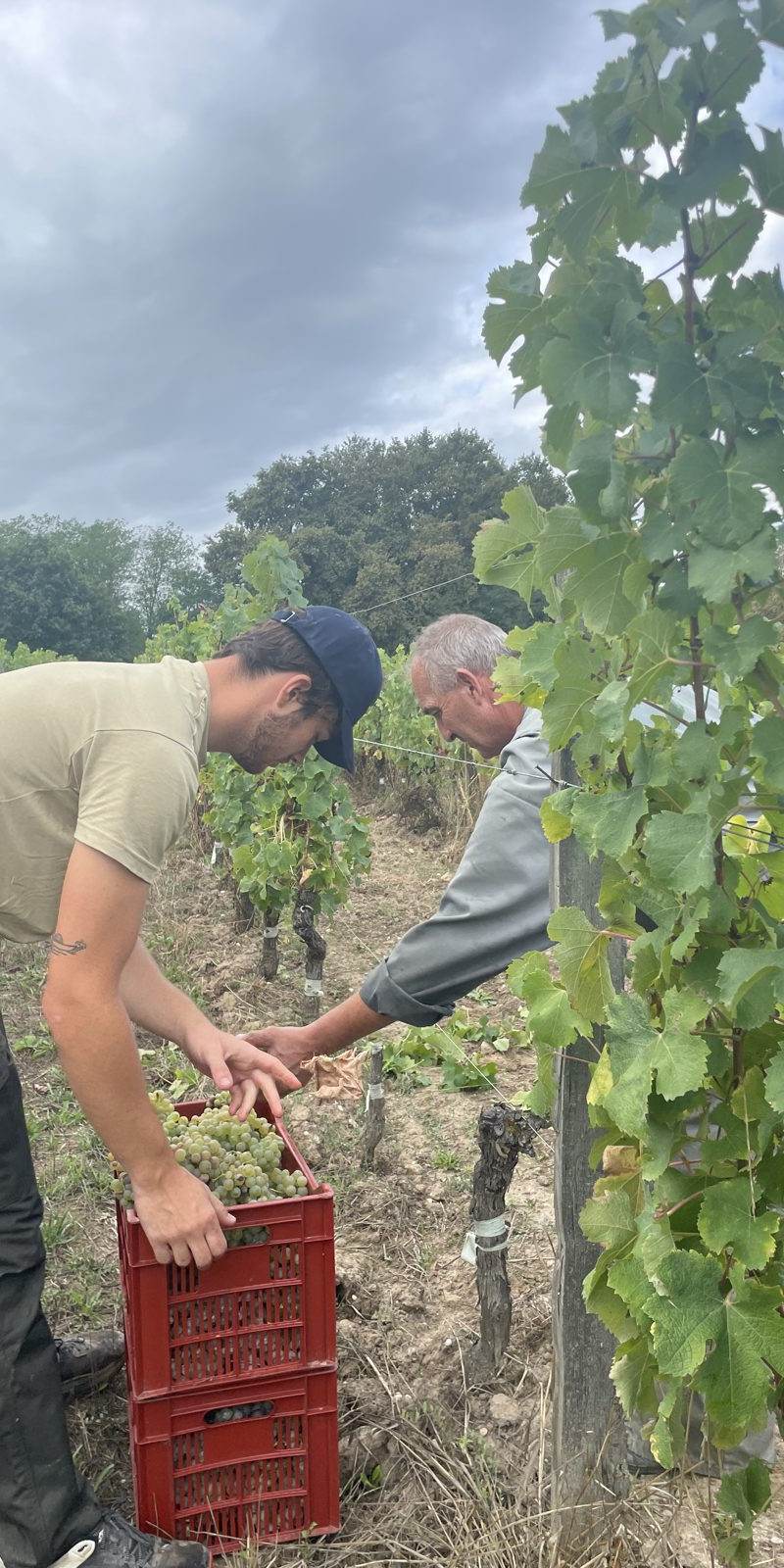
The Bordeaux vineyard, like all French appellations, has historically been governed by strict rules defined by the Institut National de l’Origine et de la Qualité (INAO). These regulations guarantee the authenticity and typicity of wines, but can sometimes limit winemakers' ability to experiment and adapt to new challenges. Faced with the imperatives of climate change and the search for new disease resistance, the framework has evolved to allow the introduction of what are known as Varieties of Interest for Adaptation, or VIFA.
The integration of a grape variety as a VIFA follows a rigorous process. Firstly, it is up to the syndicate of the appellation concerned to compile a reasoned dossier, often the result of preliminary research and experimentation. This dossier is then reviewed by the INAO, which evaluates the relevance of the grape variety in terms of adaptation objectives and the preservation of the appellation's identity. Once validated, winemakers can plant these varieties, but in limited proportions, generally 5 % of the total planted area of the estate and not exceeding 10 % of the wine's final blend. This experimental period usually lasts ten years, after which a decision is made regarding their definitive integration into or exclusion from the appellation's specifications. If the grape variety is not retained, the planted vines must be uprooted or converted, representing a significant risk and cost for winegrowers.
Despite a demanding regulatory framework, the Bordeaux vineyard has embarked on the path of VIFAs. As early as 2021, grape varieties such as Touriga Nacional, Castets, Alvarinho, Marselan, and Arinarnoa were authorised on an experimental basis to cope with rising temperatures and evolving wine profiles. This initiative demonstrates a collective desire to anticipate climate changes, while preserving the balance and renown of Bordeaux wines. The future of Bordeaux grape varietals is thus shaped by this ability to innovate while respecting a centuries-old heritage.
The objective is not to drastically revolutionise the grape varietals, but rather to offer winemakers additional tools to ensure the sustainability of their activity. VIFAs are often selected for their increased resistance to fungal diseases such as downy mildew and powdery mildew, thereby reducing the need for phytosanitary treatments. They can also exhibit different vegetative cycles, allowing for better management of drought periods or heatwaves. This approach is fully integrated into a broader consideration of the typicity of Bordeaux wines in the face of climatic challenges.
I am in favour of going much further. The VIFA initiative is vital and beneficial.
However, it seems to me that the adoption of these VIFAs has remained largely minor in the vineyard.
Because the grape varieties that have been adopted are not necessarily those the vineyard expects.
Because the vineyard is suffering and does not always have the means to invest.
At the same time, global warming is progressing faster than our experimentation periods.
What will happen in 10 years if we realise that the VIFA grape varieties chosen are not the right ones...
... for market expectations,
... for their disease resistance,
... for their drought resistance.
We want to conduct tests, but we define a reduced and restrictive test scope from the outset. The result is that it doesn't work, and we spend ten years drawing conclusions.
For my part, at Château Cazebonne, I have decided not to wait for our appellations to change. It will be too late. We are replanting 70 grape varieties on the estate and accumulating data on their behaviour in relation to global warming: budburst, disease susceptibility, sugar and acidity at harvest, organoleptic quality...
This data will be invaluable to us for making decisions in the coming years.
To collect and structure the data, we have developed an application that allows us to record this data daily, simply, from our mobile.
That is why I believe winemakers should be given 5% total freedom.
And not just 5% freedom, on a few VIFA grape varieties, a list that sometimes takes years for the syndicate to validate.
Do we have time to wait? No.
This will not change the taste of the wine, but it would allow us to learn much faster if 4000 of us in Bordeaux were doing tests, planting what we wish without constraints.
A full-scale test laboratory that would undoubtedly give rise to solutions for the future.
Sources
At the heart of the advocacy for winemaker's freedom, La Dame Noire is so named because the Jurançon noir, one of its grape varieties, cannot be mentioned on the label.
Our suggestions
-5%on your 1st order with code BIENVENUE
The essential92/100 RVFVin de France — heritage grapes, 92/100 RVF
The pre-phylloxera Bordeaux blend, revived at the estate.
Castets, Mancin, Pardotte: the Bordeaux before Bordeaux.
I want it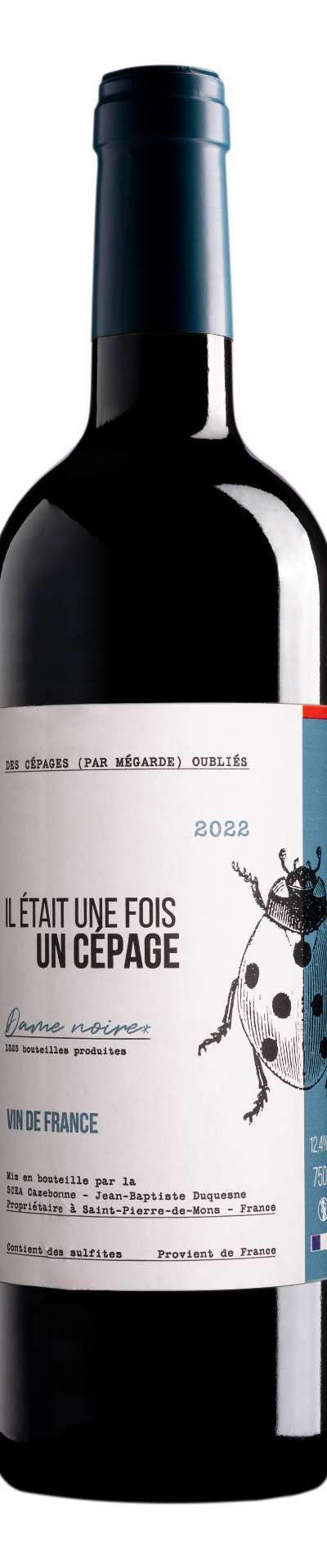 Our recommendation
 Go further
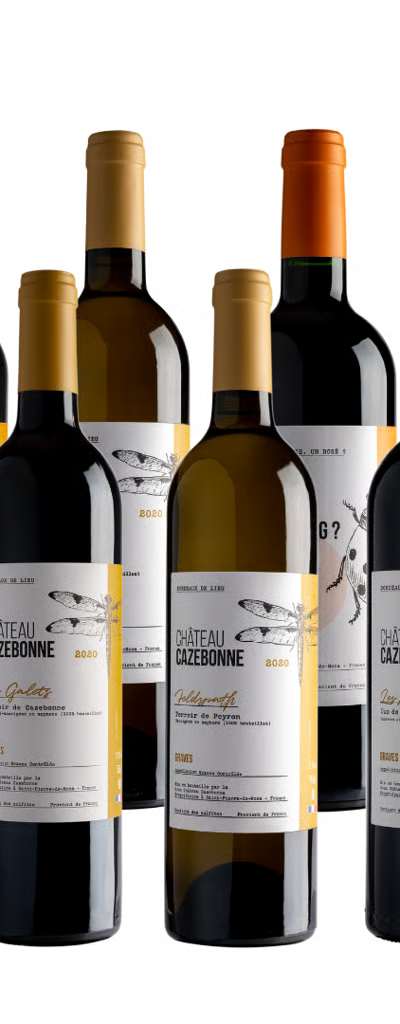
12 bottles — the whole range
12 bottles, the whole range tasted: the best discovery-to-price ratio.
The complete tour of the estate, in a single case.
I want itThe cellar, forgotten grape varieties and our cuvées, twice a month. 5% off your first order with the code BIENVENUE.