
 The essential92/100 RVF
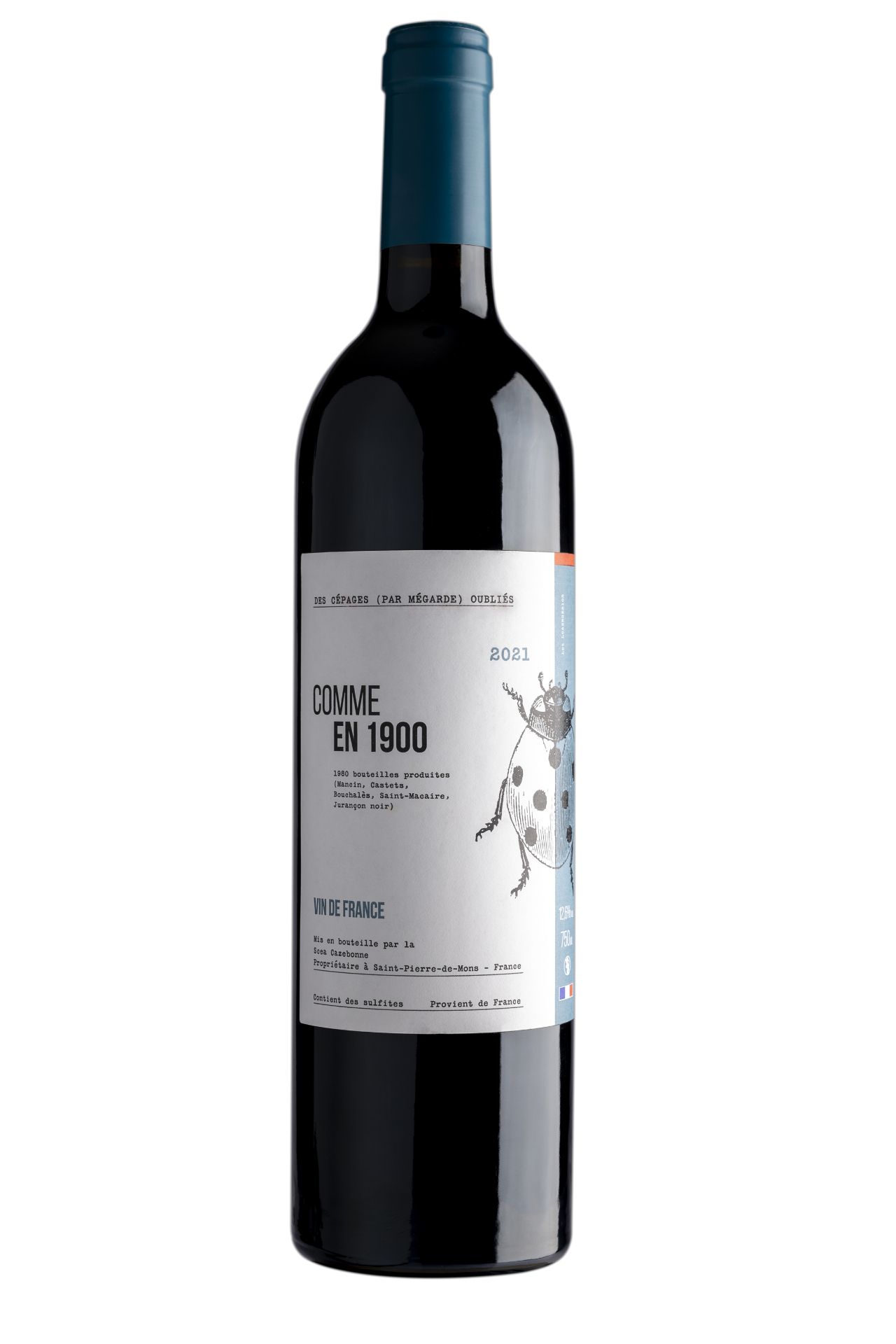
Comme en 1900 red 2022
Vin de France — heritage grapes, 92/100 RVF
The pre-phylloxera Bordeaux blend, revived at the estate.
Castets, Mancin, Pardotte: the Bordeaux before Bordeaux.
I want it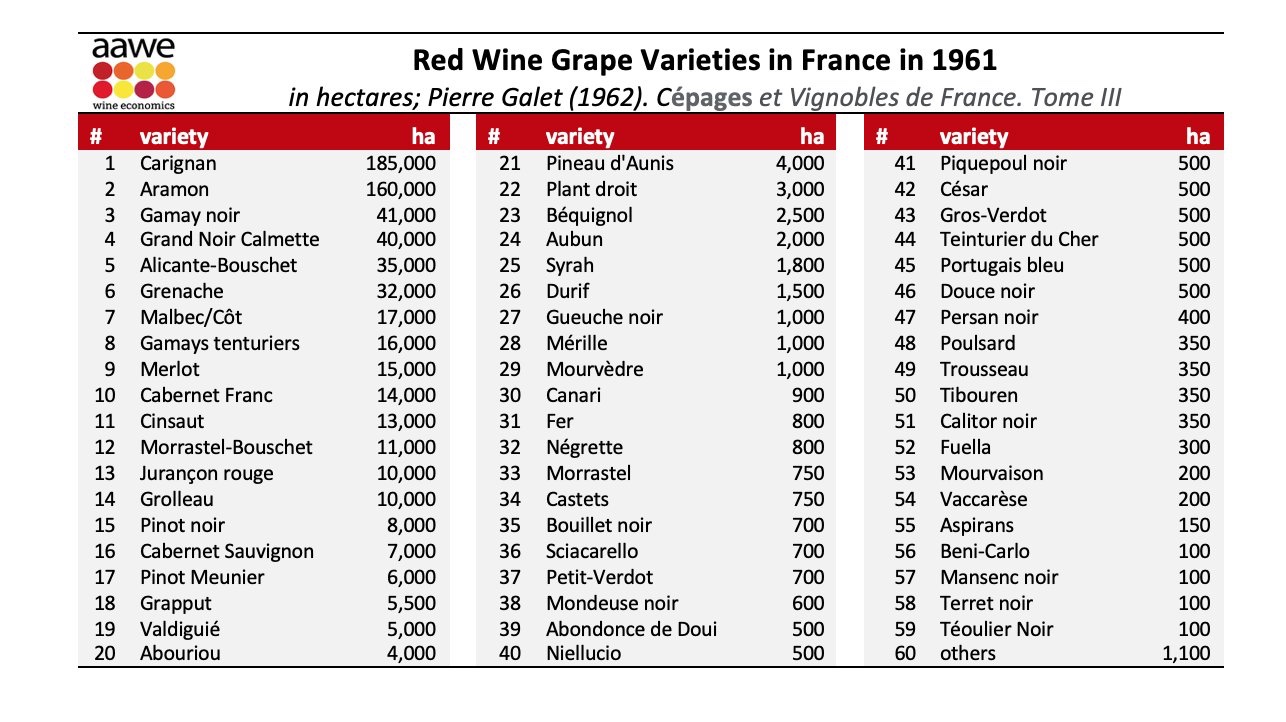
In 1961, France cultivated a red vineyard whose composition differed vastly from today's. The statistics published by Pierre Galet in his work "Cépages et vignobles de France, Tome III" (1962) depict a nation where everyday table wines far outweighed the grands crus, and where the grape varieties that epitomise modern Bordeaux or Burgundy were still a national minority.
Carignan (185,000 ha) and Aramon (160,000 ha) alone accounted for nearly 345,000 hectares in 1961, surpassing the surface area of all other French red grape varieties combined. These varieties from the viticultural Midi were planted en masse after phylloxera to supply négociants with blending wines and the bulk table wine market. Other high-yielding or teinturier varieties followed, such as Grand Noir de la Calmette (40,000 ha), Alicante Bouschet (35,000 ha), Morrastel-Bouschet (11,000 ha), and the teinturier Gamays (16,000 ha).
By comparison, grape varieties considered "quality-driven" today had a modest footprint: Pinot Noir covered a mere 8,000 ha, Syrah 1,800 ha, Mourvèdre 1,000 ha, and Grenache just 32,000 ha. The 1961 vineyard was thus intrinsically a post-war vineyard, geared towards high-volume, low-alcohol production—a model worlds apart from the contemporary viticultural landscape where Syrah exceeds 60,000 ha and Merlot 110,000 ha.
An analysis of Galet's figures for Bordeaux is particularly revealing. The grape varieties that define Bordeaux AOC wines today then showed surprisingly small national surface areas:
Merlot: 15,000 ha (9th nationally)
Cabernet Franc: 14,000 ha
Malbec / Côt: 17,000 ha
Cabernet Sauvignon: 7,000 ha (16th nationally)
Petit Verdot: 700 ha
In 1961, Cabernet Sauvignon, which is now France's second most-planted red grape variety with around 50,000 ha, represented only a third of Merlot's plantings. Even more tellingly, these "noble" varieties were locally, in the Gironde, widely supplanted by cultivars that are nowadays classified as "forgotten grape varieties". In the same way, one can examine the situation of white grape varieties in 1961 to understand the overall evolution of French varietal plantings.
Jurançon Noir and Bouchalès are two striking examples. These grape varieties were once ubiquitous in Bordeaux prior to the widespread standardisation of the 1970s and 1980s.
With 10,000 hectares in 1961 (13th nationally), Jurançon Noir (also known as Jurançon Rouge, Folle Noire, or Dame Noire) was ahead of varieties such as Pinot Noir, Cabernet Sauvignon, Grapput, Petit Verdot, and Mérille. Although its name suggests a link with the Jurançon AOC, it was a South-West variety widely planted across Lot-et-Garonne, Dordogne, Charente, and Gironde. It produced supple, colourful, and high-yielding wines, well-suited to everyday consumption. Today, fewer than 500 hectares remain in France. At Château Cazebonne, we celebrate this heritage by having replanted Dame Noire, as it was known locally.
Grapput, the Lot-et-Garonne name for Bouchalès (or Prolongeau in Gironde), represented 5,500 hectares in 1961 (18th nationally). This highly productive lowland grape variety formed the backbone of plantings on the "côtes" of the Entre-deux-Mers and the palus plots of Bordeaux throughout the first half of the 20th century. Its plantings were four times greater than today, as it has now virtually vanished with around 50 ha. In 1961, Bouchalès accounted for 80% of Cabernet Sauvignon nationally, and almost certainly surpassed it considerably within the Bordeaux vineyard.
The 1961 census also reveals the presence of Mérille (1,000 ha), Castets (750 ha), and Fer (800 ha), all three being historic varieties of the South-West and Bordeaux's Left Bank. Combined with Jurançon Noir, Bouchalès, and Petit Verdot, these "secondary" Bordeaux varieties totalled around 18,000 hectares in 1961, an area larger than Cabernet Sauvignon and Petit Verdot combined. The historical trajectory of grape varieties in Bordeaux clearly shows an evolution since this era.
Galet's table highlights two major trends that have shaped the French vineyard since 1961:
The decline of high-yielding varieties from the Midi (Aramon, Carignan, teinturiers), driven mainly by grubbing-up schemes and the quality-oriented restructuring policies of the 1980s and 1990s.
The rise of around ten "international" grape varieties (Merlot, Cabernet Sauvignon, Syrah, Pinot Noir), leading to the near-disappearance of regional varieties deemed less prestigious.
In Bordeaux, this manifested as a drastic reduction—and in some cases the complete disappearance—of Jurançon Noir, Bouchalès, Mérille, and Castets, in favour of a more streamlined varietal profile centred on Merlot, Cabernet Sauvignon, Cabernet Franc, Petit Verdot, and Malbec, dictated by appellation regulations. To learn more, read our article on the reasons behind the simplification of grape varieties in the vineyard.
The 1961 document is far more than a simple historical archive. It reminds us that over sixty years ago, Bordeaux wines stemmed from a far more diverse varietal palette, deeply rooted in its terroir, than current appellation decrees permit. Jurançon Noir, Bouchalès, Mérille, and Castets were an integral part of the vineyard landscape of our old vines, and therefore of the flavour profile of Bordeaux wines. It is this rich varietal heritage that we strive to bring back to life at Château Cazebonne by replanting these heritage grape varieties in our historic parcels: Bouchalès, Castets, Mancin, Pardotte, Jurançon Noir (Dame Noire), and Mérille. This initiative is not driven by nostalgia, but by the conviction that these varieties, perfectly attuned to our soils and resilient in the face of climate change, offer fresh tasting perspectives: fresher wines, with lower alcohol levels and greater drinkability. Our approach is part of a broader renaissance for Bordeaux.
Château Cazebonne is committed to preserving and showcasing Bordeaux's historic grape varieties, offering a fresh interpretation of the region's wines, made possible by the support of the wine lovers who embrace our creations. To delve deeper into this rich history, we invite you to download our book "Bordeaux, une histoire de cépages" which charts the ampelographic past of the Bordeaux region, test your wine knowledge with our quizzes, or discover and enjoy our wines crafted from these ancient varieties directly via our online shop.
Sources
Our suggestions
-5%on your 1st order with code BIENVENUE
The essential92/100 RVFVin de France — heritage grapes, 92/100 RVF
The pre-phylloxera Bordeaux blend, revived at the estate.
Castets, Mancin, Pardotte: the Bordeaux before Bordeaux.
I want it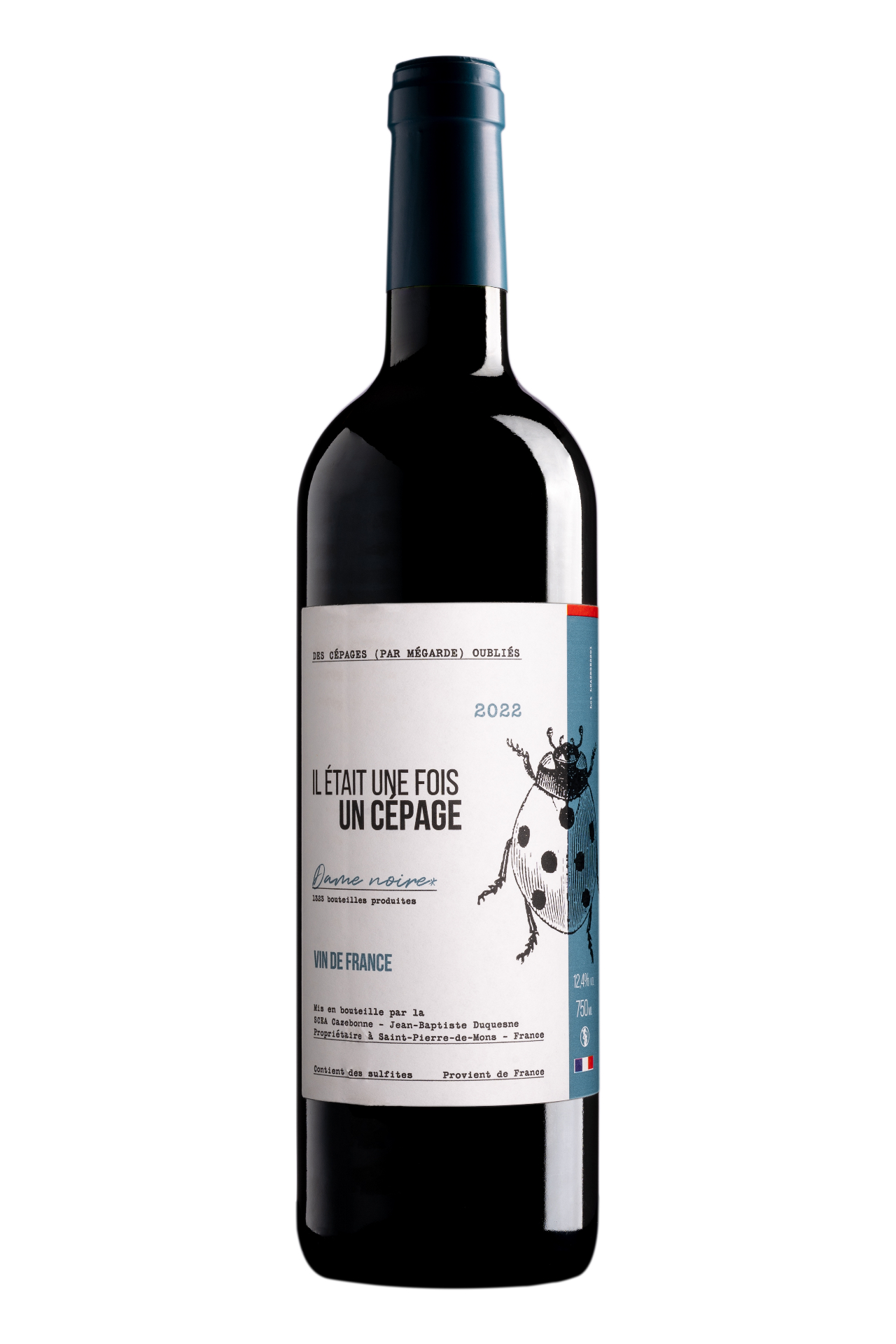 Our recommendation
IGP Atlantique — rare grape variety
A forgotten grape brought back: dense colour, wild fruit.
For the curious about lost grape varieties.
I want it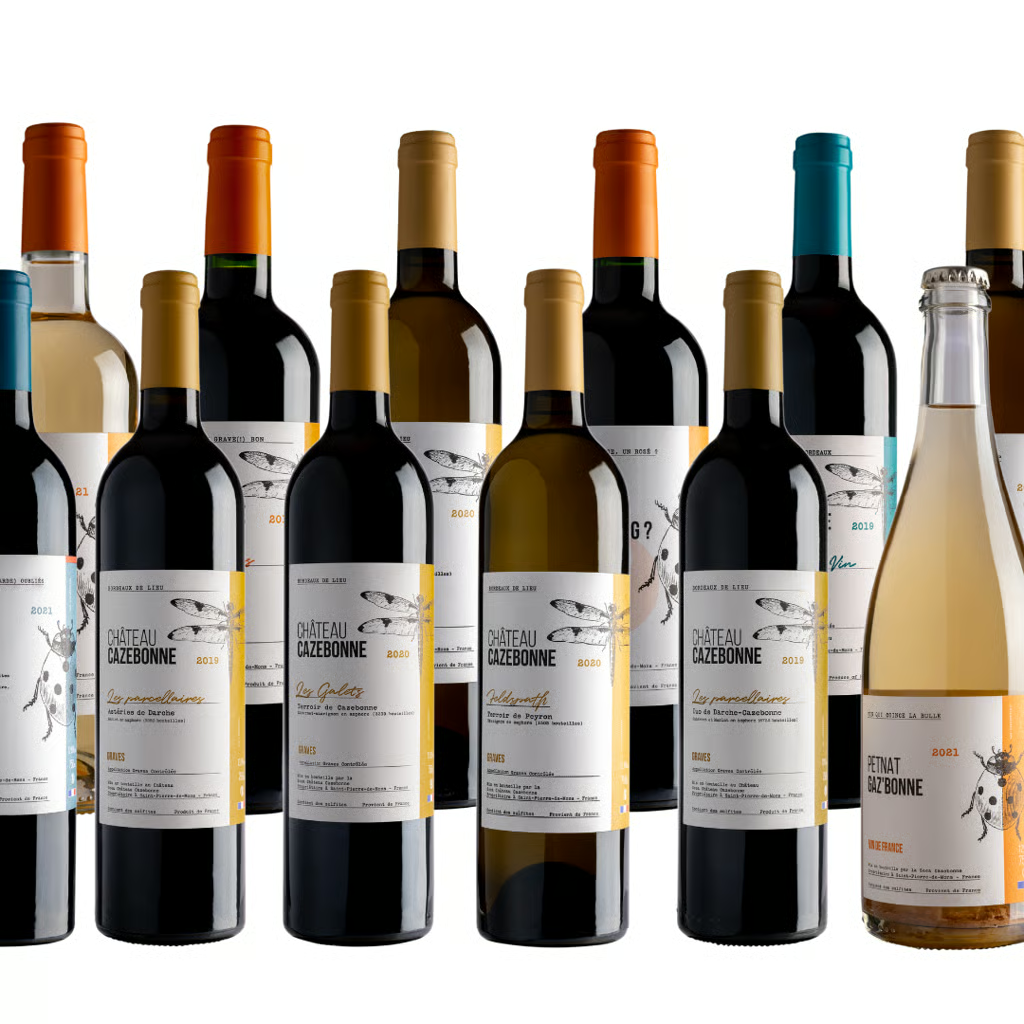 Go further
12 bottles — the whole range
12 bottles, the whole range tasted: the best discovery-to-price ratio.
The complete tour of the estate, in a single case.
I want it