 The essential
6 × Entre Amis red
6 bottles — Graves red 2022
The best price of the cellar: €12 per bottle delivered.
The everyday red: generous and straight to the point.
I want it
At Château Cazebonne, as on many wine estates, we are closely watching the changes our climate is imprinting on our vineyards. It is a question that preoccupies us, pushing us towards introspection and experimentation: is the very notion of a "great terroir" set in stone? Or, under the effect of climate change, could the qualities we sought yesterday become constraints tomorrow?
The hierarchy of terroirs, as we know and appreciate it, is not frozen in time. It is the product of a complex alchemy between soil, grape variety or varieties, climate and the farming practices of a given era. Historically, excellence often lay in a terroir's ability to bring grapes to optimal ripeness in climates that were sometimes cool. Think of well-exposed slopes, of free-draining gravels that store and release heat, or of other situations that favour sugar accumulation and full aromatic expression. But today, the central question arises: what becomes of a terroir when it now has to slow ripening down rather than secure or hasten it? Do our benchmarks still hold?
Here at Cazebonne, we are experiencing this first-hand. The warm, free-draining gravel croupe that was our finest terroir for decades, the one that always gave us grapes of great concentration and lovely richness, now presents us with new challenges. Recent hot vintages confront us with vines that suffer and can experience ripening blockages. We are seeing a mismatch between technological ripeness (sugars, acidity) and phenolic ripeness (tannins, colour), high pH levels, sugars rising too quickly, acidity that is hard to retain, and skins that struggle to soften, failing to develop the suppleness we are looking for. The terroir that once helped our grapes ripen can now make them ripen too fast, forcing us to adapt our practices and rethink our choices.
This observation leads us to a fascinating line of thought: what if the characteristics we once regarded as agronomic "handicaps" became, under the effect of climate change, the most sought-after qualities? We are thinking in particular of deep soils offering better water reserves, of clay soils that hold more water and coolness, of less sunny north- or east-facing aspects, of cooler lower slopes, of plots at higher altitudes or in areas traditionally considered later-ripening. Their ability to delay grape ripening and to protect fruit from excessive heat spikes could well become their greatest asset. Of course, the vine's response remains nuanced and will always depend on many factors: the rootstock used, the plant material selected, rooting depth, the grape variety and, naturally, the farming practices we apply day after day.
The hierarchy of Europe's great growths was built at a time when cool weather was a frequent challenge and excessive heat a rarity. Today, the situation is reversed. Is it not legitimate to ask whether the real agronomic value of terroirs might evolve faster than their established reputation? We may be witnessing a growing gap between the intrinsic viticultural value of a site, in light of current and future climate challenges, and its economic value, which often reflects past history and prestige.
The example of regions such as Burgundy is striking. Land prices there are driven by a unique combination of scarcity, a thousand-year history and unwavering global demand. But does the market, in its speculative dimension, really factor in climate risk over a 20- or 50-year horizon? Or do the dream and the brand still outweigh tomorrow's agronomic reality? This question is not unique to Burgundy; it runs through all the great historic vineyards, including our own in Bordeaux.
It is a troubling paradox. Plots that once sold for millions of euros for their ability to produce exceptional wines could see their agronomic advantage eroded by climatic pressure. Conversely, plots once less prized, because they are higher, cooler, richer in clay or less exposed, could gain in appeal and in viticultural value. Might we not witness a new form of vineyard speculation, focused on the terroirs best suited to the climatic conditions of 2050 and beyond? It is a prospect that calls on us, as winegrowers at Cazebonne, to engage in deep strategic reflection.
Beyond the geography of terroirs, the very definition of what we call a "great terroir" may have to evolve. Yesterday, we often prized concentration, power and aromatic richness. Tomorrow, freshness, vibrant acidity, subtle balance, slower ripening and fine tannins may well become the essential criteria of excellence. The great terroir of tomorrow may be the one best able to slow time down, offering gradual, harmonious ripening in a world that is speeding up.
Let us be nuanced. The great historic terroirs will not lose their strengths overnight. Their history, their soil depth and their geological complexity give them a certain inertia and resilience. Yet the signals are clear: the pursuit of slow ripening is becoming a central quest for us as winegrowers. This will have consequences for our choice of grape varieties and rootstocks and for our everyday farming practices, and could even, in time, redraw the map of appellations and, inevitably, land prices. A great terroir may not be the one that ripens grapes best. Tomorrow, it may be the one that ripens them most slowly. A new era is dawning for terroir, full of challenges but also of promise.
To deepen your knowledge of the fascinating world of wine, discover Bordeaux, une histoire de cépages, test your knowledge with our wine quizzes, or explore our cuvées in our shop.
The Clay soils, considered essential for the terroirs of tomorrow, yield Argile ocre, a white wine from a fine terroir.
Our suggestions
-5%on your 1st order with code BIENVENUE
The essential6 bottles — Graves red 2022
The best price of the cellar: €12 per bottle delivered.
The everyday red: generous and straight to the point.
I want it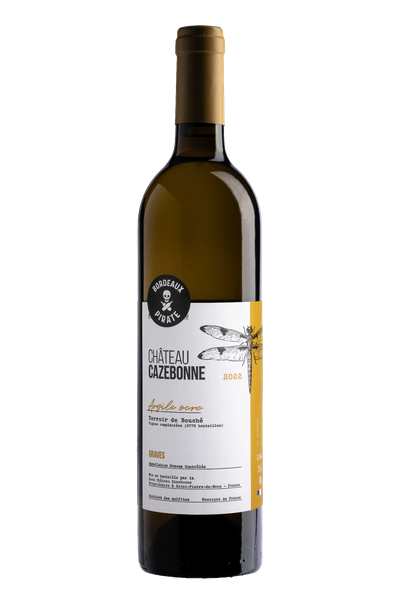 Our recommendation
6 bottles — AOC Graves 2022
€24 per bottle.
I want it Go further
12 bottles — the whole range
12 bottles, the whole range tasted: the best discovery-to-price ratio.
The complete tour of the estate, in a single case.
I want itThe cellar, forgotten grape varieties and our cuvées, twice a month. 5% off your first order with the code BIENVENUE.