The essential
6 × Entre Amis red
6 bottles — Graves red 2022
The best price of the cellar: €12 per bottle delivered.
The everyday red: generous and straight to the point.
I want itPlantain
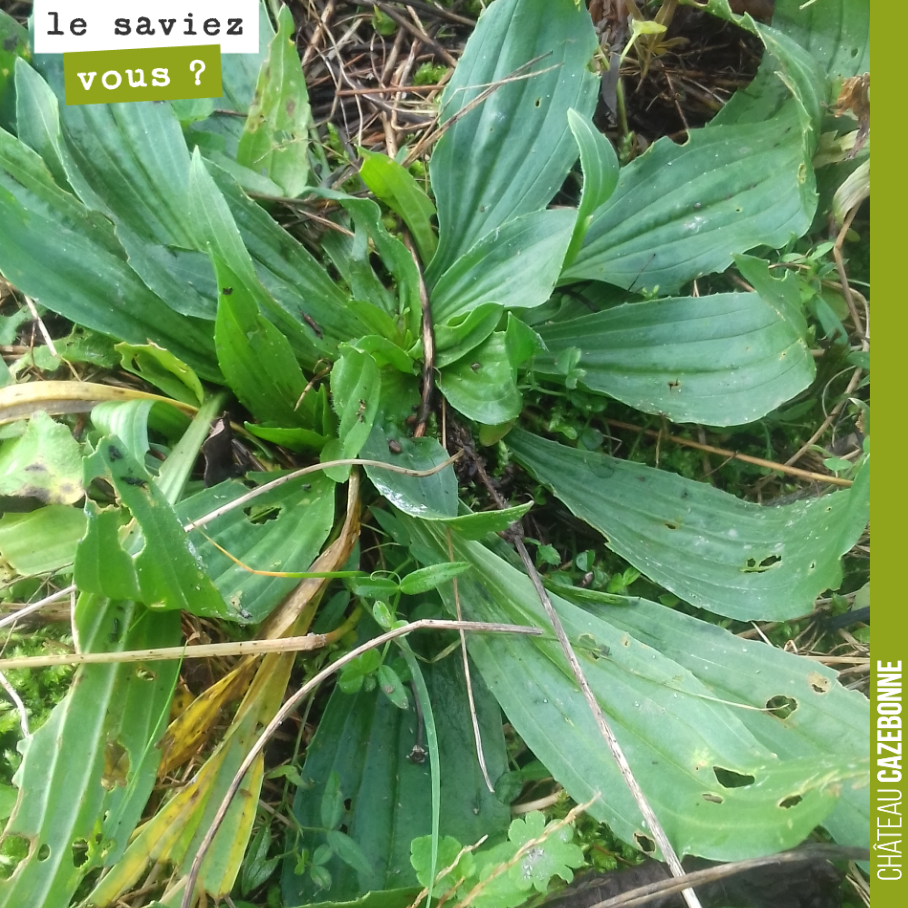
At Château Cazebonne, we carefully observe every element of the spontaneous flora that flourishes between our rows of vines. Among these discreet yet revealing plants, the plantain (genus Plantago), a member of the Plantaginaceae family, holds a special place. Far from being a mere weed, this perennial herbaceous plant, recognisable by its broad, ribbed leaves and its often robust floral stems bearing small white, pink or purplish flowers from May to October, is a silent witness to the quality of our soils.
Whether it is the Greater Plantain (Plantago major), recognisable by its broad basal leaves, or the Ribwort Plantain (Plantago lanceolata) with its finer leaves, their presence in our viticultural terroirs is never insignificant. These species, often wrongly considered as simple "weeds" in a conventional approach, are precious allies for us. They provide us with information about the structural richness of our terroir and its composition. Indeed, a soil where plantain thrives is often an uncompacted soil, with good biological activity, conducive to the deep rooting of our vines and the expression of our terroir's complexity. They also participate in improving soil structure through their roots, promote water infiltration and provide a refuge for many beneficial insects.
This meticulous observation of plant biodiversity is at the heart of our agroecological approach to viticulture. It allows us to better understand and intervene in harmony with natural cycles, avoiding any intervention that would break this fragile balance. Plantain, like other wild plants, contributes to the vitality of underground ecosystems, which are essential to the health and resilience of the vine. Jean-Baptiste Duquesne, in his book "Bordeaux, une histoire de cépages", does not fail to underline the crucial importance of these complex interactions between the soil, the plant and the climate, which shape the profound identity of a great wine.
Plantain is a particularly resilient plant, capable of adapting to various types of soils and climates. Its presence is often a sign of living soils, rich in humus and endowed with good water retention capacity. It generally develops from April to October and can be observed in the inter-rows of vineyards, notably at Château Cazebonne, where we foster biodiversity. Its deep roots help to loosen the soil, thereby facilitating the penetration of water and air, and creating an environment conducive to microfauna and microflora.
In concrete terms, we observe at Cazebonne that areas where plantain is well established benefit from a better soil structure, which results in better resistance of the vine to periods of drought and stronger biological soil activity. These spontaneous plants help reduce erosion and create a favourable microclimate, thus participating in the general balance of our viticultural ecosystem. Plantain is therefore not a competitor for the vine, but a partner that contributes to the overall health of the environment, a key element of our approach to sustainable viticulture.
Just as we value the spontaneous flora that enriches our soils, we are equally passionately committed to reviving the forgotten grape varieties of Bordeaux. This process of replanting historic varieties such as Castets, Mancin or Saint-Macaire is a way of echoing natural plant diversity and rediscovering unique and authentic flavours. This conservation work is made possible thanks to the invaluable support of all the wine lovers who have discovered and adopted the unique cuvées crafted from our rediscovered grape varieties. To find out more about the ancestral grape varieties of Bordeaux and our commitment, we also invite you to receive the digital version of the book "Bordeaux, une histoire de cépages", published by Éditions BBD and written by Jean-Baptiste Duquesne. You can also test your knowledge of wine and grape varieties, or discover the unique expression of our terroirs and our rediscovered grape varieties by visiting our online shop.
Sources
Our suggestions
-5%on your 1st order with code BIENVENUE
The essential6 bottles — Graves red 2022
The best price of the cellar: €12 per bottle delivered.
The everyday red: generous and straight to the point.
I want it Our recommendation92/100 RVF
6 bottles — Graves red 2022, 92/100 RVF
Rated 92/100 by La Revue du vin de France: a solid 10-year ageing potential.
Our Graves for ageing, the finest gateway to the estate.
I want it Go further
12 bottles — the whole range
12 bottles, the whole range tasted: the best discovery-to-price ratio.
The complete tour of the estate, in a single case.
I want itThe cellar, forgotten grape varieties and our cuvées, twice a month. 5% off your first order with the code BIENVENUE.