The essential
6 × Entre Amis red
6 bottles — Graves red 2022
The best price of the cellar: €12 per bottle delivered.
The everyday red: generous and straight to the point.
I want itRumex
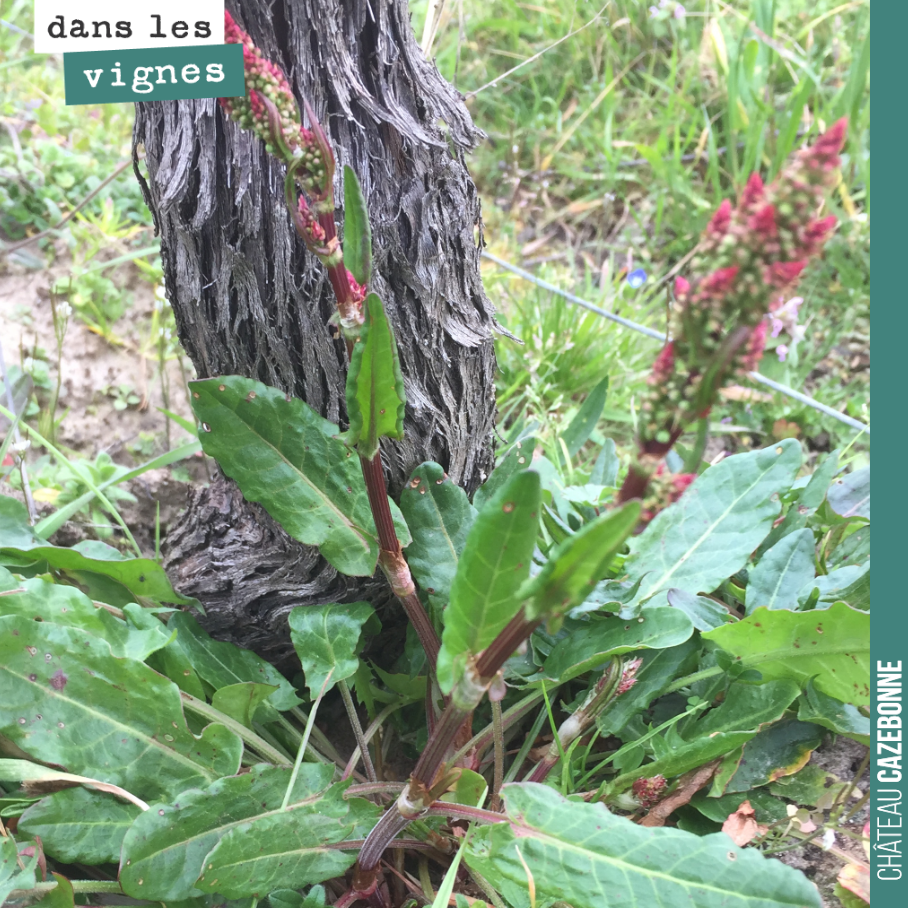
Rumex, an emblematic genus of the Polygonaceae family, is much more than a simple plant in our landscapes. It encompasses around 200 species of herbaceous plants, whether perennial, annual, or biennial. Predominantly wild, some varieties also find their place as ornamental or food plants, like sorrel or wild rhubarb, sometimes referred to under the generic name of "patience dock". These plants are easily distinguished by their often heart-shaped leaves and their flowers clustered in panicles or spikes, creating unique silhouettes. At Cazebonne, we mainly encounter Rumex obtusifolius (broad-leaved dock) and Rumex crispus (curled dock), which are common species in meadows and along paths.
These plants are characterised by a basal rosette of large leaves, often dark green, which can reach over 30 centimetres in length. The leaves of the broad-leaved dock are wider and rounded at the base, while those of the curled dock have wavy edges and a more lanceolate shape. Erect floral stems, which can exceed a metre in height, develop in summer, bearing small greenish or reddish flowers, clustered in dense spikes that will become bunches of triangular, brown seeds when mature. These seeds, which are very numerous and light, are easily dispersed by wind, water, and even animals, possessing an impressive germination capacity and a long viability in the soil.
The life cycle of rumex is generally perennial. After budburst in spring, the leaf rosettes appear and develop rapidly. Flowering occurs in summer, followed by the massive production of seeds in late summer and autumn. The long, robust taproots allow the plant to draw water and nutrients from deep below, and to regenerate its aerial part from year to year, even after mowing or the passage of a tool. This survival capacity is an asset in an environment like the vineyard, where disturbances are frequent.
In the plots of Château Cazebonne, rumex is often found in areas where the soil tends to be compacted or unbalanced. Its presence is not uniform, and we observe it more particularly in the aisles or between the rows where the passage of agricultural machinery can lead to compaction. It prefers soils rich in nitrogen and organic matter, which is often the case in our plots farmed using agroecology, promoting living soil.
At Château Cazebonne, rumex is not seen as a simple weed, but rather as a valuable indicator of the life and composition of our soils. Its presence in moderate quantities can, for example, signal a soil rich in nutrients, or sometimes even slightly compacted. Its deep roots work the top layers of the soil, naturally contributing to its aeration and decompaction. This root work helps to improve the soil structure, thus promoting better water infiltration and a more even distribution of nutrients—essential processes for the vitality of our vines in organic farming. It also contributes to the biodiversity of the plots by providing a refuge or a food source for various insects, such as ladybirds, and birds, whilst reducing erosion.
The interaction of rumex with the vine is complex. Rather than solely being a competitor for water and nutrients, its presence, when managed, can be beneficial. By decompacting the soil, it facilitates the root development of the vine and access to deeper resources. Too high a density of rumex could, however, lead to competition, especially for young vines. A reasoned management of the grass cover, by mowing rather than uprooting, allows us to control its proliferation whilst preserving its benefits for the soil.
Observing rumex in our vine rows allows us to adjust our cultivation practices. Rather than seeking to eradicate it systematically, we prefer to understand the message it sends us. It is fully part of the flora that we seek to cultivate and protect. Jean-Baptiste Duquesne, in his book, highlights the importance of interactions between spontaneous plants and the soil for the balance of the viticultural ecosystem. Every species plays a role, however subtle, in the constitution of an exceptional terroir. By observing it closely, we can uncover information about the health of our soils, acting as a true bioindicator to refine our decisions regarding soil amendments or tillage, notably through mechanical weeding or the use of cover crops.
This approach to living things, where each plant has its place and function, is at the heart of our commitment to preserving the historic grape varieties of Bordeaux. Varieties like Castets, Mancin, or Saint-Macaire, long forgotten, are coming back to life in our plots. This meticulous and fascinating work of preservation and rehabilitation is only possible thanks to the unwavering support of all the wine lovers who have embraced the unique flavours of our cuvées, thus helping to write a new chapter in Bordeaux's wine history. We invite you to learn more about this approach by downloading the digital version of the book "Bordeaux, une histoire de cépages", to test your wine knowledge with our oenological quizzes, or to discover our wines online in the Cazebonne boutique.
Sources
Our suggestions
-5%on your 1st order with code BIENVENUE
The essential6 bottles — Graves red 2022
The best price of the cellar: €12 per bottle delivered.
The everyday red: generous and straight to the point.
I want it Our recommendation92/100 RVF
6 bottles — Graves red 2022, 92/100 RVF
Rated 92/100 by La Revue du vin de France: a solid 10-year ageing potential.
Our Graves for ageing, the finest gateway to the estate.
I want it Go further
12 bottles — the whole range
12 bottles, the whole range tasted: the best discovery-to-price ratio.
The complete tour of the estate, in a single case.
I want itThe cellar, forgotten grape varieties and our cuvées, twice a month. 5% off your first order with the code BIENVENUE.