04 December 2023
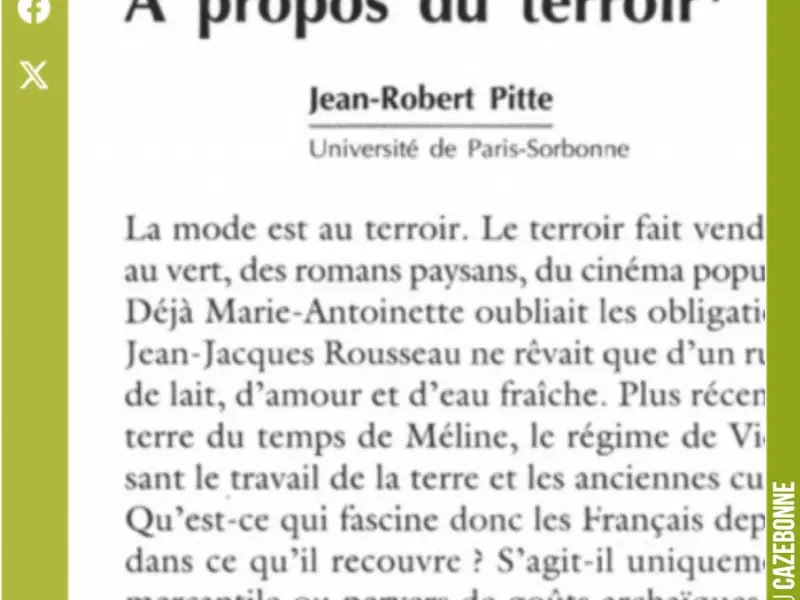
Reading a few posts by @raphael bord on his blog Les bordures this evening, he mentions this text by Jean-Robert Pitte on the notion of terroir……He reminds us that Roger Dion taught: 'The.
By Jean-Baptiste Duquesne

Terroir
At the heart of our estate, the singularity of our wines stems from the exceptional diversity of our terroirs. Spread across six distinct plots, these soils each tell a story, lending every cuvée its own identity and a fascinating complexity.
The sand and silt, light and supple, bring an ethereal elegance and a delicate aromatic finesse to our wines, often marked by floral and fruity notes. They impart a silky texture on the palate and great drinkability.
The deep gravels, for their part, are the birthplace of more structured and complex wines. These well-draining soils of rolled pebbles force the vine to plunge its roots deep, thus extracting an incredible mineral richness. They give rise to wines of great aromatic persistence, with notes of black fruit, spices, and sometimes even hints of graphite, promising a beautiful ageing potential.
Finally, the clay-limestone terroirs, with their capacity to retain water while ensuring good drainage, are essential for the balance and freshness of our wines. The limestone, in particular, plays a crucial role in maintaining acidity and provides a beautiful minerality, contributing to wines with an elegant backbone, a beautiful tension, and a lingering finish. These soils allow the vine to fully express its vigour and character.
It is this incredible mosaic of terroirs that offers us the freedom to create a range of wines with such varied profiles, each capable of expressing a unique facet of the Bordeaux appellation.
The terroirs of the Graves, where our estate is located, are distinguished by their unique geological composition. These soils are primarily composed of alluvium deposited by the Garonne over millennia. They contain a wide variety of pebbles, gravel, sand, and clay, which have been transported from the Pyrenees. This geological diversity gives the wines a particular mineral and aromatic complexity. The asteriated limestone, present in places, also plays an important role in water regulation and the contribution of minerality, which is essential for the finesse and freshness of the wines.
Terroir is much more than a simple characterisation of the soil; it encompasses a complex set of interacting elements: climate, subsoil, topography, and human intervention. The structure and composition of the soil directly influence the rooting of the vines, their water and mineral nutrition, and consequently the ripening of the grapes. Well-drained soils like ours encourage deep rooting, allowing the vine to draw its resources even during periods of relative drought. This synergy between all the factors of the terroir contributes to the aromatic singularity and typicity of our wines.
At Château Cazebonne, we attach paramount importance to the life of our soils, which reflects our commitment to environmentally friendly viticulture, notably biodynamics. A living soil is rich in microbial and faunal biodiversity (earthworms, bacteria, fungi), which promotes the transformation of organic matter and the availability of nutrients for the vine. This approach allows the vine to express itself fully and develop a natural resistance to threats. To learn more about the importance of soil life, visit our dedicated page on living soils or organic matter in soils.
To understand our terroirs is to dive into the heart of Château Cazebonne's identity. Each plot is a fragment of this geological and biological mosaic, offering an infinite palette of expressions for our wines. This profound respect for the terroir is essential to our philosophy; it allows us to create authentic wines that reflect the unique character of our environment. For a complete immersion, we invite you to contact us.
This diversity also allows us to lead an ambitious project: replanting forgotten grape varieties in Bordeaux, rediscovering the ampelographic wealth of yesteryear, as beautifully described in the book "Bordeaux, une histoire de cépages" by Jean-Baptiste Duquesne, published by Éditions BBD. This pioneering work is made possible by the unwavering support of the many enthusiasts who have adopted our wines and share our passion for Bordeaux's winegrowing heritage, as well as the essential role played by the sharecropping contract. To deepen your knowledge of Bordeaux's wine history, do not hesitate to download our digital book on grape varieties and the history of the Bordeaux vineyard, test your knowledge with our oenological quizzes, and of course, discover the extent of our cuvées, including the Parcellaires cuvées, and experience Château Cazebonne by visiting our online shop. Alternatively, delve into the fascinating history of the Cazebonne ridge.
Sources
04 December 2023
By Jean-Baptiste Duquesne
04 August 2023
By Jean-Baptiste Duquesne
27 March 2023
By Jean-Baptiste Duquesne
The cellar, forgotten grape varieties and our cuvées, twice a month. 5% off your first order with the code BIENVENUE.