
 The essential
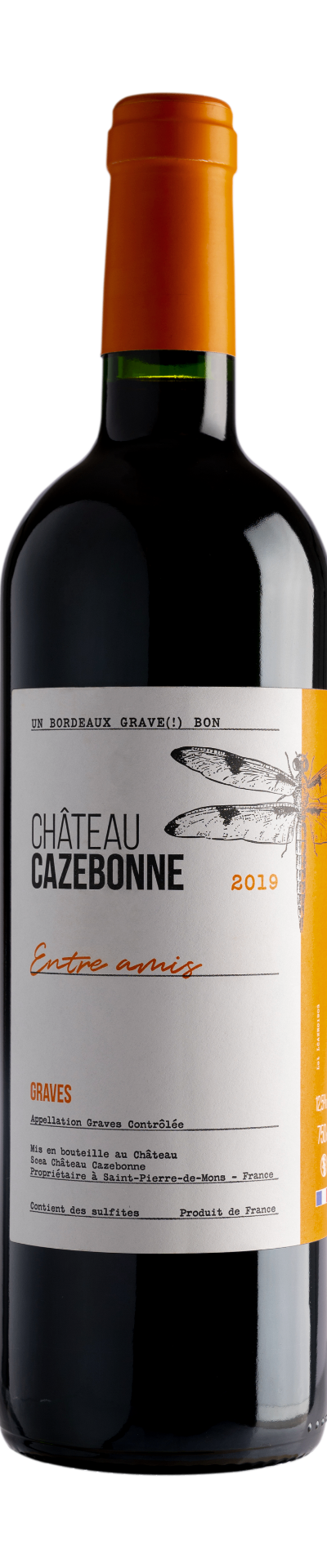
6 × Entre Amis red
6 bottles — Graves red 2022
The best price of the cellar: €12 per bottle delivered.
The everyday red: generous and straight to the point.
I want itÉmeutes de 1907
In brief. In 1907, a collapse in wine prices drove hundreds of thousands of Languedoc winegrowers onto the streets, culminating in deaths in Narbonne. This crisis of overproduction, exacerbated by fraud, accelerated a series of laws: the 1905 law on fraud, the 1907 laws, the 1919 law on appellations of origin, and then the 1935 decree-law that created the AOCs. Bordeaux, delimited as early as 1911 and recognised as an AOC in 1936, is a direct heir to this legacy.
At the beginning of the 20th century, Languedoc had replanted extensively after phylloxera. The vineyards produced large quantities of everyday wine, sold to merchants. Historian Jean Sagnes places the start of the crisis in 1904: prices plummeted, and winegrowers could no longer sell their harvests. Many blamed fraud, meaning «wine» manufactured or diluted outside the vineyard.
The first target was chaptalisation (the addition of sugar). The law of 29 January 1903 had facilitated the addition of sugar to grapes during harvest. Winegrowers in the Midi saw this as a way to produce artificial volumes that competed with their wines. In addition, there was the practice of adding water to wine (the «mouillage») and highly contested imports of wines from Algeria.
The issue was not new. The Griffe law of 1889 had already defined wine as the product of fermenting fresh grapes. The law of 1 August 1905 on the repression of fraud reaffirmed this principle and paved the way for designations of origin. According to historian Geneviève Gavignaud-Fontaine, over 40% of samples taken in 1907 by the fraud repression service were still found to be in breach: the law existed, but it was poorly enforced.
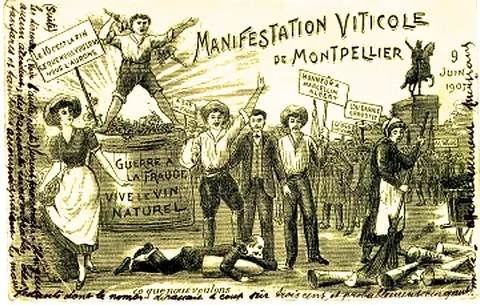
The movement began in Argeliers, in the Aude region, led by Marcelin Albert, a café owner and small landowner. He demanded the repeal of the 1903 law on chaptalisation. From March 1907 onwards, meetings followed one another in the towns of the Languedoc wine region, with increasingly large crowds. On 9 June, in Montpellier, over 500,000 people demonstrated, according to the figure cited by Jean Sagnes; other estimates go up to 600,000. It was one of the largest demonstrations of the Third Republic.
The Argeliers committee issued an ultimatum to the government for 10 June. It called for a tax strike and the resignation of municipal councils. On 14 June, 442 municipalities resigned. Among the elected officials at the forefront was Ernest Ferroul, mayor of Narbonne.
Facing the 1907 wine crisis and the violent riots that ensued, Georges Clemenceau, then President of the Council, adopted a two-pronged approach. On the ground, the repression was severe : in Narbonne, on 19 and 20 June, troops opened fire on the crowd, causing five deaths and dozens of injuries. Simultaneously, Clemenceau invited Marcelin Albert, the emblematic figure of the movement, to Paris on 23 June. After their meeting, the President of the Council released information to the press aimed at discrediting Albert, presenting him as having compromised with the government (Clemenceau had given him money for his return ticket!). This strategy, combining military firmness and political manoeuvre to discredit, contributed to the gradual calming of the revolt.
The movement subsided, but the government understood that it had to legislate quickly.
The law of 29 June 1907 directly addressed the demands of the Midi region:
mandatory harvest declaration for each owner after the vintage;
surtax on sugars used in winemaking, and declaration of sugar sales exceeding 25 kg by merchants;
prohibition of circulating volumes exceeding the property's actual production;
possibility for unions to join as civil parties in fraud trials.
A new text in July 1907 regulated the dilution of wine («mouillage») and the circulation of wines and spirits. On 22 September 1907, the Confédération générale des vignerons du Midi was founded in Narbonne, under the presidency of Ernest Ferroul. It became an important player in the fight against fraud.
The 1905 and 1907 laws protected the «wine» product. The next step was to protect its origin. Several stages led to this:
Administrative Delimitations (1908-1911): The State delimited several regions, including Bordeaux in 1911. The method, highly contested, showed its limitations.
Law of 6 May 1919: This created appellations of origin and entrusted their delimitation to the courts, at the request of producers.
Winegrowing Statute of 1931: The law of 4 July 1931 taxed high yields, limited new plantings, and encouraged distillation.
Decree-Law of 30 July 1935: This created the appellations d'origine contrôlée (controlled appellations of origin) and the National Committee for Appellations of Origin, later to become INAO. Its proposals could not be modified by the administration. This co-decision between professionals and the State remains the principle of AOCs. Joseph Capus was its first president, from 1935 to 1947.
The first AOCs were recognised on 15 May 1936: Arbois, Cassis, Cognac, Châteauneuf-du-Pape, Monbazillac, and Tavel.
Bordeaux did not experience the 1907 revolt, but it inherited the entire framework from it. The «Bordeaux» appellation was delimited as early as 1911. Between the two World Wars, applying the 1919 law, courts settled boundary disputes between Graves, Sauternes, Barsac, and Cérons, and the legislator confirmed these decisions in 1936 and 1937. The Bordeaux AOC was recognised by the decree of 14 November 1936, and the Graves AOC by that of 4 March 1937.
This framework protected wines of origin against imitations. However, it also froze the grape varieties permitted. As we have recounted in this journal, the 1936 decree still tolerated secondary Bordeaux grape varieties, which were subsequently banned. Several grape varieties we discuss in our pages on Bordeaux's forgotten grape varieties thus disappeared from the appellations during the 20th century.
More than a century later, the question posed in 1907 remains the same: how can the origin and authenticity of a wine be protected without preventing winegrowers from evolving?
Jean Sagnes, «À propos de la Révolte des vignerons de 1907» (About the 1907 Winegrowers' Revolt), Études sur Pézenas et sa région, 1973: etudesheraultaises.fr
Geneviève Gavignaud-Fontaine, «Les vignerons du Midi et la réglementation française du marché des vins de consommation courante 1907-1970» (Languedoc Winegrowers and French Regulation of the Table Wine Market 1907-1970), Études héraultaises n° 35, 2004-2005: etudesheraultaises.fr
INAO, «Key Dates of SIQO and INAO»: inao.gouv.fr
INAO, «1935-1970: The Advent of INAO and the Creation of AOCs»: inao.gouv.fr
Jean-Claude Hinnewinkel, «La construction sociale des terroirs» (The Social Construction of Terroirs) (Bordeaux delimitations), IVES: ives-openscience.eu
INAO, specifications for AOC Bordeaux and Graves (recognition decree dates): CDC Bordeaux, CDC Graves
Jean-Baptiste Duquesne, Bordeaux, une histoire de cépages (Bordeaux, a history of grape varieties) published by Editions BBD, 2021
The genesis of appellations of origin, originating from the events of 1907, established rules influencing the name La Dame Noire, a wine made from Jurançon noir and Mérille.
Our suggestions
-5%on your 1st order with code BIENVENUE
The essential6 bottles — Graves red 2022
The best price of the cellar: €12 per bottle delivered.
The everyday red: generous and straight to the point.
I want it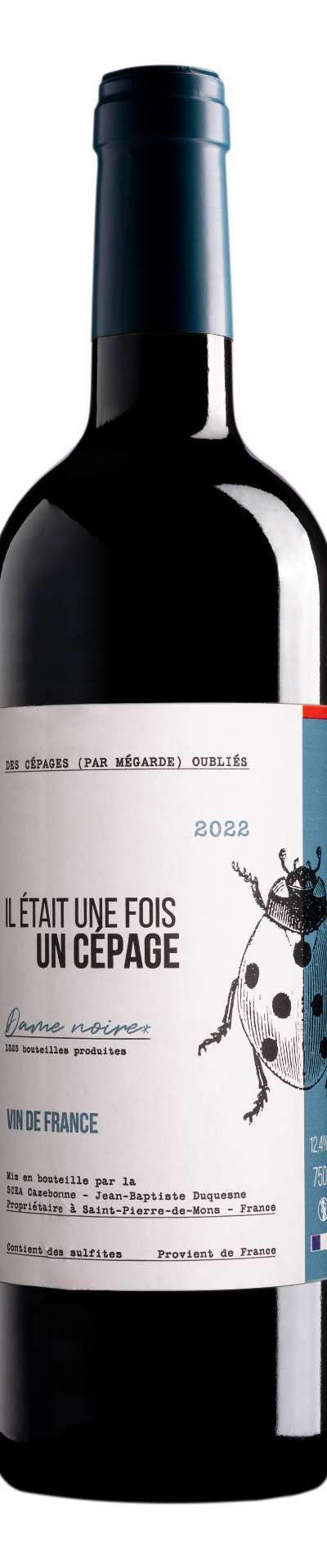 Our recommendation
 Go further
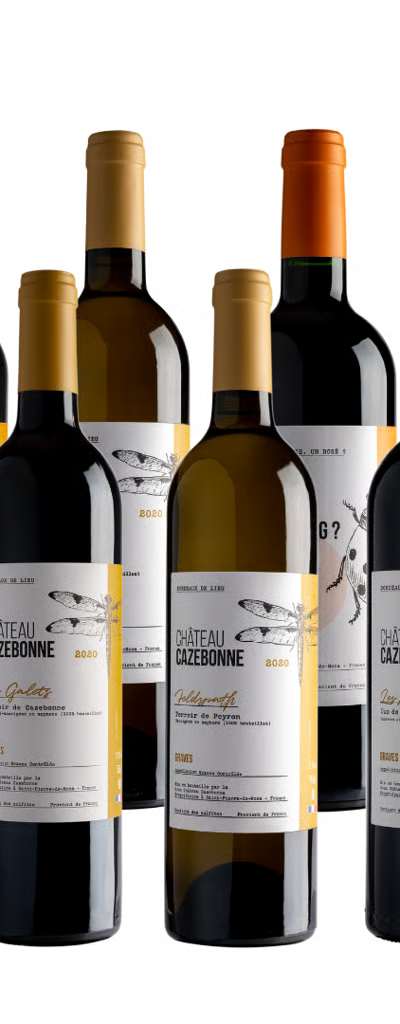
12 bottles — the whole range
12 bottles, the whole range tasted: the best discovery-to-price ratio.
The complete tour of the estate, in a single case.
I want itThe cellar, forgotten grape varieties and our cuvées, twice a month. 5% off your first order with the code BIENVENUE.