
 The essential92/100 RVF
Comme en 1900 red 2022
Vin de France — heritage grapes, 92/100 RVF
The pre-phylloxera Bordeaux blend, revived at the estate.
Castets, Mancin, Pardotte: the Bordeaux before Bordeaux.
I want itMérille
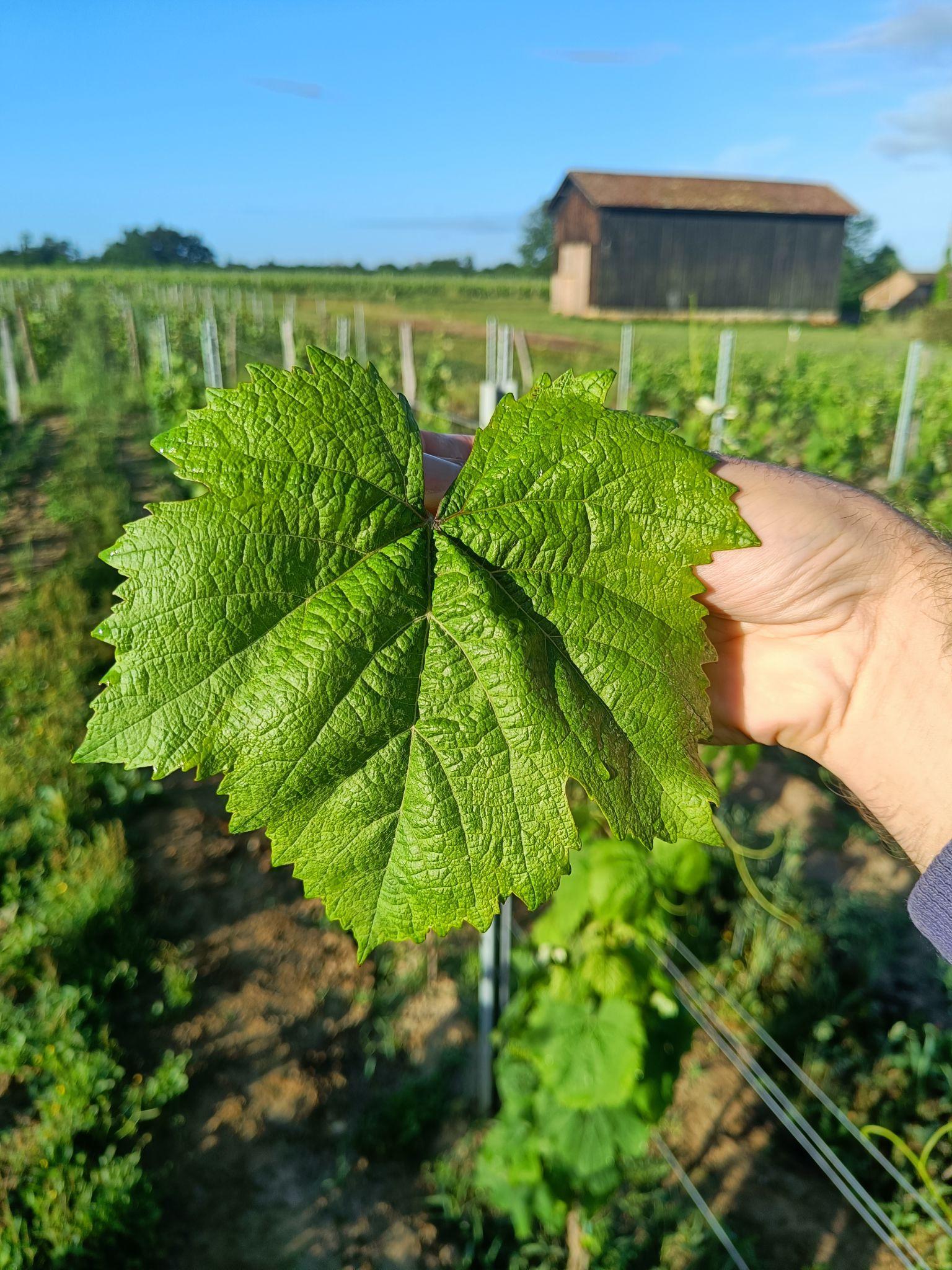
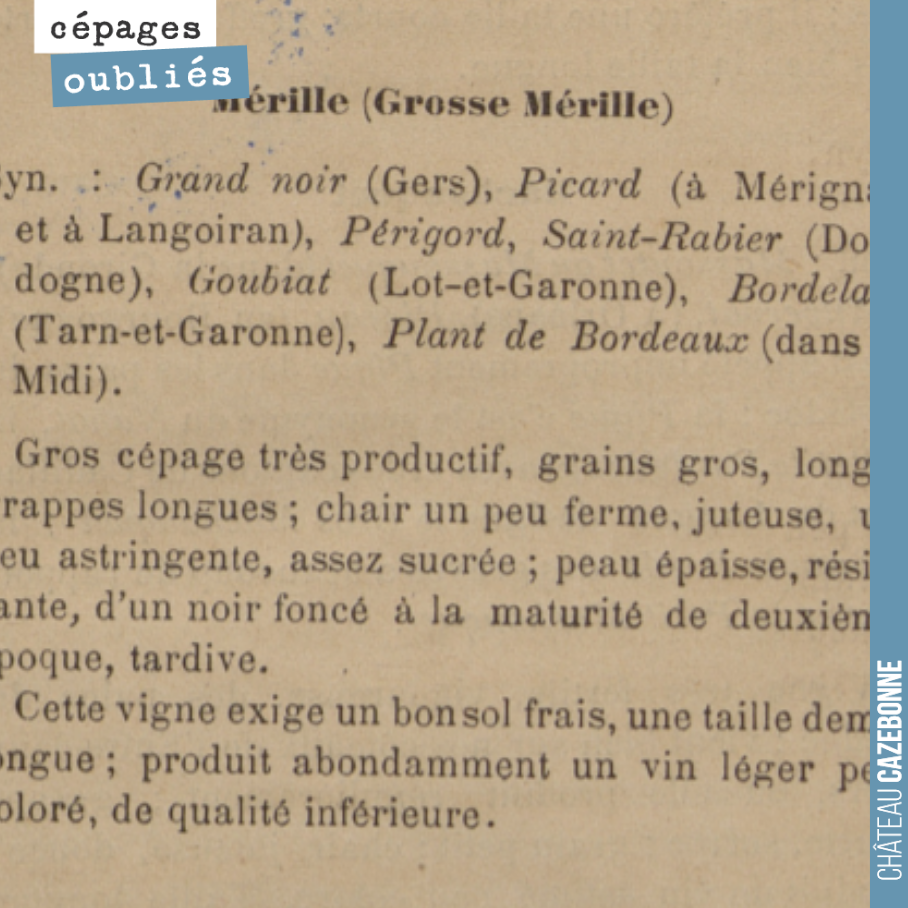
Mérille perfectly embodies one of those forgotten treasures of our Bordeaux wine heritage. Its history, punctuated by appearances and disappearances in the writings of ampelographers, bears witness to the richness and evolution of planting choices that have spanned the centuries. The first mention of this grape variety dates back to 1785, penned by Jean-Baptiste de Secondat. He distinguishes between "Petite Mérille", characterised by its round berries, and "Grosse Mérille", with oval berries, which was already listed among the red grape varieties of the time.
Over time, other iconic wine figures took an interest in it. Comte Odart, in 1844, also mentions Grosse Mérille, classifying it as a "second-line" grape variety in the Bordeaux region, thereby highlighting its presence, albeit secondary, in the viticultural landscape. But it was the Féret, in its 1878 edition, that marked a turning point by mentioning it in the category of grape varieties "tending to disappear". A premonition that unfortunately proved true since Mérille was not included in the list of secondary grape varieties during the Bordeaux appellation decree in 1935, effectively relegating it to the shadows of history.
| Characteristic | Description |
|---|---|
| Synonyms | Périgord, Plant de Bordeaux, Pouchou, Pounchon, Grosse Mérille, Bordelais, Boudoulès, Pica, Picard, Picardie, Saint-Rabier, Plant de Gibert |
| Budburst | Early (like Cabernet-Franc) |
| Flowering | One week after Merlot |
| Veraison | Late, up to 3 weeks after Chasselas |
| Ripening | Late second epoch (slightly before Cabernet-Sauvignon) |
| Vigour | Vigorous, highly productive |
| Growth habit | Upright |
| Susceptibility to downy mildew | Low susceptibility |
| Susceptibility to powdery mildew | Low susceptibility |
| Susceptibility to botrytis (grey rot) | Very low susceptibility |
| Susceptibility to black rot | Not specified |
| Aromatic profile | Potential for aromatic complexity |
| Winemaking potential | Produces relatively light, elegant and structured wines |
Historically, Mérille, also known by various names such as Périgord or Plant de Bordeaux, was a grape variety with a significant presence. Bisson noted that it could account for up to a quarter of red plantings in certain Bordeaux regions such as Graves, Réolais, Bas-Médoc and Premières Côtes. Despite its vigour and ability to produce in quantity, it had to be pruned short to ensure good ripening, especially as it could struggle to reach full maturity when yields were too high. Its resistance to coulure was also an asset. Its non-inclusion as a secondary grape variety in the 1935 Bordeaux appellation decree (which also relegated many forgotten grape varieties) marked the decline of its cultivation, the fate of many grape varieties having been profoundly altered following the phylloxera crisis in Bordeaux and the establishment of the AOCs.
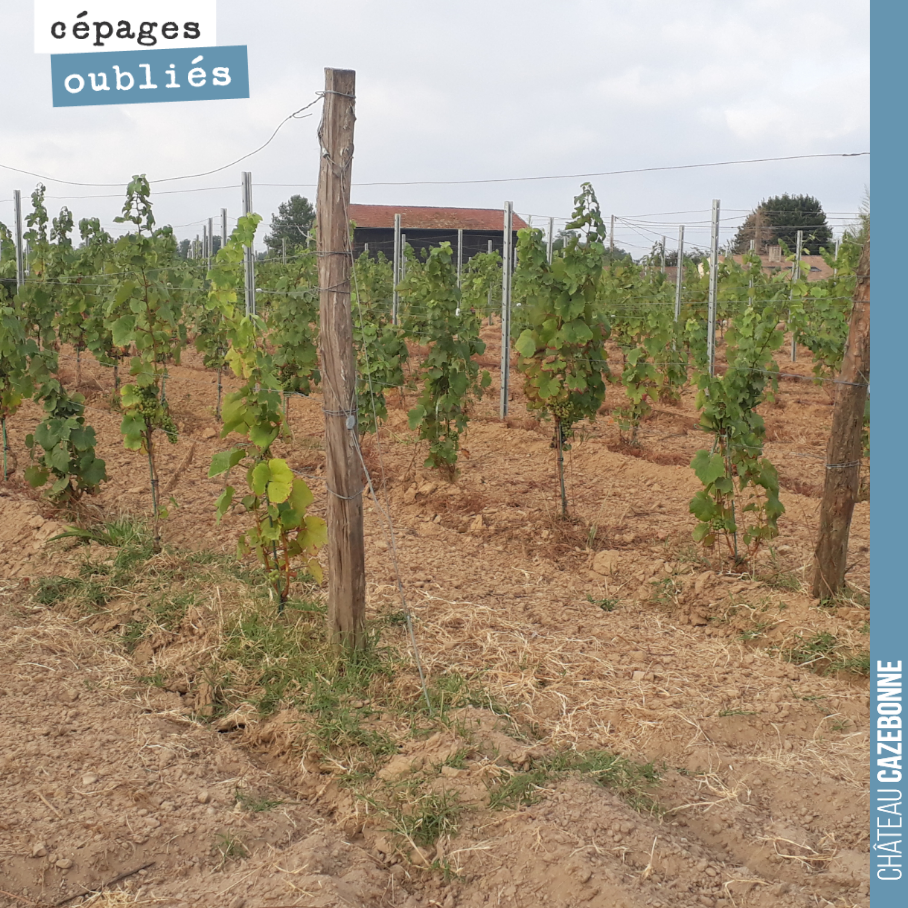
Despite its gradual fading, Mérille possesses notable agronomic qualities, which undoubtedly explain its historic presence in the vineyards. It is an early-budding grape variety, which can be an advantage in certain climatic conditions, notably to escape late frosts. Above all, it shows remarkable natural resistance. Having low susceptibility to powdery and downy mildew, it is also renowned for its low vulnerability to grey rot, a valuable asset for winegrowers seeking a more environmentally friendly viticulture that limits treatments. Although highly productive, it does, however, fear soils with excess moisture. Its ripening is late, classified as second epoch, which allows it to develop beautiful aromatic complexity and an elegant tannic structure when conditions are optimal.
At Château Cazebonne, we are convinced that these grape varieties of yesteryear, such as Mérille, have a role to play in the reinvention of Bordeaux wines, offering a palette of flavours and resilience in the face of current climate challenges. We are committed to reviving them, one vine at a time, to breathe life back into a little-known part of our heritage. This work of memory and perseverance is only possible thanks to the invaluable support of the many enthusiasts who have embraced our wines and share our passion for rediscovering the Bordeaux wine heritage, thereby helping to preserve the genetic richness of our vineyard. To learn more about the fascinating history of Bordeaux grape varieties and support our approach, do not hesitate to download the digital version of "Bordeaux, une histoire de cépages". You can also test your wine knowledge with our oenological quizzes, and of course, discover and taste our cuvées made from these rediscovered grape varieties, a testament to our commitment and the richness of our terroir. You can also find our writings on The Syrah grape variety (in Bordeaux).
Sources
Our suggestions
-5%on your 1st order with code BIENVENUE
The essential92/100 RVFVin de France — heritage grapes, 92/100 RVF
The pre-phylloxera Bordeaux blend, revived at the estate.
Castets, Mancin, Pardotte: the Bordeaux before Bordeaux.
I want it Our recommendation
IGP Atlantique — rare grape variety
A forgotten grape brought back: dense colour, wild fruit.
For the curious about lost grape varieties.
I want it Go further
12 bottles — the whole range
12 bottles, the whole range tasted: the best discovery-to-price ratio.
The complete tour of the estate, in a single case.
I want it
09 August 2023
06 September 2022
19 May 2021

30 April 2021
04 August 2020
18 February 2019
The cellar, forgotten grape varieties and our cuvées, twice a month. 5% off your first order with the code BIENVENUE.