The essential
6 × Entre Amis red
6 bottles — Graves red 2022
The best price of the cellar: €12 per bottle delivered.
The everyday red: generous and straight to the point.
I want itBindweed
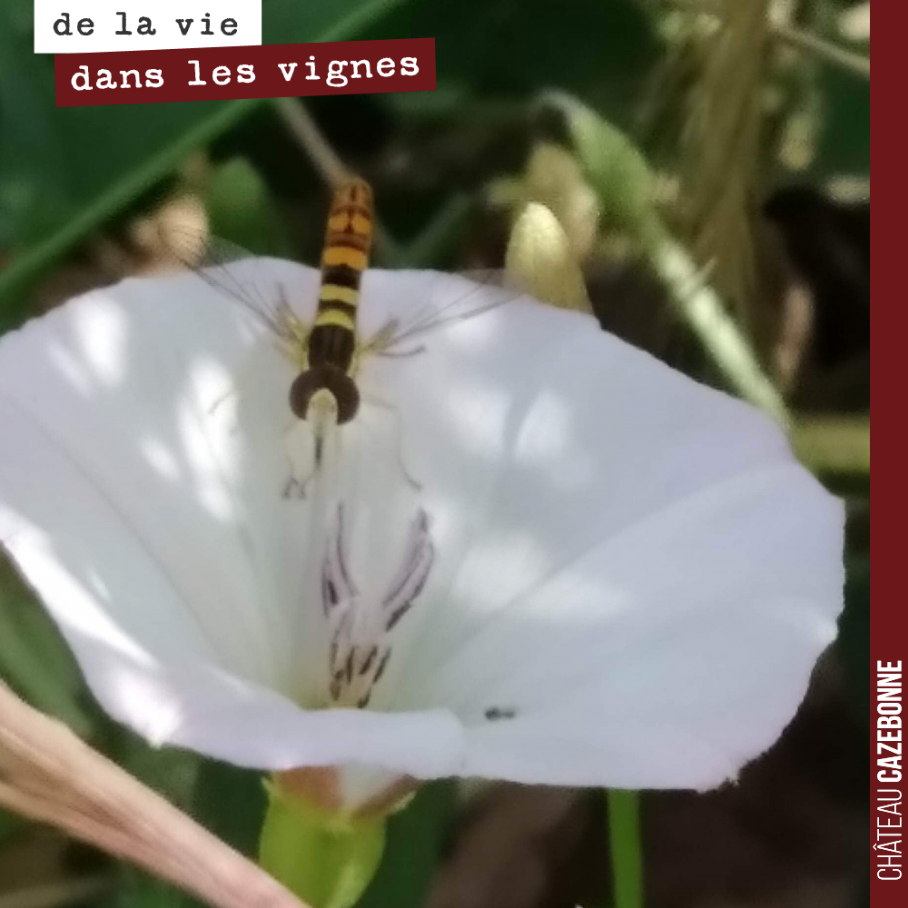
At the heart of our Château Cazebonne vineyard, we carefully observe every plant that finds its place there, sometimes interpreting the presence of one or another as a valuable indicator of the balances to be respected. Bindweed, a climbing plant of the Convolvulaceae family, is one of those species which, although often perceived as "invasive", reveals a fascinating facet of the biodiversity of our living soils. Characterised by its supple and twining stems, its heart-shaped leaves and its ephemeral, bell-shaped white, pink or purple flowers, bindweed is a symbol of vitality that populates our vine rows.
Far from being treated as an enemy, bindweed is observed as an actor in the ecosystem. Its deep roots, although sometimes competitive, participate in soil aeration, helping to improve its structure. Its presence can also play a role in protecting against erosion and excessive evaporation in summer, by creating a plant cover that retains moisture and provides shade to the ground. At Château Cazebonne, our approach to organic farming leads us to favour gentle management of this plant, promoting balance rather than systematic eradication. We are learning to live with bindweed, to understand it, and to integrate its presence into our global vision of biodiversity.
This approach to bindweed is emblematic of our philosophy: to restore an ecosystem where every element has its place and its role. It is in this same spirit that Château Cazebonne is passionately committed to replanting ancient and forgotten grape varieties in Bordeaux, such as Castets, Mancin, or Saint-Macaire. These varieties, once driven out of our terroirs, are today once again cultivated with care, bringing an aromatic richness and historical depth to our wines. This work of safeguarding and rehabilitation is only possible thanks to the unwavering support of the many enthusiasts who have adopted our wines, thereby helping to write a new chapter in Bordeaux's winemaking history.
Discover the unique expression of our terroirs and our rediscovered grape varieties by visiting the Cazebonne shop.
To find out more about the ancestral grape varieties of Bordeaux and our commitment, we also invite you to receive the digital version of the book "Bordeaux, une histoire de cépages", published by Éditions BBD and written by Jean-Baptiste Duquesne.
Bindweed, which is frequently encountered in our vineyards, comes in two main forms: field bindweed (Convolvulus arvensis) and hedge bindweed (Calystegia sepium). These two species, although similar in their overall appearance with their twining stems and funnel-shaped flowers, are distinguished by their habitat and size. Field bindweed is smaller and spreads its stems on the ground or to low heights, whilst hedge bindweed is more vigorous, capable of climbing high supports and smothering other plants.
Bindweed is a perennial plant characterised by its deep and extensive root system, capable of burying itself more than two metres down. This particularity gives it great resilience and allows it to draw water and nutrients even during periods of drought. In spring, its young shoots emerge, and flowering takes place from May to September at Cazebonne, offering pretty bells, often white or slightly pinkish, which enliven the landscape of the vineyard. The appearance of its heart-shaped leaves signals the beginning of its annual cycle, where it can coexist with the vine, especially when biodiversity is encouraged.
At Château Cazebonne, we observe bindweed as an integral part of the flora of our plots. It is often an indicator of living and well-structured soils. Its presence, far from being systematically harmful, contributes to the microbial life of the soil thanks to its root system. It is also a plant that participates in the enrichment of humus, providing organic matter and shelter for various organisms. This climbing plant can thus be an ally in managing ground cover in the vineyard.
The interaction of bindweed with the vine is complex and multifaceted. While excessive proliferation can compete with the vine for water and nutrients, particularly on young plantings, a moderate presence is managed in such a way as to avoid any negative impact. Its ability to cover the soil protects against erosion and maintains coolness, significant assets in the face of climatic variations. Furthermore, its flowers attract many pollinating insects, thus contributing to the overall balance of the ecosystem. We favour a gentle approach, such as undervine ploughing, to control its development without affecting the vitality of the soil. Some of us will recognise the beauty of plants like datura, often present in the same biotopes, adding to the charm of the plant diversity in our plots.
At Château Cazebonne, our approach to organic farming drives us to consider bindweed not as a weed to be eradicated, but as a component of our viticultural ecosystem. We observe its growth to understand its role and we only intervene when its development risks harming the vine, using environmentally friendly mechanical methods. This thoughtful management is in line with our desire to restore an ecosystem where every element has its place and its role.
This work of safeguarding and rehabilitation, like that of replanting forgotten grape varieties in Bordeaux, is made possible thanks to the unwavering support of the many enthusiasts who have adopted our wines. To deepen your knowledge, please feel free to download the digital version of the book "Bordeaux, une histoire de cépages", or test your skills on the subject with our oenological quizzes. And to discover the unique expression of our terroirs and our rediscovered grape varieties, visit our online shop without delay.
Sources
Our suggestions
-5%on your 1st order with code BIENVENUE
The essential6 bottles — Graves red 2022
The best price of the cellar: €12 per bottle delivered.
The everyday red: generous and straight to the point.
I want it Our recommendation92/100 RVF
6 bottles — Graves red 2022, 92/100 RVF
Rated 92/100 by La Revue du vin de France: a solid 10-year ageing potential.
Our Graves for ageing, the finest gateway to the estate.
I want it Go further
12 bottles — the whole range
12 bottles, the whole range tasted: the best discovery-to-price ratio.
The complete tour of the estate, in a single case.
I want itThe cellar, forgotten grape varieties and our cuvées, twice a month. 5% off your first order with the code BIENVENUE.