The essential
6 × Entre Amis red
6 bottles — Graves red 2022
The best price of the cellar: €12 per bottle delivered.
The everyday red: generous and straight to the point.
I want itSt. John's Wort
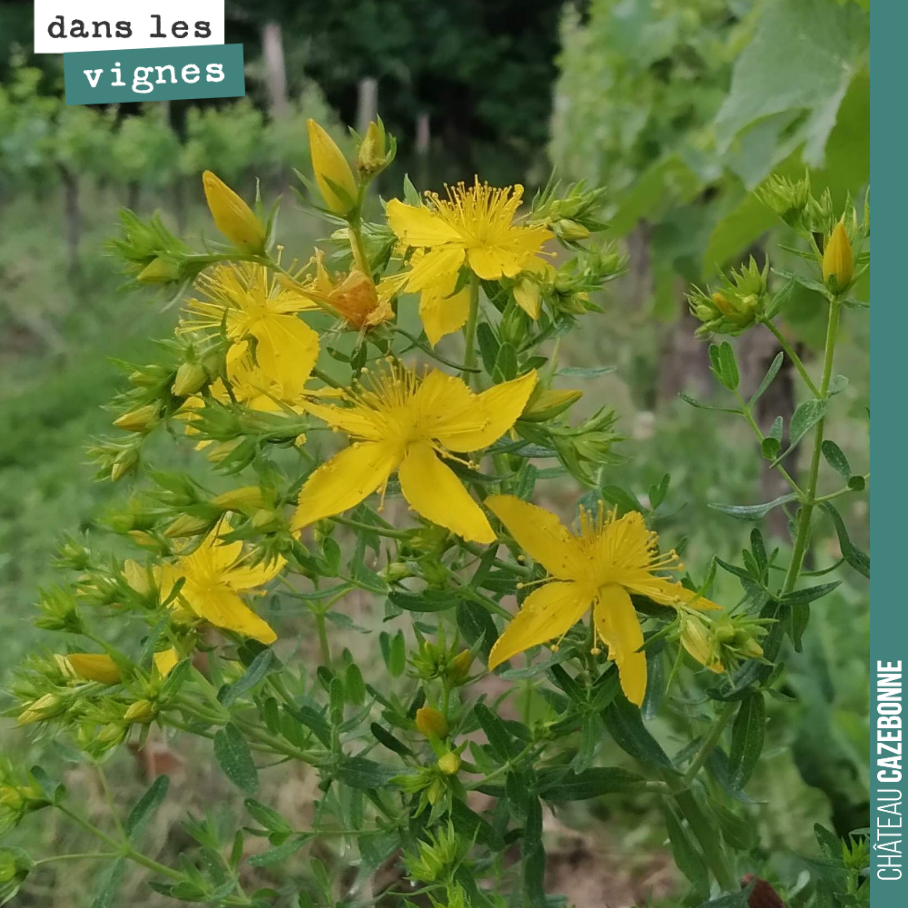
At the heart of our organic vines, St John's wort (Hypericum perforatum) stands elegantly, bearing witness to the rich biodiversity we cultivate at Château Cazebonne. This perennial herbaceous plant, recognisable by its opposite leaves and its bright, star-shaped yellow flowers that bloom during summer, is much more than a mere presence. Native to Europe and Asia, it flourishes spontaneously in our soils, acting as a precious indicator of their health and good balance.
The presence of St John's wort in our plots is not a coincidence. It signifies a vibrant, aerated and balanced terroir, actively participating in the functional biodiversity of the viticultural ecosystem. Its roots contribute to improving the soil structure, promoting better water infiltration and aeration conducive to the development of microbial life, which is crucial for living soils. Its flowers also attract a variety of pollinating and beneficial insects, essential for the natural balance of the vine and for reducing phytosanitary pressures.
St John's wort is a plant that fully blossoms during summer in our vineyards, with a flowering marked by its bright yellow flowers. Its annual life cycle offers a privileged observation of biodiversity in our agroecological approach to viticulture. It is mainly found in rather sunny and well-drained areas, conditions it frequently encounters in our grassed plots.
Beyond its ecological role, St John's wort has been renowned since Antiquity for its multiple medicinal virtues. Once used for its healing properties, particularly for skin wounds and in soothing balms, it embodies this plant wisdom which, in organic farming, guides us towards more respectful and autonomous practices. Its robustness and ability to flourish naturally in diverse environments reflect the resilience we seek to instil in our vines through our biodynamic practices, much like yarrow or the use of nettle manure, or even the benefits of chamomile. This approach also finds echoes in the study of the characteristics of other plants such as purple dead-nettle, which also contributes to the richness of our flora.
As Jean-Baptiste Duquesne points out in "Bordeaux, une histoire de cépages", the soils and the plants that inhabit them are the invisible architects of a great wine's identity. Each plant species contributes to the unique expression of our terroir. It is with this same perspective of preservation and promotion that Château Cazebonne is committed to replanting the forgotten grape varieties of Bordeaux. Castets, Mancin, Saint-Macaire... these botanical treasures are coming back to life in our vineyards thanks to the invaluable support of all the wine lovers who have embraced the uniqueness of our cuvées. This pioneering approach is shaping the new face of the Bordeaux vineyard, rooted in history and looking to the future.
This long-term endeavour at Château Cazebonne, consisting of reintroducing and promoting grape varieties that had disappeared from the Bordeaux landscape, is made possible thanks to the commitment of many enthusiasts. To discover this fascinating story in detail, we invite you to download the digital version of "Bordeaux, une histoire de cépages". Finally, test your knowledge of viticulture and oenology by taking part in our oenological quizzes, and feel free to discover our iconic wines online.
Sources
Our suggestions
-5%on your 1st order with code BIENVENUE
The essential6 bottles — Graves red 2022
The best price of the cellar: €12 per bottle delivered.
The everyday red: generous and straight to the point.
I want it Our recommendation92/100 RVF
6 bottles — Graves red 2022, 92/100 RVF
Rated 92/100 by La Revue du vin de France: a solid 10-year ageing potential.
Our Graves for ageing, the finest gateway to the estate.
I want it Go further
12 bottles — the whole range
12 bottles, the whole range tasted: the best discovery-to-price ratio.
The complete tour of the estate, in a single case.
I want itThe cellar, forgotten grape varieties and our cuvées, twice a month. 5% off your first order with the code BIENVENUE.