
 The essential
6 × Entre Amis red
6 bottles — Graves red 2022
The best price of the cellar: €12 per bottle delivered.
The everyday red: generous and straight to the point.
I want itMallow
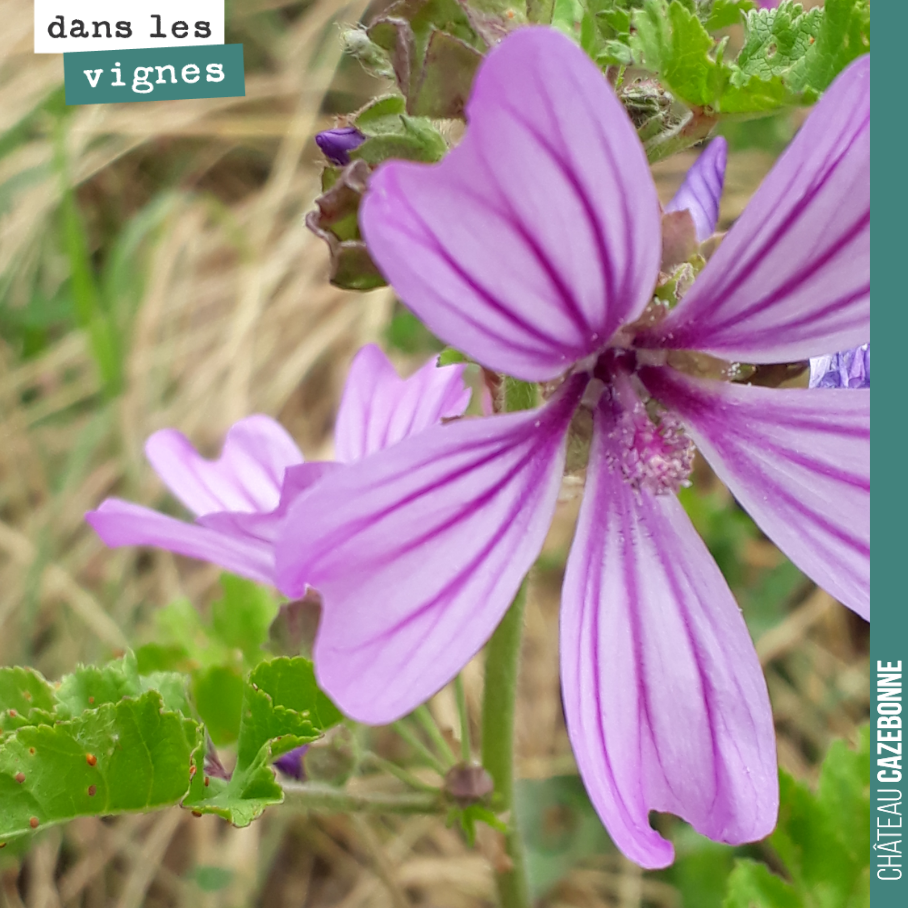
At Château Cazebonne, the presence of mallows, particularly the common mallow (Malva sylvestris), is fully in line with our agroecological approach. These perennial herbaceous plants, recognisable by their delicate flowers and graceful habit, are much more than a mere touch of colour in our plots. They are true sentinels of our soil's vitality and champions of biodiversity.
Mallows stand out with their palmate leaves and cup-shaped flowers, usually a mauve colour sometimes leaning towards pink or purple, adorned with darker veins. They can reach a considerable height, offering a pleasant visual display. Their life cycle spans several years, with flowering that begins in spring and often lasts until autumn, continuously brightening the vine rows.
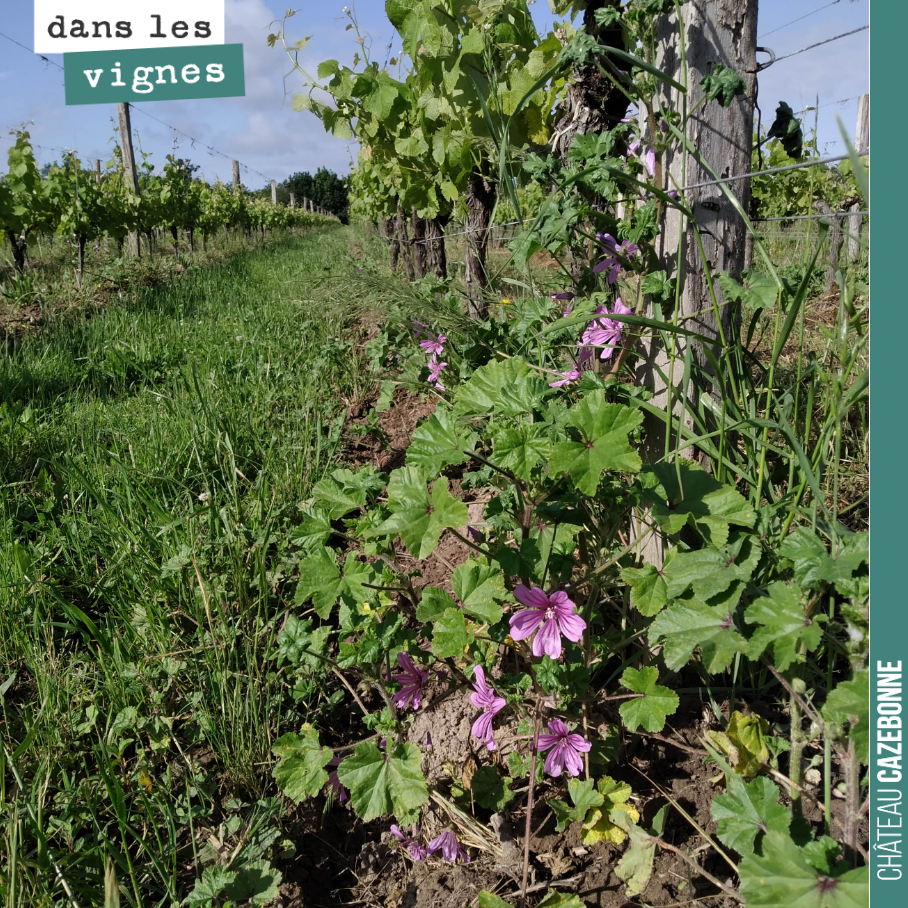
They are naturally found in grassy areas, along paths, and, of course, in the heart of our Bordeaux vineyards. At Cazebonne, we frequently observe them between and under the rows, particularly where the soil's microbial activity is most intense. Their ecological role is multiple and invaluable. Their deep roots help loosen clay soils, thereby improving their structure and water infiltration capacity, as highlighted by Jean-Baptiste Duquesne in his book "Bordeaux, une histoire de cépages".
Far from being mere weeds, mallows are essential allies for the vine. They are neither harmful nor simply neutral, but clearly beneficial. Their root system promotes better soil aeration, providing a favourable environment for the development of vine roots. Furthermore, their flowers are an important source of nectar and pollen, attracting a multitude of pollinating and beneficial insects, thus contributing to the natural regulation of pest populations. This diverse plant presence is a concrete indicator of living soil, which is essential for the resilience of our vines.
In practical terms, at Château Cazebonne, observing mallow in full bloom in our plots is a sign of a successful agronomic balance. It bears witness to our commitment to organic and biodynamic agriculture, where every element of the viticultural ecosystem plays a crucial role in crafting authentic wines that respect their terroir. It is by respecting these natural interactions that we manage to express the richness of our terroirs and the uniqueness of our forgotten grape varieties.
This work to safeguard and rehabilitate Bordeaux grape varieties also involves passing on knowledge, such as that found in our downloadable book "Bordeaux, une histoire de cépages", and continues with an invitation to test your knowledge with our oenological quizzes. We also invite you to discover the unique expression of our terroirs and rediscovered grape varieties by visiting our online shop.
Sources
Our suggestions
-5%on your 1st order with code BIENVENUE
The essential6 bottles — Graves red 2022
The best price of the cellar: €12 per bottle delivered.
The everyday red: generous and straight to the point.
I want it Our recommendation92/100 RVF
6 bottles — Graves red 2022, 92/100 RVF
Rated 92/100 by La Revue du vin de France: a solid 10-year ageing potential.
Our Graves for ageing, the finest gateway to the estate.
I want it Go further
12 bottles — the whole range
12 bottles, the whole range tasted: the best discovery-to-price ratio.
The complete tour of the estate, in a single case.
I want it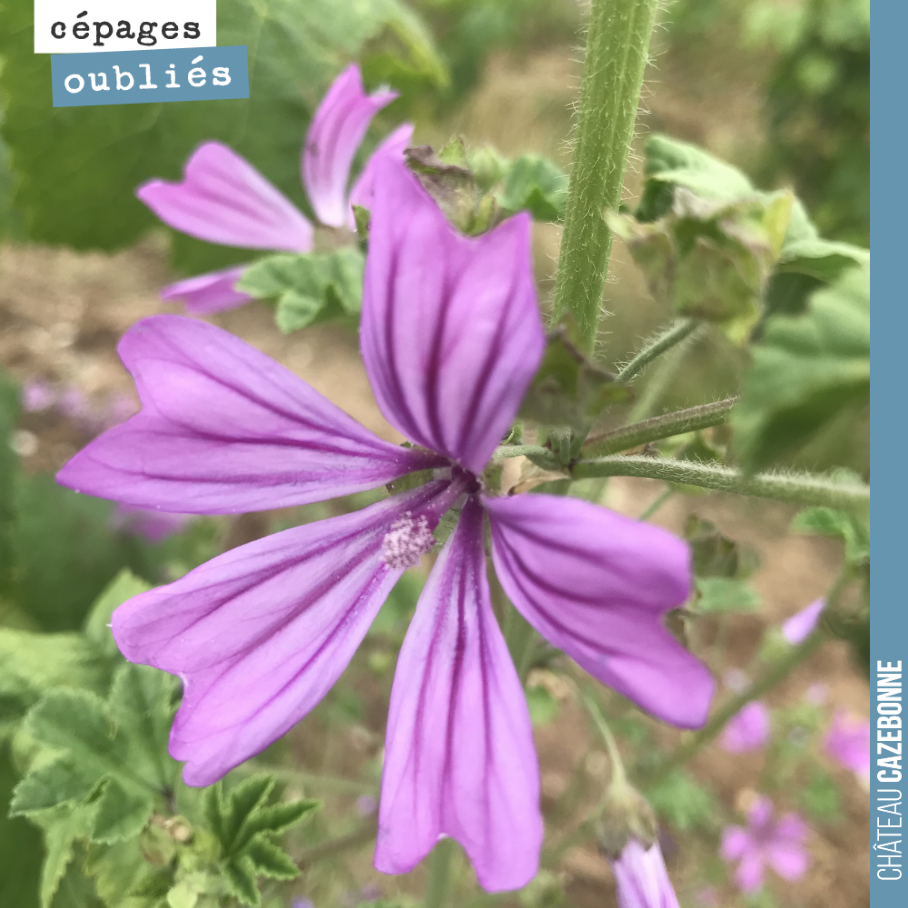
16 June 2020
07 June 2020
19 June 2019
The cellar, forgotten grape varieties and our cuvées, twice a month. 5% off your first order with the code BIENVENUE.