The essential
6 × Entre Amis red
6 bottles — Graves red 2022
The best price of the cellar: €12 per bottle delivered.
The everyday red: generous and straight to the point.
I want itBirds of prey
At the heart of Château Cazebonne's restored ecosystem, birds of prey reign supreme in the skies above our vineyards. These majestic birds, endowed with piercing eyesight and unparalleled aerial agility, are essential players in biodiversity. Buzzards, kestrels, and sometimes even discreet owls roam our parcels, acting as true natural sentinels. Their presence is a strong indicator of our environment's good health and the richness of the wildlife that thrives there.
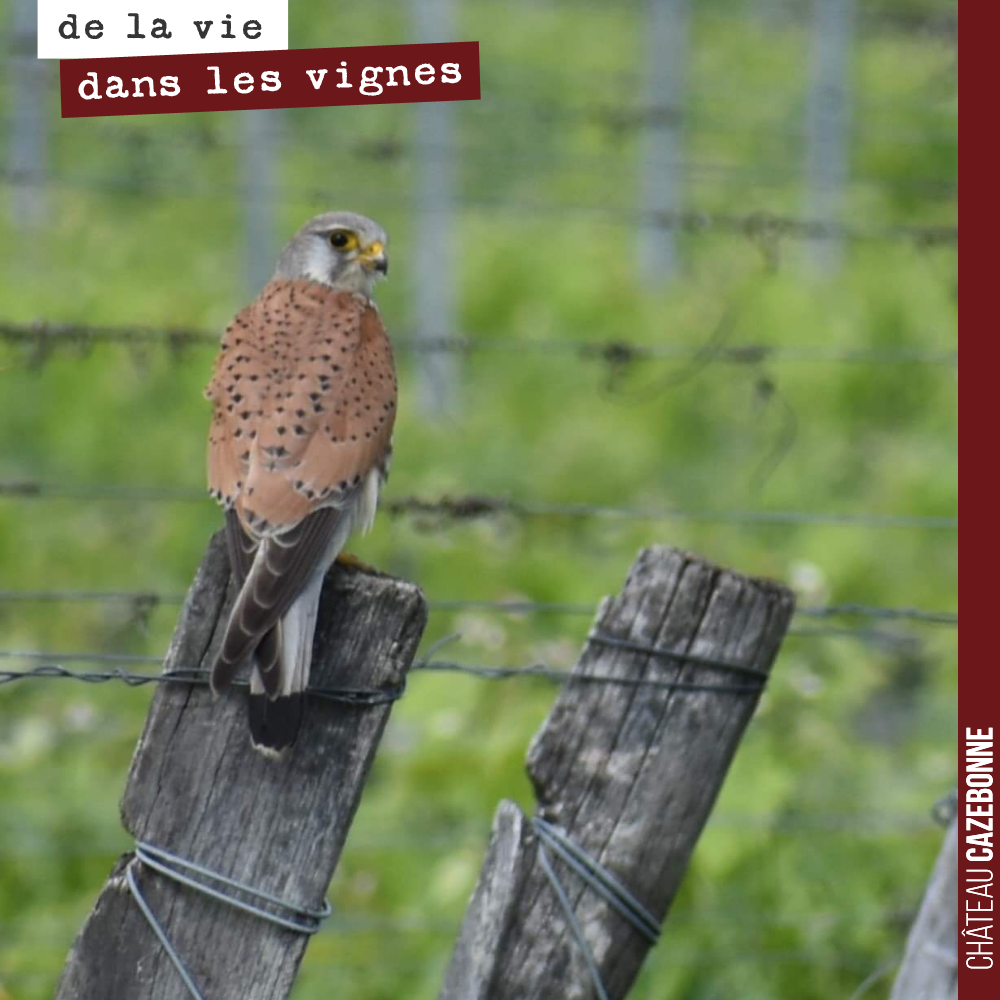
Diurnal birds of prey, most frequently observed in our vineyards during the day, mainly include the Common Buzzard (Buteo buteo) and the Kestrel (Falco tinnunculus). The buzzard, recognisable by its stocky silhouette and broad wings, often glides in circles, scanning the ground. The kestrel, smaller and with pointed wings, is famous for its characteristic hovering flight, the 'windhover', where it seems suspended in the air, motionless.
Come evening, nocturnal birds of prey take over. Among them, the Tawny Owl (Strix aluco) and the Little Owl (Athene noctua) can be heard or spotted, ensuring the regulation of rodent and insect populations during the night. Their discretion makes them harder to observe, but their role is no less crucial.
The cycle of birds of prey integrates perfectly with that of the vine. From spring, with budburst and flowering, these birds are active for breeding. Their hunting is particularly intense during the nesting and chick-rearing period, coinciding with high rodent activity. In summer and autumn, up to the harvest and beyond, birds of prey are always present, keeping the pressure on prey populations. Their presence throughout the year ensures continuous and natural regulation.
At Château Cazebonne, we encourage the settlement of birds of prey by preserving and creating suitable habitats. Groves, isolated trees, like those bordering our single-parcel cuvées, and uncultivated areas are essential nesting and roosting spots. Installing specific nest boxes for owls and kestrels is part of our approach to amplify their presence. These initiatives contribute to the general biodiversity of our estate, where every species has its place and a role to play.
Birds of prey play a fundamental ecological role. Their diet, mainly consisting of small rodents (voles, field mice) and birds deemed "pests" to crops, actively contributes to population regulation. By limiting the proliferation of these animals, they naturally protect our young vine plants from potential depredation and maintain a delicate balance within the ecosystem.
The interaction of birds of prey with the vine is highly beneficial. As natural predators of rodents and certain granivorous birds, they help protect the roots of young vines against damage from field mice and voles. Furthermore, they limit the damage caused by birds that might peck at the ripe berries before veraison. This natural collaboration allows us to reduce our interventions and cultivate our vines in the most respectful way possible, in line with our philosophy of virtuous and sustainable viticulture.
Every buzzard flight above our rows is a reminder of the importance of these predators for a living and balanced vineyard, where every species has its place and a role to play. The presence of the Kestrel, a true sentinel of the Cazebonne sky, is a daily spectacle, as is that of the Black Kite (Milvus migrans) with its broad dark wings, which can be seen gliding majestically above the parcels. These concrete observations testify to the good health of our viticultural environment and our commitment to agriculture that respects living ecosystems.
We invite you to discover our cuvées, the fruit of this passion and commitment. Our approach to reviving the Bordeaux viticultural heritage, by replanting the forgotten grape varieties that forged the identity of our terroir, is made possible thanks to the support of wine lovers who have embraced our wines. To deepen your knowledge of these resurrected grape varieties and Bordeaux viticultural history, feel free to visit our page dedicated to the book "Bordeaux, une histoire de cépages" or to test your knowledge with our oenological quizzes. And of course, you can find all our cuvées directly via our online shop.
Sources
Our suggestions
-5%on your 1st order with code BIENVENUE
The essential6 bottles — Graves red 2022
The best price of the cellar: €12 per bottle delivered.
The everyday red: generous and straight to the point.
I want it Our recommendation92/100 RVF
6 bottles — Graves red 2022, 92/100 RVF
Rated 92/100 by La Revue du vin de France: a solid 10-year ageing potential.
Our Graves for ageing, the finest gateway to the estate.
I want it Go further
12 bottles — the whole range
12 bottles, the whole range tasted: the best discovery-to-price ratio.
The complete tour of the estate, in a single case.
I want itThe cellar, forgotten grape varieties and our cuvées, twice a month. 5% off your first order with the code BIENVENUE.