
 The essential92/100 RVF
Comme en 1900 red 2022
Vin de France — heritage grapes, 92/100 RVF
The pre-phylloxera Bordeaux blend, revived at the estate.
Castets, Mancin, Pardotte: the Bordeaux before Bordeaux.
I want itConsequences of phylloxera in Bordeaux
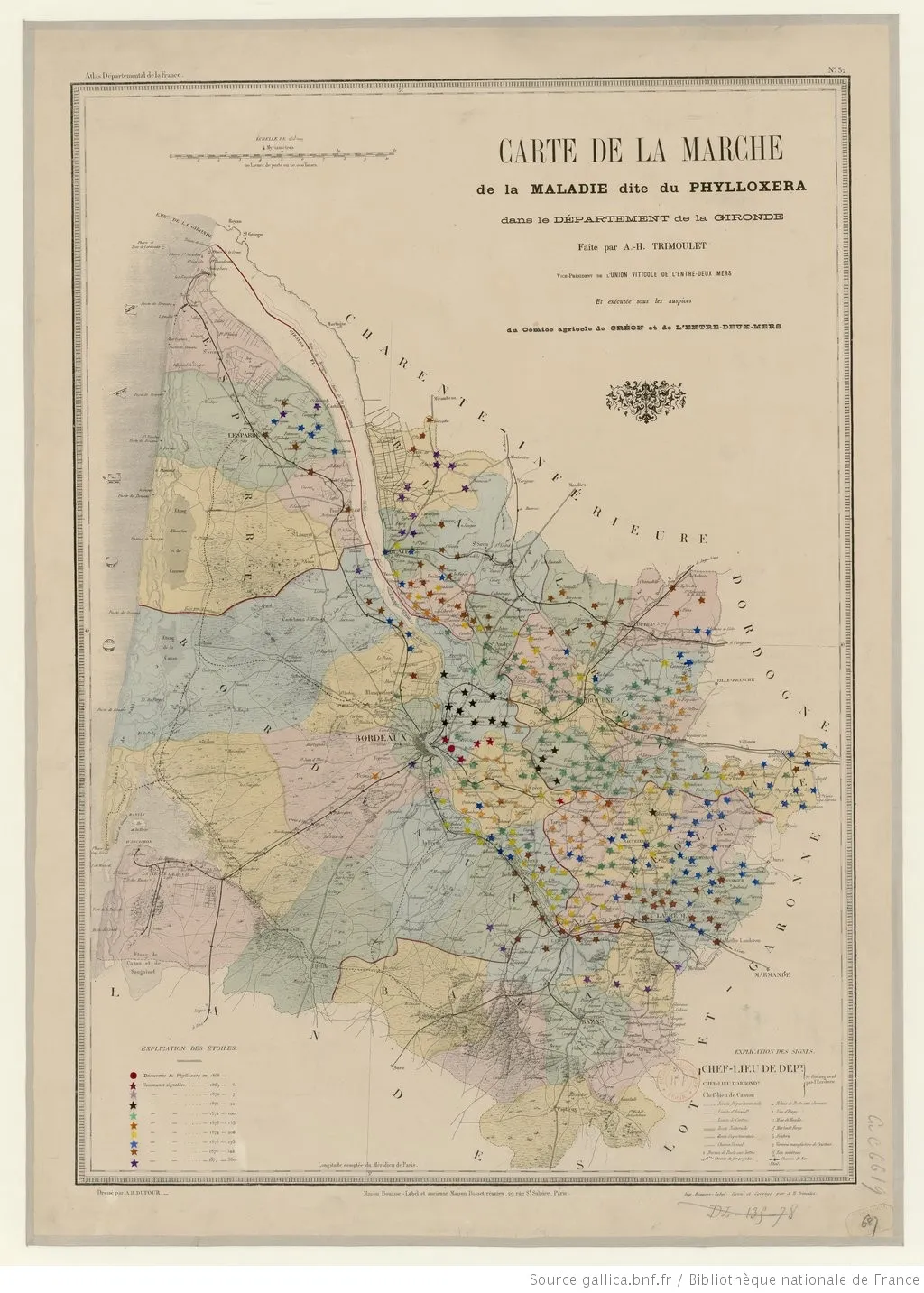
The phylloxera crisis, an epidemic of unprecedented scale that swept through French and European vineyards from the 1860s onwards, represents one of the most dramatic and defining turning points in viticultural history. Bordeaux, the flagship of world viticulture, was unfortunately not spared by this scourge, and its repercussions are still evident today in the region's grape varieties.
The culprit behind this catastrophe: phylloxera (Daktulosphaira vitifoliae), a tiny aphid native to North America, accidentally introduced into Europe. This formidable pest relentlessly attacks the roots of European vines (Vitis vinifera), depriving them of nutrients and inevitably leading to their death within a few years. It spread with lightning speed, devastating a large part of the French vineyard area in just a few decades.
The first recorded outbreaks of phylloxera in Europe date back to 1863, in greenhouses in Hammersmith near London, before spreading to Switzerland and France. The scourge broke out simultaneously in several parts of southern France as early as 1867. In Bordeaux, phylloxera appeared between 1865 and 1869, before spreading massively from 1872 onwards. Entre-deux-Mers was the first area affected, quickly followed by the whole of the Gironde. By 1880, more than half of the Bordeaux vineyard area was already either infected or completely destroyed, as noted by Jean-Baptiste Duquesne in his book. This crisis followed the powdery mildew (oïdium) crisis in Bordeaux which, between 1853 and 1856, had already considerably affected wine production.
The consequences were dramatic and multifaceted:
Massive destruction: Thousands of hectares of vines were uprooted, leaving desolate landscapes.
An unprecedented economic and social crisis: The loss of harvests plunged many winegrowers into deep poverty, triggering significant rural depopulation and the loss of ancestral expertise.
A desperate quest for solutions: Faced with the scale of the disaster, intense research was undertaken. Chemical soil treatments, such as carbon disulfide, proved costly, hazardous, and ineffective on a large scale. Winter flooding of vineyards, whilst effective in wetlands (palus), could only be applied to a tiny fraction of the vineyard.
Salvation finally came with the discovery of the natural resistance of American vines to phylloxera. The idea of grafting European grape varieties (Vitis vinifera) onto rootstocks derived from these resistant American vines, notably the "Isabelle" vine, proved decisive. While this method allowed the vineyard to be replanted, it had major and lasting consequences on Bordeaux's grape varieties:
Alteration of the vine/terroir balance: The vine was no longer in direct contact with its native soil, but via an intermediary (the rootstock), potentially altering the expression of terroir.
Selection and standardisation of grape varieties: The need to replant the vineyards rapidly, combined with the uneven adaptation of grape varieties to grafting, favoured certain varieties such as Merlot, which proved particularly well-suited to this technique. Unfortunately, this selection hastened the disappearance of many ancient or forgotten grape varieties, which were unable to adapt or deemed less "profitable".
The crisis period also saw the introduction of hybrid grape varieties, such as Clinton, Elvira, or Herbemont, which, although resistant, never accounted for more than 5% of the vineyard plantings at the time, even though this share rose above 30% after 1950. These hybrids, such as Clinton, Isabelle, Jacquez, Herbemont, or Othello, are today prohibited in the production of Appellation d'Origine Contrôlée wines.
Understanding the phylloxera crisis is therefore essential to grasp modern Bordeaux grape varieties. It is precisely with this approach that Château Cazebonne is committed, reviving these forgotten varieties and contributing to precious pre-phylloxera diversity. We invite you to discover our cuvées made from these rare grape varieties on the Cazebonne online shop. This long-term work is made possible thanks to the unwavering support of the many wine enthusiasts who have embraced our wines and share our passion for this viticultural heritage. To deepen your knowledge of Bordeaux wine history and grape varieties, and particularly the Dutch influence on Bordeaux wines, we also invite you to receive the digital edition of the book "Bordeaux, une histoire de cépages" by Jean-Baptiste Duquesne, published by Éditions BBD, by visiting our dedicated heritage grape varieties book page, and test your knowledge with our online wine quizzes.
Sources
Our suggestions
-5%on your 1st order with code BIENVENUE
The essential92/100 RVFVin de France — heritage grapes, 92/100 RVF
The pre-phylloxera Bordeaux blend, revived at the estate.
Castets, Mancin, Pardotte: the Bordeaux before Bordeaux.
I want it Our recommendation
IGP Atlantique — rare grape variety
A forgotten grape brought back: dense colour, wild fruit.
For the curious about lost grape varieties.
I want it Go further
12 bottles — the whole range
12 bottles, the whole range tasted: the best discovery-to-price ratio.
The complete tour of the estate, in a single case.
I want itThe cellar, forgotten grape varieties and our cuvées, twice a month. 5% off your first order with the code BIENVENUE.