08 October 2023
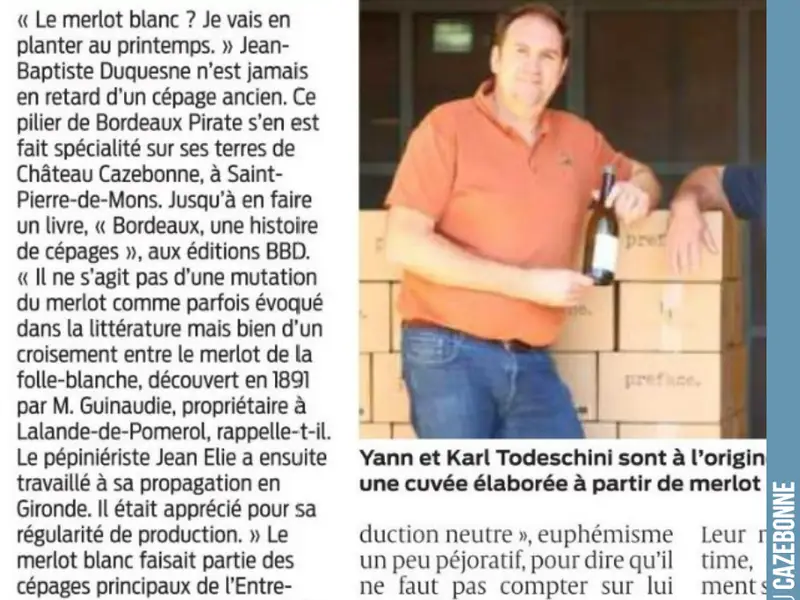
What if Merlot blanc returned to centre stage……Article published today in Sud-Ouest, on the occasion of the launch of a Merlot blanc cuvée by the Todeschini brothers.
By Jean-Baptiste Duquesne

Merlot blanc
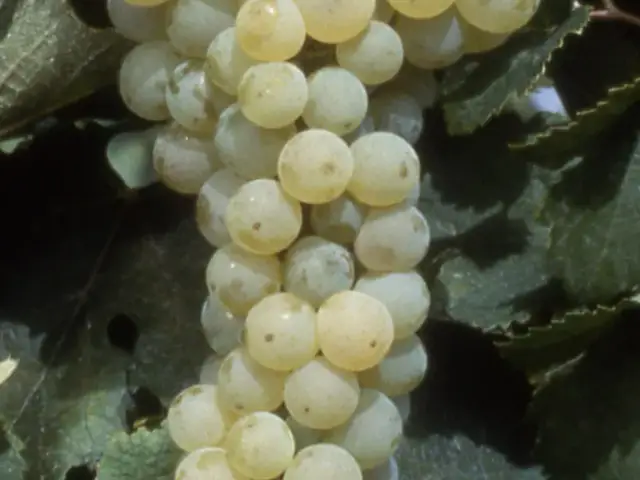
Although sharing part of its name with the famous red grape variety, Merlot Blanc is actually a distinct variety whose history and characteristics deserve to be explored. Not a cross of Pinot and Gouais as sometimes suggested, but a natural cross between Merlot and Folle Blanche, two varieties of great historical importance, thus establishing a direct lineage with red Merlot.
Recorded in Gironde under the name "Blanc de Nantes" according to Galet, it was listed in the Official Catalogue of Vine Varieties, highlighting its historical presence in the Bordeaux vineyard. Observations by Chauveau in the 1960s identified numerous Merlot Blanc vines in Gironde, attesting to its enduring, if now discreet, presence. It is therefore historically established in the region, alongside many other lost or forgotten Bordeaux varieties such as Saint-Macaire or Béquignol. Nonetheless, historical classifications could sometimes cause confusion. For example, Édouard Féret, in his 1878 "Statistique générale du département de la Gironde", listed a "Blanc-Auba" among the white grape varieties, also cited as a variety producing a highly sought-after wine in Sainte-Croix du Mont in the work "La vigne et le vin", without mentioning a specific Merlot Blanc.
| Characteristic | Description |
|---|---|
| Budburst | Early |
| Flowering | Mid-early |
| Véraison | Mid-late |
| Ripening | Late second epoch |
| Vigour | Medium to high |
| Growth habit | Semi-erect |
| Downy mildew susceptibility | Medium |
| Powdery mildew susceptibility | Medium |
| Botrytis susceptibility | Medium |
| Black rot susceptibility | Low |
| Aromatic profile | Fresh, well-balanced white wines with floral and citrus notes, sometimes mineral. |
| Winemaking potential | Suited to crafting crisp, dry white wines. |
Merlot Blanc produces rich, well-balanced white wines. Its aromatic profile is characterised by floral and citrus notes, occasionally accompanied by a subtle minerality, giving it genuine oenological interest, particularly for the production of dry white wines. In the face of climate change, this variety could offer an interesting avenue to complement the range of grape varieties in Graves white wines. Estates such as Château Cazebonne, dedicated to preserving and reviving forgotten varieties, take a keen interest in these grapes for their adaptive potential and the diversity they bring to the vineyard. Thanks to its late second-epoch ripening, Merlot Blanc could provide valuable resilience against increasingly hot summers. Its tasting profile, combining freshness and balance, makes it a genuine asset for producing varietal wines that fully express their terroir.
Our post of 8 October 2023, "What if Merlot blanc returned to centre stage?", shared a Sud-Ouest article published on the occasion of the launch of a Merlot blanc cuvée by the Todeschini brothers. We announced our plan to top-graft some in the spring in our conservatory plot at Cazebonne, and recalled that this grape variety is a cross between Merlot and Folle blanche, "and not a mutation of Merlot as is sometimes suggested in literature".
Merlot blanc was discovered in 1891 by Mr Guinaudie, an estate owner in Lalande-de-Pomerol, during a hunting trip outside the département. He named it after the resemblance of its leaves and the bunch's susceptibility to mildew attacks. The nurseryman Jean Élie then worked on propagating it in Gironde, where it was appreciated for its consistent production. Productive, with a higher potential alcohol than Ugni blanc, it has compact bunches prone to rot, and its early budburst leaves it vulnerable to spring frosts.
Listed among the principal grape varieties of Entre-Deux-Mers in the 1936 decree, it became a secondary variety in the 1950s, before disappearing from most Bordeaux appellation decrees. It is still permitted in Bordeaux if it accounts for less than 30% of the blend.
Merlot Blanc is one of those grape varieties that, while lesser-known today, contributed to the diversity and richness of our viticultural heritage. Château Cazebonne is committed to preserving and championing these historic varieties. You can explore this rich legacy by downloading our book "Bordeaux, une histoire de cépages", testing your knowledge with our wine quizzes, or discovering our wines directly in our online shop.
Sources
The cellar, forgotten grape varieties and our cuvées, twice a month. 5% off your first order with the code BIENVENUE.