The essential
6 × Entre Amis red
6 bottles — Graves red 2022
The best price of the cellar: €12 per bottle delivered.
The everyday red: generous and straight to the point.
I want itCutworm
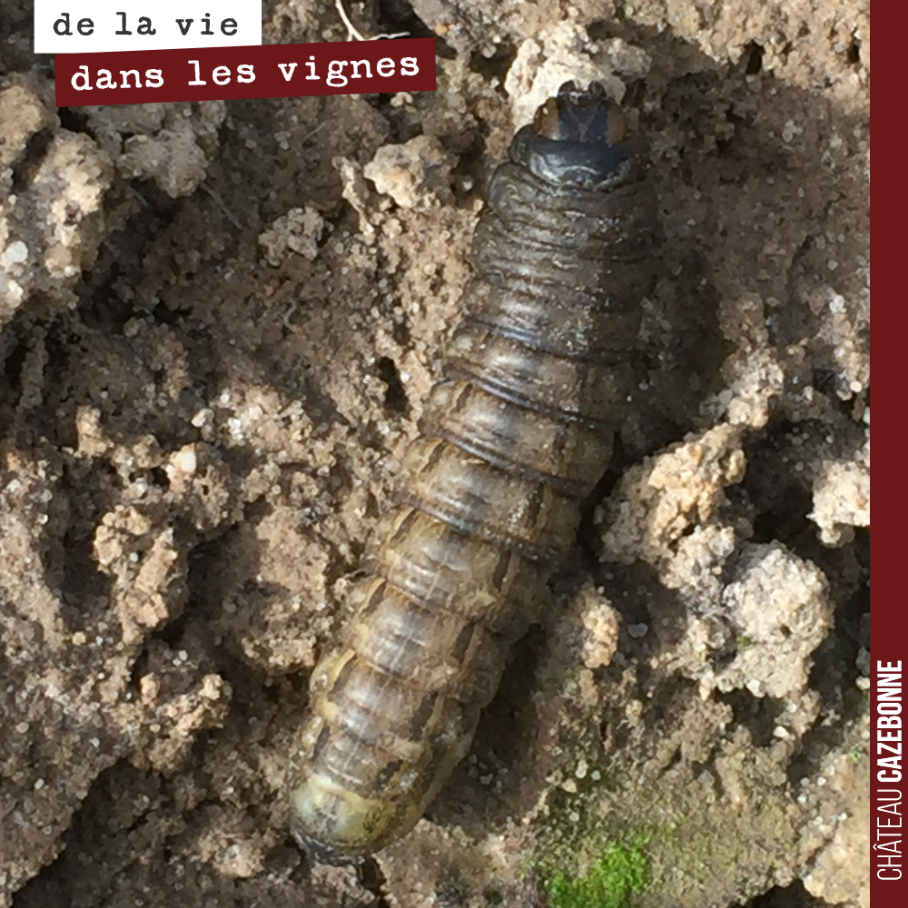
Within the rich biodiversity that characterises our Bordeaux vineyard landscapes, the noctuid moth (genus *Noctua*) is an emblematic figure, often little-known to the general public. Belonging to the vast Noctuidae family, these moths are distinguished by their crepuscular and nocturnal activity. Their wings, in a colour palette ranging from brown to grey, are subtly adorned with discreet patterns, allowing them to blend into their environment with great skill. Around 25,000 species of noctuid moths are recorded worldwide, with some being common in our latitudes. Their presence in the vineyard is not insignificant and bears witness, in many respects, to the complex interactions that we observe and seek to balance at Château Cazebonne.
Noctuid moths are heteroceran insects, meaning moths with antennae of various shapes, but never clubbed, which is typical of diurnal butterflies. Their bodies are generally stout and covered in dense hair. The adult noctuid moth, with its wingspan varying according to the species (often between 2 and 5 cm), is characterised by cryptic colours, ranging from light brown to black, with patterns and spots that help it to camouflage itself on tree bark or the ground. These moths are primarily active from dusk until dawn.
The life cycle of the noctuid moth is fascinating and closely linked to the seasons. After mating, the female lays her eggs on various food plants. From these eggs hatch larvae, commonly known as caterpillars. These caterpillars are voracious and go through several developmental stages, moulting each time. After reaching their maximum size, they transform into pupae, usually in the soil, from which the adult moth will emerge. Several generations can succeed one another during a year, with the duration of each cycle being strongly influenced by climatic conditions and the availability of food. This seasonality is the subject of careful observation within our estate, as part of our sustainable viticulture approach.
At Château Cazebonne, we observe noctuid moths and their larvae throughout our terroir, particularly in areas where the spontaneous flora is rich and diverse. The presence of wild plants and the existence of embankments or planted hedges provide a suitable habitat and a biodiversity reservoir for these insects. These refuge areas are essential to foster natural balances and guarantee a healthy environment for local wildlife.
The ecological role of noctuid moths is twofold. The adults, as moths, participate in the pollination of certain plant species, thus contributing to the richness of the biodiversity. Their larvae, on the other hand, constitute an important food source for many natural predators such as birds, spiders, or other insects. They play a role in the food chain and population regulation.
The interaction of noctuid moths with the vine can be complex. While many noctuid moths contribute positively to the ecosystem by feeding on nectar and pollen, thus participating in pollination, other species, through the action of their larvae, can present challenges for crops. These larvae, fond of young shoots, buds, and tender leaves, are known for their potential to influence plant growth, including that of the vine. However, this pressure is often limited and forms part of a natural balance that we seek to preserve at Cazebonne.
At Château Cazebonne, our approach is not limited to the simple management of insect populations. We aspire to a genuine coexistence with local wildlife, including noctuid moths, by establishing cultural practices that strengthen biodiversity and foster natural balances. We regularly observe the presence of caterpillars in the vines, but rarely at thresholds requiring significant interventions. This vigilance is part of our philosophy of a viticulture that understands and respects the natural dynamics of its terroir. Jean-Baptiste Duquesne, in his book "Bordeaux, une histoire de cépages", highlights the centuries-old interdependence between the vine and its biological environment, reaffirming the importance of every organism, even the most modest, in the great tapestry of life.
This work of balance and respect for living things is deeply rooted in the identity of Château Cazebonne and allows us today to replant forgotten grape varieties in Bordeaux, varieties that had almost disappeared from our vineyard landscapes, such as Béquignol or Saint-Macaire. This ambitious and exciting project is only made possible thanks to the invaluable support of the many enthusiasts who have adopted our wines and share our vision of a respectful, sustainable viticulture that is intrinsically linked to the richness of its ecosystem. To learn more about our approach and the history of Bordeaux grape varieties, we invite you to download the digital version of our book "Bordeaux, une histoire de cépages" or to test your knowledge via our oenological quizzes. And of course, you can always discover the expression of our terroirs and our philosophy by exploring our wines online.
Sources
Our suggestions
-5%on your 1st order with code BIENVENUE
The essential6 bottles — Graves red 2022
The best price of the cellar: €12 per bottle delivered.
The everyday red: generous and straight to the point.
I want it Our recommendation92/100 RVF
6 bottles — Graves red 2022, 92/100 RVF
Rated 92/100 by La Revue du vin de France: a solid 10-year ageing potential.
Our Graves for ageing, the finest gateway to the estate.
I want it Go further
12 bottles — the whole range
12 bottles, the whole range tasted: the best discovery-to-price ratio.
The complete tour of the estate, in a single case.
I want itThe cellar, forgotten grape varieties and our cuvées, twice a month. 5% off your first order with the code BIENVENUE.