
19 October 2023
This document is a cornerstone in understanding the reasons that led to the choice of grape varieties known in Bordeaux today in the context of the creation of the first AOCs in 1935
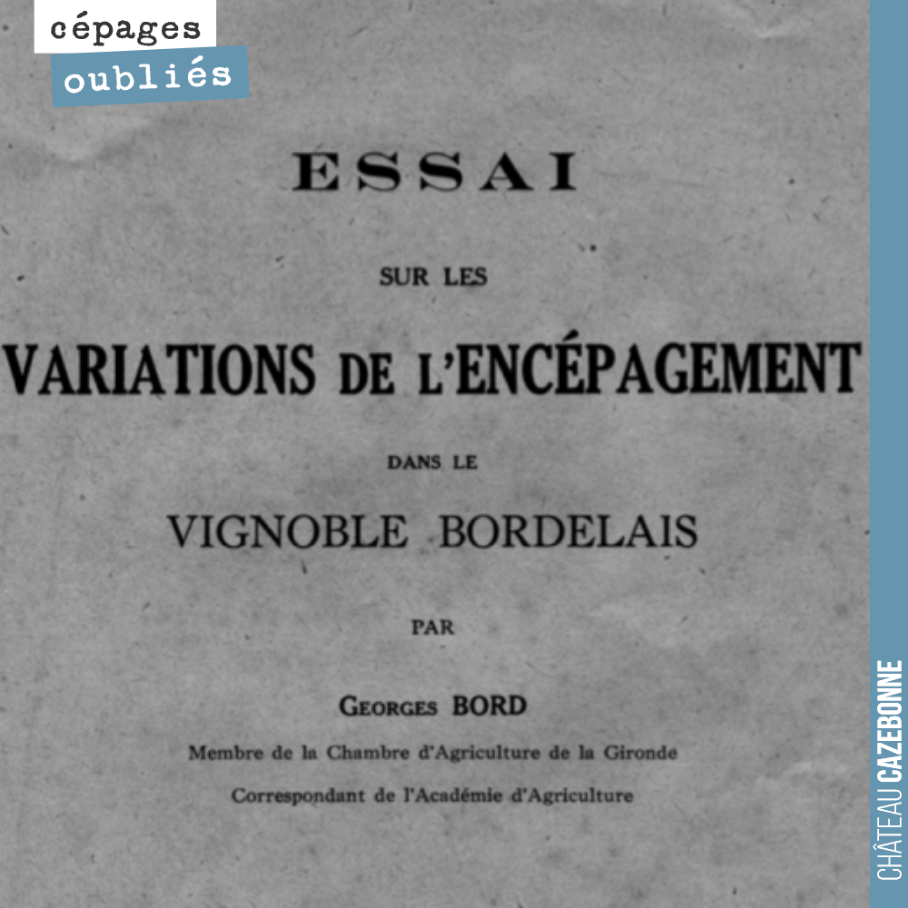
This document is a cornerstone in understanding the reasons that led to the choice of grape varieties we know in Bordeaux today in the context of the creation of the first AOCs in 1935.
The author draws on all the 19th-century literature praising the quality of Cabernet Sauvignon, Merlot and other Sauvignons/Sémillons. He therefore concludes that these varieties must be adopted without the slightest hesitation. Secondary grape varieties were tolerated in 1935, and winegrowers were given 10 years to grub them up. This would indeed happen after the 1956 frost and the subsequent need to replant a large part of the vineyard. Secondary varieties would permanently disappear in Bordeaux in favour of Merlot for reds and Sauvignon for whites.
Without disputing the quality of the grape varieties Bordeaux chose, George Bord’s reasoning seems questionable to me on two points.
19th-century authors mainly visited the vineyards of the Médoc and Sauternes, 1855 estates with already substantial vineyard areas. It is worth remembering that the Pont de Pierre was only built in the mid-19th century, making access to the Right Bank vineyards more complicated. These Médoc and Sauternes estates had skilled estate managers capable of magnifying the quality of the Left Bank grape varieties.
In 1850, there were 200,000 winegrowers in Gironde, and one can naturally assume that these smallholdings struggled to produce compelling wines with their local grape varieties. But to conclude from this that the varieties they vinified were of lesser quality...
Thirdly, in the 19th century, vineyards were ungrafted (en franc de pied), making the perfect match between a grape variety and its terroir essential. Outside of Graves soils, Cabernet Sauvignon was susceptible to root rot. It could not establish itself on the Right Bank. It was the widespread adoption of grafting after phylloxera that enabled a broader spread of Médoc varieties onto the Right Bank.
Without this essay, Bordeaux’s encépagement might never have been the same. It is up to us, Bordeaux winegrowers, to replant and give this immensely rich ampelographic heritage another chance. We will find solutions there for the future.
Our suggestions
Treat yourself
-5%on your 1st order with code BIENVENUE
 The essential92/100 RVF
Comme en 1900 red 2022
Vin de France — heritage grapes, 92/100 RVF
The pre-phylloxera Bordeaux blend, revived at the estate.
Castets, Mancin, Pardotte: the Bordeaux before Bordeaux.
I want it Our recommendation
La Dame Noire 2023
IGP Atlantique — rare grape variety
A forgotten grape brought back: dense colour, wild fruit.
For the curious about lost grape varieties.
I want it Go further
Discovery case, 12 bottles
12 bottles — the whole range
12 bottles, the whole range tasted: the best discovery-to-price ratio.
The complete tour of the estate, in a single case.
I want it