The essential
6 × Entre Amis red
6 bottles — Graves red 2022
The best price of the cellar: €12 per bottle delivered.
The everyday red: generous and straight to the point.
I want itPhacelia
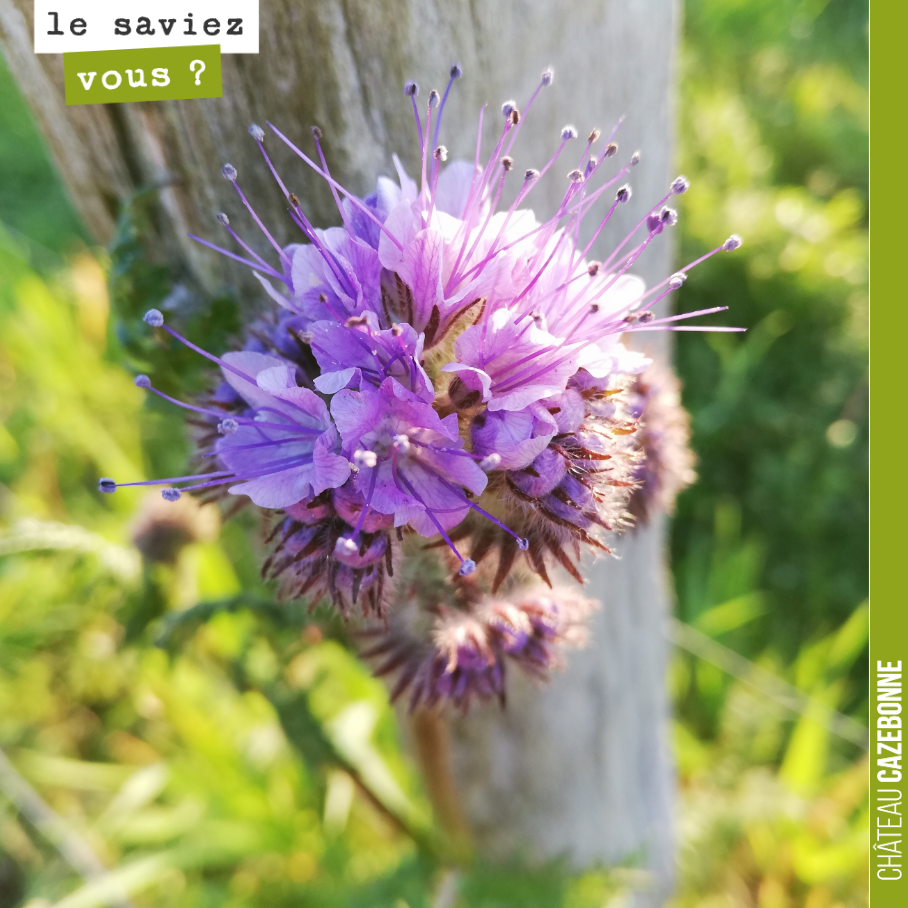
Lacy phacelia (Phacelia tanacetifolia) is an annual plant in the Boraginaceae family, a name that evokes its elegant, fiddlehead-coiled flower heads. Also known as tansy-leaved phacelia, purple tansy or blue tansy, it is far more than just a plant with striking purple or blue flowers. At Château Cazebonne, we regard it as a genuine partner to our vines and a key contributor to the vitality of our soils.
Generally standing between 30 and 60 cm in height, this plant is distinguished by its finely dissected foliage, reminiscent of tansy, and its profuse flowering. Yet beyond its aesthetics and delightful fragrance, its agronomic benefits are manifold. Carefully sown between our vine rows as part of our organic farming practices, phacelia works on several fronts.
Firstly, its root system—both fine and deep—acts as a true soil architect. The roots work the soil gently, aerating it and considerably improving its structure. This natural action is essential to prevent soil compaction, a persistent challenge in many vineyards. A well-aerated soil encourages better rainwater infiltration, thereby reducing run-off and erosion while optimising the availability of this vital resource for the vine, particularly during dry spells. Its dense canopy also creates a natural mulch, limiting evaporation and shielding microbial life from direct sunlight.
Secondly, phacelia is a champion of biodiversity. Rich in nectar and pollen, its flowers provide an abundant food source for a host of pollinating insects, notably honeybees and bumblebees, which are essential to ecosystem balance. It also attracts numerous beneficial insects, such as hoverflies and ladybirds, whose larvae are voracious predators of vineyard pests. This biocontrol strategy, where nature itself regulates unwanted insect populations, lies at the very heart of our philosophy. As Jean-Baptiste Duquesne explains in his book "Bordeaux, une histoire de cépages", "the richness of a terroir also depends on the subtle balance of its flora and fauna, fostering natural resilience".
Lacy phacelia is an annual plant, meaning it germinates, flowers, sets seed and dies back within a single growing season. At Château Cazebonne, it typically blooms in spring and early summer, carpeting our parcels with eye-catching purple and blue blossoms. These flowers, clustered in scorpioid cymes, are instantly recognisable and provide a much-appreciated visual spectacle.
On our estate at Cazebonne, phacelia is ideally established as a cover crop between the vine rows. It thrives in well-drained, sunny soils—conditions characteristic of our terroirs. Its presence serves as a clear indicator of the health of our living soils and our steadfast commitment to agroecology in viticulture.
Its ecological role reaches far beyond the supply of nectar. By penetrating deep into the ground, phacelia roots enhance soil structure and porosity. In doing so, they facilitate the circulation of water and air, curtailing erosion and run-off. As it decomposes, the biomass of phacelia enriches the soil with organic matter, aiding the formation of humus, which is vital for soil fertility and microbial life. It therefore acts directly on soil flora and fauna, creating an ideal environment for the vine.
In practice, phacelia interacts synergistically with our vineyard. Not only does it actively help protect against pests by attracting beneficial fauna, but its rapid, dense ground cover also suppresses competing weeds. This natural competition reduces the need for mechanical weeding and contributes to more effective ground-cover management in the vineyard, an integral part of our biodynamic approach. The result is stronger, more resistant vines and soils that are far more resilient in the face of climatic variability.
The presence of lacy phacelia across our estate reflects our commitment to plant diversity and a healthy environment. By nurturing this biodiversity, we foster a living soil that nourishes our vines, enabling us to craft wines that express the purity and complexity of our terroir. This rich, balanced ecosystem is also a vital asset in our mission to revive Bordeaux’s forgotten grape varieties. At Château Cazebonne, we passionately replant historic varieties such as Castets and Mancin—grapes that tell a crucial part of Bordeaux's viticultural history and are now reclaiming their rightful place. This preservation work is made possible thanks to the steadfast support of the many wine lovers who have embraced our wines, helping us write a new chapter in the story of the Bordeaux vineyard. To discover more about these varieties and our philosophy, we invite you to download the digital edition of our book "Bordeaux, une histoire de cépages". Feel free to test your wine knowledge with our quizzes, or explore the unique expression of our terroirs and revived grape varieties by visiting the Cazebonne online shop.
Sources
Our suggestions
-5%on your 1st order with code BIENVENUE
The essential6 bottles — Graves red 2022
The best price of the cellar: €12 per bottle delivered.
The everyday red: generous and straight to the point.
I want it Our recommendation92/100 RVF
6 bottles — Graves red 2022, 92/100 RVF
Rated 92/100 by La Revue du vin de France: a solid 10-year ageing potential.
Our Graves for ageing, the finest gateway to the estate.
I want it Go further
12 bottles — the whole range
12 bottles, the whole range tasted: the best discovery-to-price ratio.
The complete tour of the estate, in a single case.
I want itThe cellar, forgotten grape varieties and our cuvées, twice a month. 5% off your first order with the code BIENVENUE.