The essential
6 × Entre Amis red
6 bottles — Graves red 2022
The best price of the cellar: €12 per bottle delivered.
The everyday red: generous and straight to the point.
I want itSpeedwell
At Château Cazebonne, we cultivate our vines with the care of a passionate gardener, observing every detail, every sign of life. In the heart of our Bordeaux plots, where the earth breathes and teems with biodiversity, a discreet little plant particularly catches our eye: wall speedwell (Veronica arvensis). A humble yet essential member of the vast Plantaginaceae family, this annual herbaceous plant is a regular feature in our soils. Native to Europe and Asia, it is also known under the evocative name of "corn speedwell".
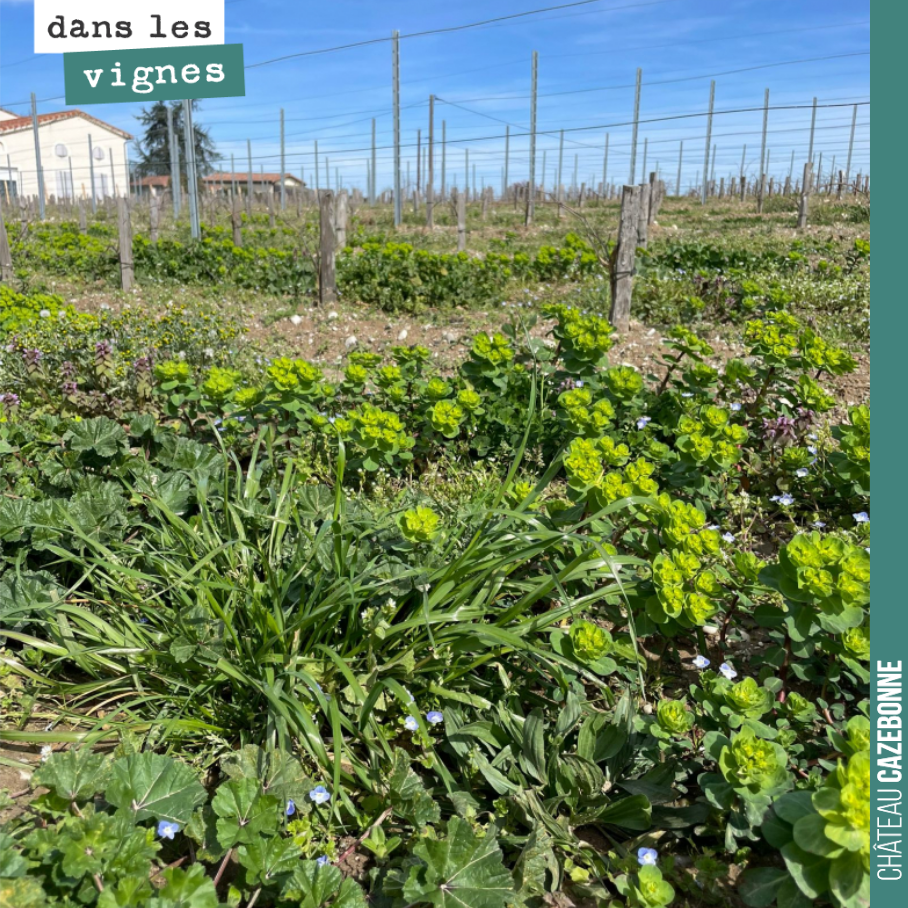
It modestly spreads its creeping or upright stems, rarely exceeding 30 centimetres in height. Its small leaves, delicately lobed and serrated, evoke the shape of miniature oak leaves, giving rise to its French common name ("petit-chêne"). From the very first gentle rays of spring, tiny azure-blue flowers, sometimes tinged with violet or pearly white, brighten the vineyard floor. These corollas, subtle though they may be, are a genuine beacon for pollinating insects, actively contributing to the rich insect biodiversity working silently between our rows.
Yet beyond its modest beauty, wall speedwell is for us a valuable indicator of the health and vitality of our soils. Its balanced presence signals a living, well-aerated soil with a structure conducive to the harmonious development of the vine. It bears witness to a soil that does not suffer from excessive tillage or compaction, and thanks to its fine root system, helps maintain good soil porosity. Far from being viewed as a mere "weed", we consider it a partner, an integral part of the complex ecosystem found in our organically farmed vineyards. As Jean-Baptiste Duquesne emphasizes, observing these indicator plants is vital to understanding and respecting the terroir.
At Château Cazebonne, we find it mainly in the inter-rows of our parcels, where it thrives on natural grass cover and minimal soil disturbance. Its flowering period, spanning from early spring to late summer, makes it a long-standing companion to the vine, actively participating in the dynamics of our gravel terroirs. This annual plant self-seeds spontaneously, ensuring its life cycle and ongoing contribution to the balance of the ecosystem.
The presence of wall speedwell is a positive sign for the biodynamic winegrower. Its shallow root system limits water competition with mature vines while preventing erosion. It contributes to maintaining the structure of living soil and encourages microbial activity, an essential element for soil fertility. As a host plant, it can also provide shelter for beneficial vineyard organisms. Its role is therefore overwhelmingly positive, aligning perfectly with our commitment to encouraging biodiversity and agricultural practices that respect living organisms.
At Château Cazebonne, observing wall speedwell and countless other floral species reminds us at every moment of the importance of preserving and cherishing our botanical heritage. This same philosophy guides us in more ambitious projects deeply rooted in Bordeaux's viticultural history: the reintroduction of almost forgotten grape varieties. Historic varieties such as Castets, Mancin, and Saint-Macaire, once pillars of our region's wine identity, are finding new life in our parcels today. This meticulous and passionate conservation work is made possible only through the warm and unwavering support of wine lovers everywhere. By embracing the unique flavours of our cuvées, they actively help write a new chapter in Bordeaux wine history, defined by diversity, authenticity, and respect for life. If you wish to learn more about other plants beneficial to our vineyard ecosystem, explore borage, tassel hyacinth, or red deadnettle. They too play an important role in our soil biodiversity.
To deepen your knowledge of this fascinating history and the grape varieties that shaped our region, we invite you to download the digital version of the book "Bordeaux, une histoire de cépages". And to test your knowledge, feel free to try our wine quizzes. Finally, discover the unique expression of our terroirs and revived grape varieties by visiting the Cazebonne shop.
Sources
Our suggestions
-5%on your 1st order with code BIENVENUE
The essential6 bottles — Graves red 2022
The best price of the cellar: €12 per bottle delivered.
The everyday red: generous and straight to the point.
I want it Our recommendation92/100 RVF
6 bottles — Graves red 2022, 92/100 RVF
Rated 92/100 by La Revue du vin de France: a solid 10-year ageing potential.
Our Graves for ageing, the finest gateway to the estate.
I want it Go further
12 bottles — the whole range
12 bottles, the whole range tasted: the best discovery-to-price ratio.
The complete tour of the estate, in a single case.
I want itThe cellar, forgotten grape varieties and our cuvées, twice a month. 5% off your first order with the code BIENVENUE.