The essential
6 × Entre Amis red
6 bottles — Graves red 2022
The best price of the cellar: €12 per bottle delivered.
The everyday red: generous and straight to the point.
I want itSpurge
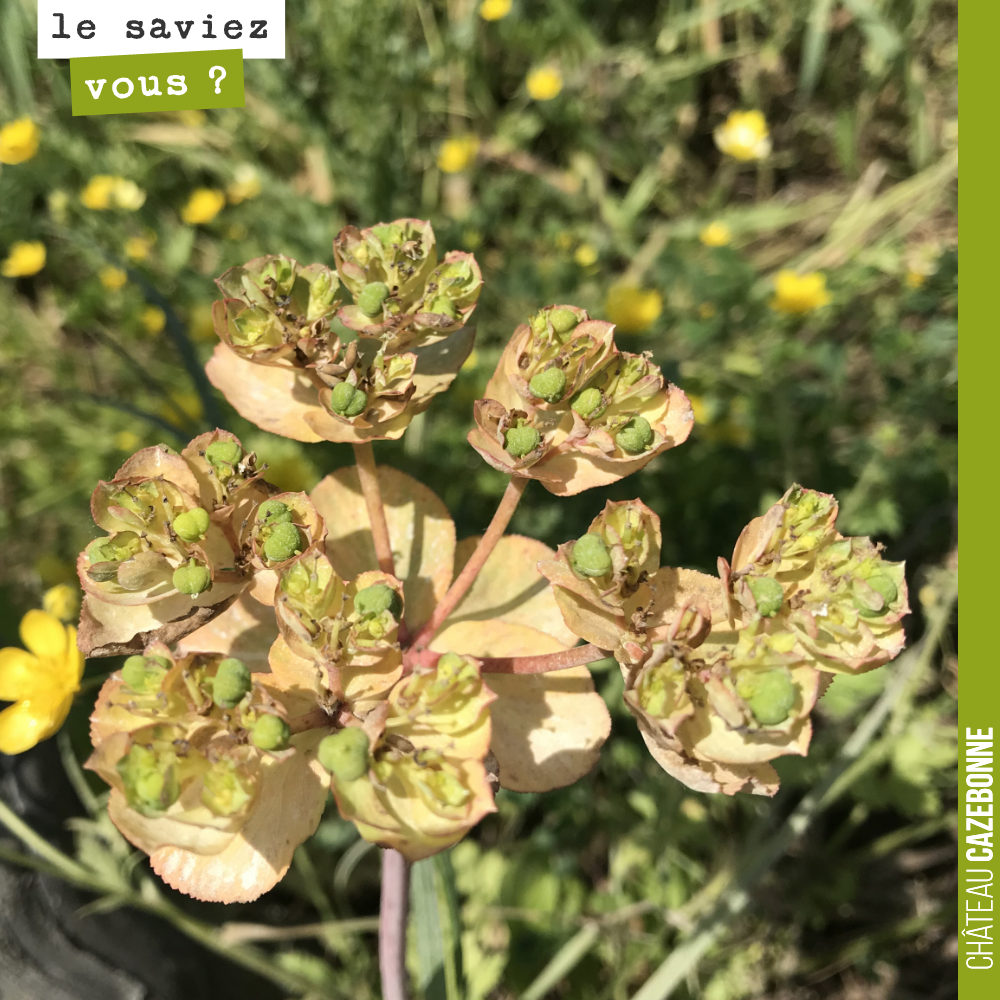
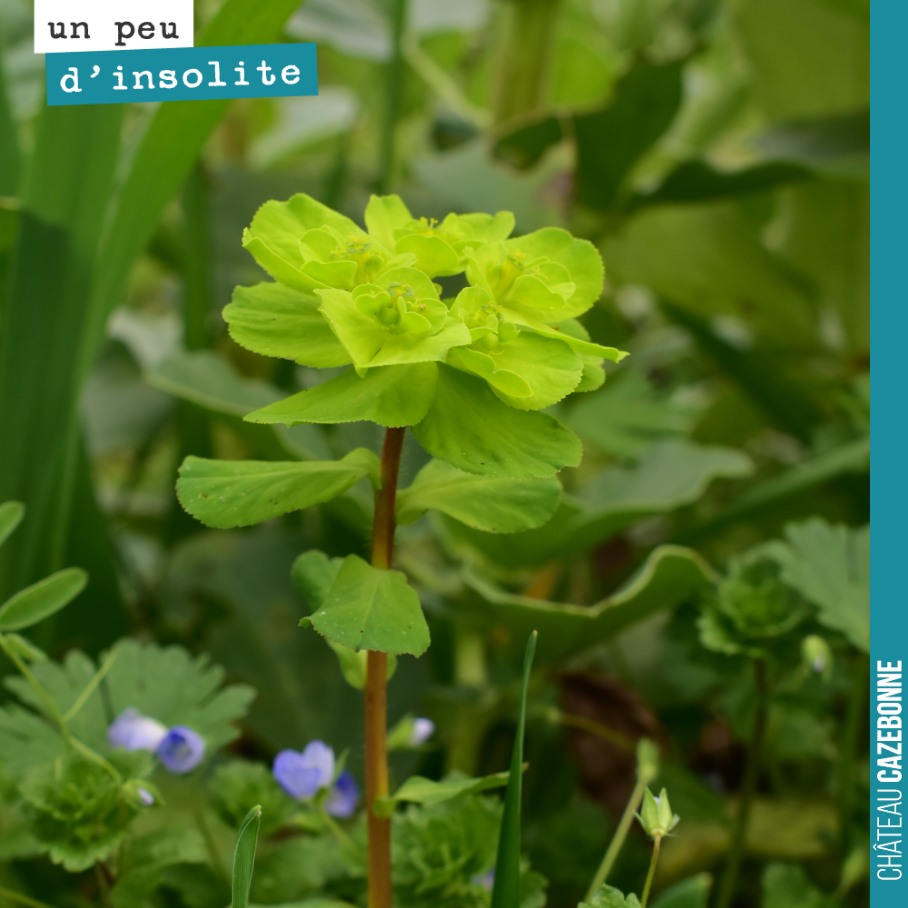
At Château Cazebonne, we pay close attention to every inhabitant of our living soils. Spurge, with its diversity and specificities, is a perfect example. This plant genus, belonging to the vast Euphorbiaceae family, comes in a multitude of annual or perennial species, discreetly present between our vine rows. They are distinguished by their simple or lobed leaves and their inflorescences, which are often grouped in clusters, displaying colours ranging from white to green, through to yellow.
Known by its botanical name Euphorbia, spurge manifests itself in various forms in our plots. From the small sun spurge (Euphorbia helioscopia) present from spring onwards, to the more discreet and creeping prostrate spurge (Euphorbia prostrata), the great variety of this botanical genus brings an unsuspected richness to the vineyard's ecosystem. Their flowers, known as cyathia, are often modest but essential for pollinating insects. They can reach varying sizes, from a few centimetres for annuals to several tens of centimetres for certain perennials, such as the wood spurge (Euphorbia amygdaloides) that can be found on the edge of the forest.
The life cycle of spurges adapts to the rhythms of the vineyard. Annual species germinate in spring, flower during summer, and produce their seeds before autumn, thus enriching the spontaneous flora of our soils. Perennial spurges, on the other hand, persist from one year to the next, offering continuous plant cover. They thrive particularly well in the well-drained soils of our clay-limestone plots, taking advantage of winter and spring moisture to establish their growth before withstanding the summer drought.
Far from being mere "weeds", spurges play a significant role in the balance of our viticultural ecosystem. Certain species, through their root systems, participate in the aeration and structuring of our living soils, thus contributing to better water infiltration. Others, due to their leaf density, help to retain soil moisture and limit excessive weed growth and erosion, thereby preserving the richness of our terroirs. Their presence is a valuable indicator of the good agronomic health of our plots, a testament to the biodiversity we strive to cultivate through organic farming.
Spurge interacts beneficially with our vines. By decompacting the soil, it promotes vine root development and access to nutrients. Its plant cover protects the soil from extreme thermal variations and provides shelter for various beneficial insects that participate in the natural regulation of pest populations. It thus helps to limit the need for phytosanitary interventions, fully aligning with our agroecological approach.
At Château Cazebonne, we carefully observe the presence and diversity of spurges. Their verdant flowering brightens up the vine rows and testifies to the vitality of our soils. Observing these plants is also a way for us to understand the complexity and resilience of our environment. As Jean-Baptiste Duquesne points out in his book "Bordeaux, une histoire de cépages", the richness of the flora contributes to the unique expression of a terroir. Every spurge, just like every blade of alfalfa or clover, silently contributes to the life of the soil, this invisible but essential foundation that nourishes our vines and shapes the singularity of our wines.
In the same way that we value spontaneous flora, we work passionately towards the reintroduction of another essential part of Bordeaux's biodiversity: ancient grape varieties. Through the preservation of forgotten varieties such as Castets, Mancin, and Saint-Macaire, we are recreating a genetic diversity that bears witness to the viticultural history of our region and promises unprecedented aromatic expressions. This safeguarding work is made possible thanks to the support of the many enthusiasts who, by choosing our wines, help to revive this precious plant heritage. To find out more about the ancestral grape varieties of Bordeaux and our commitment, as well as about datura, we also invite you to discover our book "Bordeaux, une histoire de cépages" or to test your knowledge. Discover the unique expression of our terroirs and our rediscovered grape varieties by visiting the Cazebonne shop.
Sources
Our suggestions
-5%on your 1st order with code BIENVENUE
The essential6 bottles — Graves red 2022
The best price of the cellar: €12 per bottle delivered.
The everyday red: generous and straight to the point.
I want it Our recommendation92/100 RVF
6 bottles — Graves red 2022, 92/100 RVF
Rated 92/100 by La Revue du vin de France: a solid 10-year ageing potential.
Our Graves for ageing, the finest gateway to the estate.
I want it Go further
12 bottles — the whole range
12 bottles, the whole range tasted: the best discovery-to-price ratio.
The complete tour of the estate, in a single case.
I want itThe cellar, forgotten grape varieties and our cuvées, twice a month. 5% off your first order with the code BIENVENUE.