12 April 2024
Saint-Macaire was once a maligned grape variety……Truth be told, winegrowers tended to push its yields a little too far.
By Jean-Baptiste Duquesne

Saint-Macaire
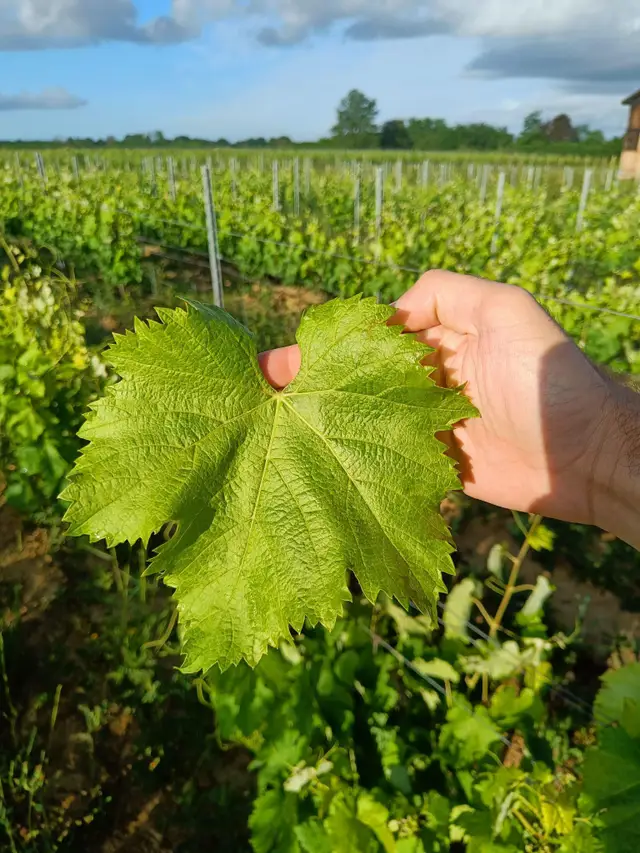
Saint-Macaire, also known as Bouton-blanc or Moustouzère, is a historic black (red-berried) grape variety of the Bordeaux vineyards, with its first official mention dating back to 1783-1784 in Libourne. Once highly prized for its adaptability to the alluvial soils of the Right Bank, notably between Saint-Macaire and La Réole, it represented a significant share of the plantings before the 1920s. Its presence is documented in Graves, Réolais, Bas-Médoc and Premières Côtes, where it could make up to a quarter of the red plantings.
Listed as a secondary grape variety in the 1935 Bordeaux appellation decree, Saint-Macaire, despite its natural vigour and good resistance to coulure (shatter), required short pruning to guarantee optimal ripeness. Its high productivity required careful management to obtain quality harvests. Today, it is among the lost grape varieties of Bordeaux that Château Cazebonne is striving to reintroduce, alongside varieties such as Fer Servadou or Mancin, as part of an approach to preserve our viticultural heritage and adapt to climatic challenges. It is worth noting that Manseng noir: a Pyrenean grape variety, is a parent of Saint-Macaire. To find out more about the Syrah grape variety (in Bordeaux), another ancient variety we are rehabilitating, consult our journal.
| Characteristic | Description |
|---|---|
| Synonyms | Bouton-blanc, Moustouzère, Saint Macaire |
| Budburst | Early: it buds early and is therefore vulnerable to frost. |
| Flowering | One week after Merlot. |
| Veraison | Not specified. |
| Ripeness | Late second epoch, just before Cabernet-Sauvignon. Requires a reduced crop load for good ripeness. |
| Vigour | Vigorous and productive. |
| Growth habit | Not specified. |
| Susceptibility to downy mildew | Relatively resistant. |
| Susceptibility to powdery mildew | More susceptible than to downy mildew. |
| Susceptibility to botrytis | Not specified. |
| Susceptibility to black rot | Not specified. |
| Aromatic profile | Well-structured, fruity wines with notes of raspberry and chocolate. |
| Winemaking potential | Initial vinifications at Cazebonne have shown a very interesting pH, with a very supple tannic structure allowing for a longer maceration (around 20 days). Promising if well-managed. |
Nicolas Jamin of Vigne Vivante described its first vinification in our post of 1 February 2021, "Nicolas Jamin from Vigne Vivante tells us today about the vinification of Saint-Macaire": medium-sized, compact bunches, later ripening and, at the final ripeness check, "peppery and fresh red fruit aromas". Vinified in 2020 alongside Jurançon Noir and Bouchalès, it produced a dense yet supple vat, supported by "acidity and salinity that bring tension to the wine", an acidity he sees as an advantage in the context of global warming. The same feedback covers Castets in our post of 31 January 2021.
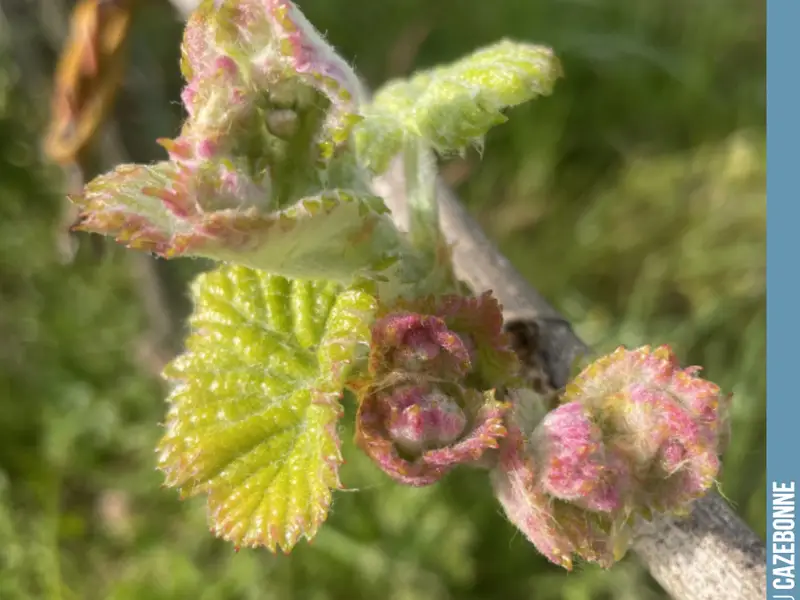
In "Good old Saint-Macaire!" (30 April 2023), we looked back at its old reputation as a high-yielding variety of little quality. Planted here since 2018, it surprises us every year with well-structured, fruity wines showing notes of raspberry and chocolate. Its productivity has an explanation: on a single bud eye, the primary, secondary and tertiary buds often burst at the same time. It therefore requires disbudding, otherwise one could harvest up to 50 bunches on a single Guyot, never fully ripe. It buds early and is therefore vulnerable to frost, has a bushy habit that makes trellising tricky, is relatively susceptible to downy mildew, and did not cope well with the 2022 heatwave, a point that remains to be confirmed on young vines.
Saint-Macaire, once a pillar of Bordeaux plantings and today in a phase of rediscovery, represents a precious viticultural heritage and an opportunity for the future of the Gironde vineyards. This work of rehabilitating forgotten grape varieties by Château Cazebonne is made possible thanks to the support of wine lovers. To learn more about these little-known varieties, we invite you to download our book dedicated to the history of Bordeaux grape varieties, to test your knowledge with our oenological quizzes, and of course, to discover the wines of Château Cazebonne, crafted with passion and respect for this rich heritage.
Sources
12 April 2024
By Jean-Baptiste Duquesne
30 April 2023
By Jean-Baptiste Duquesne
08 September 2022
By Jean-Baptiste Duquesne
The cellar, forgotten grape varieties and our cuvées, twice a month. 5% off your first order with the code BIENVENUE.