The essential
6 × Entre Amis red
6 bottles — Graves red 2022
The best price of the cellar: €12 per bottle delivered.
The everyday red: generous and straight to the point.
I want itAnts
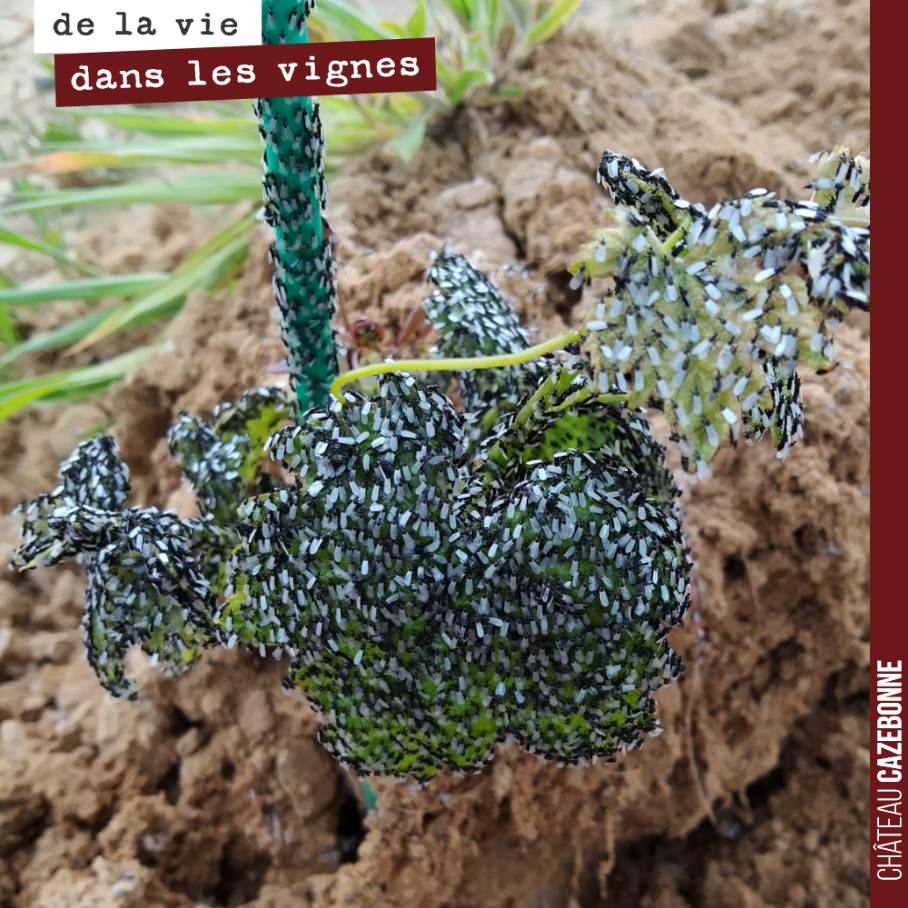
Ants, social insects of the Formicidae family, are common inhabitants of natural environments, including vineyards. Recognisable by their bodies divided into three distinct parts (head, thorax, abdomen), their six legs and their elbowed antennae, they vary greatly in size, from a few millimetres to over a centimetre, and display colours ranging from pale yellow to deep black. Their colony is complexly organised around one or more queens, numerous workers and, at certain times, winged males and future queens.
The life cycle of an ant colony spans several years. In spring and summer, winged ants, both male and female, take flight for the nuptial flight. After mating, the fertilised females found new colonies where they will lay their eggs. In the Château Cazebonne vineyard, ant activity is particularly visible from spring to autumn, when they are busy foraging for food, maintaining the nest and rearing their offspring. They favour dry, sunny soils to establish their nests, often under stones or in areas with living, well-drained soil. They can be observed across all our parcels, especially those with gravelly and sandy soils.
The ecological role of ants is multifaceted and often beneficial. They are true soil engineers, digging galleries that promote soil aeration and water infiltration, much like an earthworm would. By transporting nutrients and organic debris, they actively participate in the recycling of materials and the formation of humus, contributing to the fertility of wine-growing terroirs. They are also important predators of other insects and play a role in seed dispersal for many plants. This diversity of actions is fundamental to the biodiversity of vineyards.
The interaction between ants and vines is mostly neutral or beneficial, but can sometimes present more complex aspects. For example, the relationship between certain ant species and aphids, where the ants protect the latter in exchange for their honeydew, is a natural balancing mechanism. Although this could theoretically encourage aphid proliferation, this effect is often modulated by the presence of other natural predators such as ladybirds and the overall dynamics of the ecosystem. Agroecological management, aimed at promoting biodiversity, helps maintain these interactions in a healthy balance. As Jean-Baptiste Duquesne points out in "Bordeaux, une histoire de cépages", the complexity of interactions within the vineyard is essential to its vitality.
At Château Cazebonne, we carefully observe the presence of these "sentinels and builders" of the soil. Their activity is an indicator of the good biological health of our parcels. By favouring agroecological practices, we encourage their presence along with all the beneficial fauna, conscious that every link in the food chain contributes to the resilience and balance of our vineyard ecosystem, which is precious for the replanting of these historic Bordeaux grape varieties. This work, made possible by the support of the many lovers of our wines, allows us to revisit the history and future of Bordeaux. We invite you to discover the richness of this approach by downloading our free book on the ancient grape varieties of Bordeaux, or to test your oenological knowledge, and of course, to find all our cuvées in the Cazebonne shop.
Sources
Our suggestions
-5%on your 1st order with code BIENVENUE
The essential6 bottles — Graves red 2022
The best price of the cellar: €12 per bottle delivered.
The everyday red: generous and straight to the point.
I want it Our recommendation92/100 RVF
6 bottles — Graves red 2022, 92/100 RVF
Rated 92/100 by La Revue du vin de France: a solid 10-year ageing potential.
Our Graves for ageing, the finest gateway to the estate.
I want it Go further
12 bottles — the whole range
12 bottles, the whole range tasted: the best discovery-to-price ratio.
The complete tour of the estate, in a single case.
I want itThe cellar, forgotten grape varieties and our cuvées, twice a month. 5% off your first order with the code BIENVENUE.