The essential
6 × Entre Amis red
6 bottles — Graves red 2022
The best price of the cellar: €12 per bottle delivered.
The everyday red: generous and straight to the point.
I want itPowdery Mildew
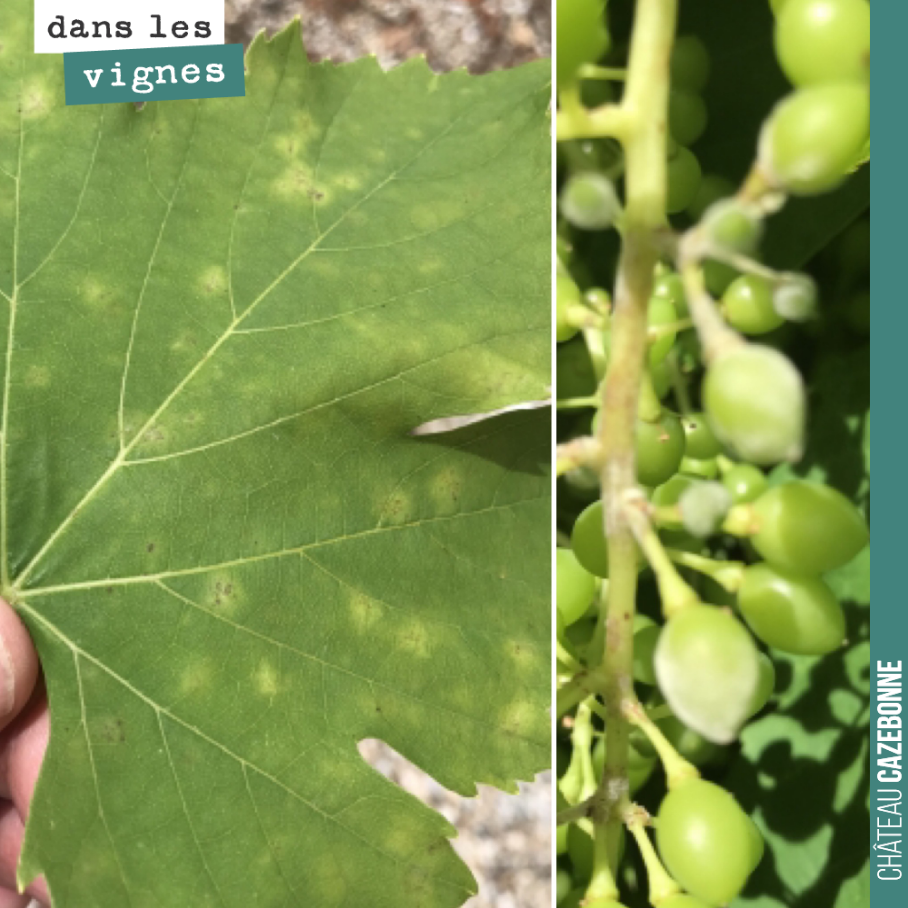
Among the cryptogamic diseases threatening the vine, oidium, caused by the Erysiphe necator fungus, is one of the most widespread. Less sudden and devastating than downy mildew in the Bordeaux region, it nonetheless remains a formidable adversary for the winegrower. This disease manifests as a powdery white felting, like a veil, which gradually covers the leaves, young shoots, and especially the grape bunches.
The consequences of oidium can be multiple and detrimental. On the leaves, it hinders photosynthesis, thereby weakening the plant. On the berries, the damage is particularly visible: the fungus develops on the surface of the grape, causing necrosis of the epidermis. The berries eventually dry out, crack, and sometimes even burst open, exposing themselves to attacks from other pathogens such as grey rot. Beyond the aesthetic aspect and the loss of yield, oidium has a direct and significant impact on wine quality. It can impart undesirable musty or mushroom aromas to the musts and wines, altering the finesse and balance of the fruity aromas.
Oidium, also known as powdery mildew due to its characteristic appearance, is an ascomycete fungus that manifests primarily from spring to late summer. It develops in a warm, dry climate alternating with humid periods, and its proliferation is encouraged by a lack of aeration or overly dense foliage. The young tissues of the vine are the most susceptible to infection. This pathogen affects all the green parts of the plant, but its damage is most critical on the bunches, potentially leading to a total loss of the harvest if left uncontrolled. Historically, disease resistance has often guided planting choices. For example, the Sauvignon grape variety is known for its susceptibility to oidium, which may have influenced its decline in favour of Sémillon at the end of the 19th century, as Jean-Baptiste Duquesne mentions in his book "Bordeaux, une histoire de cépages".
Oidium first appeared in Europe in 1845, when it was discovered in glasshouses in England. In France, it arrived in the vicinity of Paris as early as 1850. The year 1851 marks its disastrous arrival in the Bordeaux region, causing a true crisis for the vineyard. In 1853, while the ravages of oidium were at their peak, observations were made of excrescences or "galls" on certain vines, but these were ultimately deemed unrelated to the disease. However, the degradation of the oidium chain by atmospheric conditions can generate enormous quantities of mycelium, covering the young leaves with a thick white, then curled yellow appearance. For winegrowers, the onset of oidium is initially seen as a sort of white dust on the verjuice, which hardens in dry weather or putrefies in wet weather. This justified the importance of late treatments to protect the vine until leaf fall, in order to destroy all resistant forms of the fungus, particularly the perithecia, which overwinter without difficulty and cause the first invasions the following spring. For a more recent overview of the challenges related to vine diseases, including mosaic downy mildew and downy mildew on bunches, as well as lesser-known diseases and pests, such as erinose or black rot, check out our journal.
Faced with this threat, prevention is paramount. At Château Cazebonne, our commitment to organic viticulture leads us to favour gentle and environmentally friendly methods. In particular, we resort to the preventive application of sulphur, a natural fungicide authorised in organic farming, which acts by preventing the germination of the fungus spores. Sulphur must be as powdery as possible to be effective and adhesive. Although effective, it is sometimes regrettable that precipitated sulphurs, which are finer and purer, are not prepared more often. This approach is complemented by meticulous work in the vineyard: adapted pruning to ensure good aeration of the bunches, thoughtful leaf thinning to limit humidity, and constant observation of each parcel to detect the first signs of attack.
However, the prevention of oidium and other diseases is not limited solely to the application of treatments. It also involves the intrinsic strength of the vine itself. This is why, at Château Cazebonne, we have committed ourselves to rediscovering and replanting ancient grape varieties that had disappeared from Bordeaux vineyards. As Jean-Baptiste Duquesne points out in his book "Bordeaux, une histoire de cépages", many grape varieties formerly grown in Bordeaux possessed natural resistance and adaptation to local conditions and diseases. By reintroducing this genetic diversity, we aim to restore a natural resilience within our vineyard, allowing our vines to better defend themselves against pathogens like oidium. This work also helps us better understand vine diseases and how to address them sustainably.
This long-term, fascinating work, which is essential for the sustainability of our viticultural heritage, is made possible thanks to your support. By tasting our wines made from these rare grape varieties, you actively participate in the revival of these viticultural treasures and the preservation of an entire facet of Bordeaux history. Your support enables us to continue our efforts and revive the diversity of our vineyard. To deepen your knowledge of the fascinating history of Bordeaux grape varieties, we invite you to download the digital version of the book "Bordeaux, une histoire de cépages" by Jean-Baptiste Duquesne. You can also test your knowledge by visiting our oenological quizzes. Finally, to support our efforts and discover the diversity of our wines, please feel free to take a look at our online shop.
Sources
Our suggestions
-5%on your 1st order with code BIENVENUE
The essential6 bottles — Graves red 2022
The best price of the cellar: €12 per bottle delivered.
The everyday red: generous and straight to the point.
I want it Our recommendation92/100 RVF
6 bottles — Graves red 2022, 92/100 RVF
Rated 92/100 by La Revue du vin de France: a solid 10-year ageing potential.
Our Graves for ageing, the finest gateway to the estate.
I want it Go further
12 bottles — the whole range
12 bottles, the whole range tasted: the best discovery-to-price ratio.
The complete tour of the estate, in a single case.
I want itThe cellar, forgotten grape varieties and our cuvées, twice a month. 5% off your first order with the code BIENVENUE.